News
CDU expert says Australia’s East Coast drenching releases large quantities of CO2 to the atmosphere
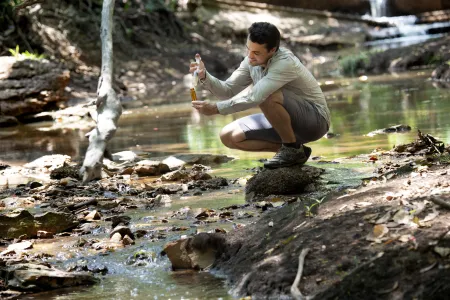
The drenching of Australia’s East Coast could have an important impact on the carbon cycle as massive amounts of carbon are lost from terrestrial ecosystems due to erosion and flooding, says a Charles Darwin University (CDU) hydrologist.
CDU Research Institute for the Environment and Livelihoods (RIEL) researcher Dr Clément Duvert said the flooding across the East Coast this wet season had exported a huge amount of carbon that was previously stored in the landscape.
“The amount of carbon that is lost from ecosystems is directly related to the amount of water that transits through streams and rivers. So, during these major floods, the carbon loss can be massive,” Dr Duvert said.
“What is less known is the fate of this carbon once in our waterways.”
He said some of it will return to the atmosphere quickly as carbon dioxide or methane.
“Some of it will be buried in sediment in coastal areas or the ocean floor, and that will be taken out of the cycle for thousands or even millions of years,” he said.
“But we don’t know the net effect of these weather events on the carbon cycle, as more rainfall also means that more carbon is captured through the new growth of plants.”
Dr Duvert has studied the water cycle for years but has recently focused his attention on the carbon loss from ecosystems through water flows.
Dr Duvert and RIEL’S Professor Lindsay Hutley have secured funding from the Australian Research Council (Discovery Program) to develop a national model of carbon loss through the river network.
The three-year project will assess the amount of carbon loss through different ecosystems throughout the different seasons.
Monitoring stations will be set up at eight to 10 stream sites across Australia including permanent monitoring stations at Litchfield National Park (tropical savanna) in the Northern Territory, on the Atherton Tableland in North Queensland (tropical rainforest), and Warra Creek (temperate rainforest) in Tasmania.
“There is a lot of research in quantifying the terrestrial carbon sink and how much CO2 is being sequestered by our various ecosystems, but recently the scientific community has realised that not all carbon is stored, and some of it is being lost to groundwater and streams,” he said.
He said the loss had to be accounted for in carbon capture modelling.
Professor Hutley said that the national model would give decision makers a more complete understanding of the carbon cycle and the impact of weather events, such as the recent flooding on the East Coast of Australia.
The team of researchers is recruiting a research fellow and two PhD candidates in hydrology and carbon cycle science to work on the project.
Related Articles
Federal funding for Country-based health and climate resilience
A new research collaboration to support and strengthen Country-based health and climate resilience has received funding through the National Health and Medical Research Council’s Centres of Research Excellence scheme.
Read more about Federal funding for Country-based health and climate resilience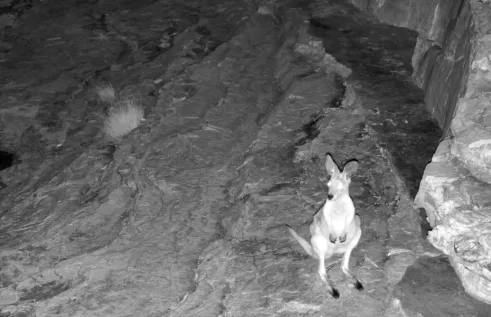
New livestream brings remote Australian arid zone waterhole to the world
A new livestream from a remote waterhole in the Northern Territory is giving people around the world the opportunity to observe wildlife in real time.
Read more about New livestream brings remote Australian arid zone waterhole to the world
Leading scientist recognised for lifetime of dedication to Australian biodiversity and conservation
One of the nation’s most distinguished experts in Australian biodiversity and conservation will be celebrated in an upcoming Charles Darwin University graduation ceremony.
Read more about Leading scientist recognised for lifetime of dedication to Australian biodiversity and conservation


