News
CDU partnership speeds up the tracing of COVID-19 in the Top End
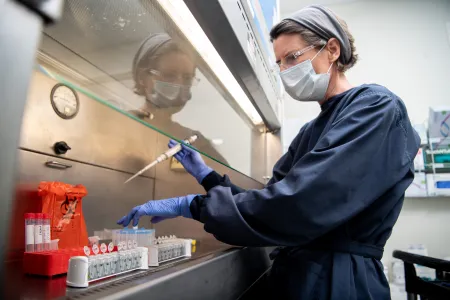
The Northern Territory now has the capacity to test its own wastewater for traces of COVID-19, thanks to a team of microbiologists at Charles Darwin University (CDU).
The Research Institute for the Environment and Livelihoods’ (RIEL) Environmental Chemistry and Microbiology Unit (ECMU) Senior Microbiologists Dr Anna Padovan and Dr Susan Pizzutto have been testing wastewater using state-of-the-art lab equipment since January 2022.
“By bringing the testing right here to Darwin, NT Health no longer has to wait for samples to be flown interstate,” Dr Padovan said.
Dr Padovan said that NT Health can now access test results within 24 hours.
“The capacity to test wastewater for COVID-19 demonstrates a small fraction of the research capability at CDU and is yet another demonstration of the benefits of universities and governments working together,” she said.
Wastewater samples are delivered to CDU, then, after some extraction processes, the researchers use the same type of PCR test that millions of Australians have been receiving at testing sites right around the country to test the samples for traces of COVID-19.
Senior Microbiologist Dr Susan Pizzutto said results are reported to NT Health, who can use the data to track the trends of COVID-19.
“By mapping long term trends of COVID-19 in community wastewater, authorities can be informed as to how the pandemic is tracking,” Dr Pizzutto said.
The ECMU’s capacity to bring this testing online in a dedicated laboratory has been supported by the Northern Territory Government, with support from Charles Darwin University.
Related Articles
Federal funding for Country-based health and climate resilience
A new research collaboration to support and strengthen Country-based health and climate resilience has received funding through the National Health and Medical Research Council’s Centres of Research Excellence scheme.
Read more about Federal funding for Country-based health and climate resilience
New livestream brings remote Australian arid zone waterhole to the world
A new livestream from a remote waterhole in the Northern Territory is giving people around the world the opportunity to observe wildlife in real time.
Read more about New livestream brings remote Australian arid zone waterhole to the world
Leading scientist recognised for lifetime of dedication to Australian biodiversity and conservation
One of the nation’s most distinguished experts in Australian biodiversity and conservation will be celebrated in an upcoming Charles Darwin University graduation ceremony.
Read more about Leading scientist recognised for lifetime of dedication to Australian biodiversity and conservation


