News
CDU researchers discover groundwater supported fish oasis in the NT
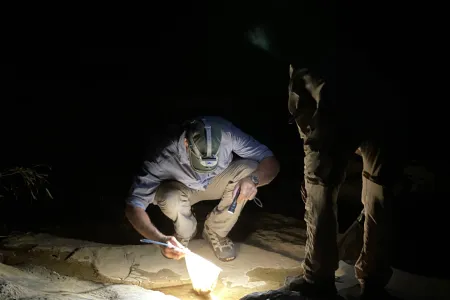
NT rivers fed through reliable groundwater flows have greater fish biodiversity than inland seasonal rivers where flows rely on rain-driven surface waters, a new Charles Darwin University (CDU) study reveals.
CDU Freshwater Ecologist Professor Jenny Davis was the lead on the first major survey of freshwater fish fauna at the Beetaloo Sub-basin and upper Roper River region of the Northern Territory.
Professor Davis said biodiversity research was vital in this region because of the emerging shale gas industry’s potential impact on river flows and water quality.
Also, despite being in monsoonal tropic and savanna environments, the river systems of the region are vastly different from each other.
“The Northern Territory experiences a range of weather conditions with high rainfall and temperatures in the tropical coastal areas and a typically dry interior, so this all plays a role in aquatic ecology,” Professor Davis said.
“There is little known about the biodiversity of this region’s water resources, so this research helps to address this major knowledge gap.”
As part of this project, the team collected an array of fish samples using both netting and electrofishing techniques as well as eDNA analysis of water and benthic sediment samples.
Fish captured by netting or electrofishing were identified and then returned to the waterbody alive.
“The collection sites varied greatly which meant that we couldn’t use a standard sampling approach. For example, in areas that had rock bars or woody debris we couldn’t use mesh nets,” Professor Davis said.
The team recorded 29 species of fish in 17 families with species richness highest at groundwater-fed sites on northward draining rivers.
Professor Davis, from CDU’s Research Institute for the Environment and Livelihoods, said the most commonly detected species were the rainbowfish and the spangled perch.
The Critically Endangered freshwater sawfish was not captured in the study however, it’s presence at the Roper River floodplain was reported to the team by the Mangagarrayi Rangers with further sampling of the upper Roper River leading to the capture (and release) of one.
“We predicted that the richest fish fauna would be present in the northernmost waterbodies receiving reliable groundwater inflows,” Professor Davis said.
“With the difference in diversity also influenced by the connectivity between freshwater and coastal systems in the northward flowing rivers ensuring that species can continually move between habitats, our results supported this prediction.”
Groundwater is water that is stored in aquifers beneath the Earth’s surface. This underground water, provided by rain that fell in the recent, or more distant past, is often ‘out of sight and out of mind’ but it provides an essential and reliable input of water to surface water systems in the semi-arid and arid regions of inland Australia.
Groundwater inflows into rivers such as the Roper provide the refugial habitats, and other aquatic species, needed to ensure that fish can persist during extended seasonal dry periods and droughts.
Professor Davis stresses that more work needs to be done to fully understand the dependence of individual species on groundwater inflows and the effect that industries such as fracking will have.
“It is evident from this research that conserving freshwater fish biodiversity in these rivers will require protection of the groundwater resources to ensure baseflows and aquatic refuges persist through the most extended of dry seasons.”
“Industry developments will require the diversion or extraction of large amounts of water which may increase the risk of contamination so there is an urgent need to collect information about these aquatic systems before major developments go ahead.”
More information on the study can be found here.
Related Articles

Federal funding for Country-based health and climate resilience
A new research collaboration to support and strengthen Country-based health and climate resilience has received funding through the National Health and Medical Research Council’s Centres of Research Excellence scheme.
Read more about Federal funding for Country-based health and climate resilience
New livestream brings remote Australian arid zone waterhole to the world
A new livestream from a remote waterhole in the Northern Territory is giving people around the world the opportunity to observe wildlife in real time.
Read more about New livestream brings remote Australian arid zone waterhole to the world
Leading scientist recognised for lifetime of dedication to Australian biodiversity and conservation
One of the nation’s most distinguished experts in Australian biodiversity and conservation will be celebrated in an upcoming Charles Darwin University graduation ceremony.
Read more about Leading scientist recognised for lifetime of dedication to Australian biodiversity and conservation


