News
CDU scientists help fight biosecurity threat
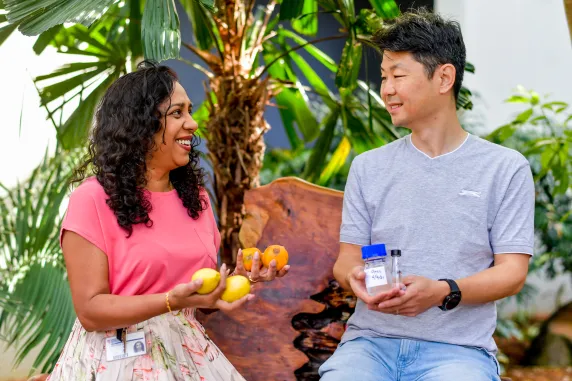
Charles Darwin University (CDU) chemists have developed a scent profile and artificial scent lures designed to help sniffer dogs to detect citrus canker disease in citrus orchards in the Northern Territory.
The Northern Territory’s citrus industry came under attack in 2018 from a highly contagious bacterial disease called citrus canker.
It was eradicated three years later and now thanks to work done by CDU scientists, the Northern Territory is well prepared should the disease return.
CDU chemists, Dr Hao Wang and Dr Vinuthaa Murthy won a contract with the Department of Industry, Tourism and Trade to develop a scent profile and synthesize artificial scent lures specifically for detection of citrus canker disease.
CDU Senior Lecturer—Chemistry, College of Engineering, IT and Environment, Dr Vinuthaa Murthy said the project set out to determine the volatile organic compound profile of the infected citrus plants at CDU’s Yellow 2 labs using a gas chromatography mass spectrometer.
“We analysed and identified key chemical compounds that were emitted by different citrus varieties in both infected and non-infected plants. We were then able to develop the chemical composition of the scent blend to make an artificial lure which is used to train detector dogs,” Dr Murthy said.
Detector dogs can discover the disease before symptoms are visible to the human eye. The dogs can also search large farms and orchards very quickly, compared with previous methods.
Citrus canker attacks lemon, lime, grapefruit, mandarins, and native citrus plants, causing the fruit to drop to the ground before it ripens. Crops are destroyed, income drops, and jobs are lost.
“It was a challenging and exciting project to be involved in, and extremely satisfying, because not only does our work help protect the citrus industry, it has the potential to detect all kinds of biosecurity threats,” Dr Murthy said.
Two sniffer dogs are now trained to detect citrus canker in infected plants using the artificial lure.
Related Articles
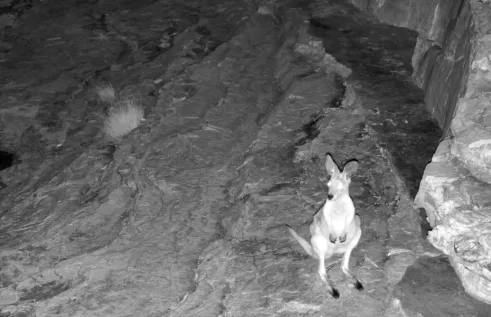
New livestream brings remote Australian arid zone waterhole to the world
A new livestream from a remote waterhole in the Northern Territory is giving people around the world the opportunity to observe wildlife in real time.
Read more about New livestream brings remote Australian arid zone waterhole to the world
Leading scientist recognised for lifetime of dedication to Australian biodiversity and conservation
One of the nation’s most distinguished experts in Australian biodiversity and conservation will be celebrated in an upcoming Charles Darwin University graduation ceremony.
Read more about Leading scientist recognised for lifetime of dedication to Australian biodiversity and conservation
New construction management course to bolster NT’s building industry
A new Master of Construction Management from Charles Darwin University (CDU) is set to bolster the Northern Territory’s building industry.
Read more about New construction management course to bolster NT’s building industry


