news article
CDU student in line to win international competition

An animation created by a Charles Darwin University PhD student is in the running to win an international Visualise your Thesis competition.
Dr Winnie Chen created the animation to showcase a tool she is developing through the Menzies School of Health Research to help doctors diagnose and manage kidney disease.
Dr Chen won the CDU leg of the Visualise your Thesis competition in August to go in the running for the international Visualise Your Thesis competition, where she will go up against entrants from other Australian and international universities.
Her video will be assessed by a panel of judges for the overall prize while she also has a chance to win the people’s choice award if her animation receives the most views.
A practising GP, Dr Chen said it took her around two days to compile the minute-long video, using clear and simple graphics to help explain her research.
“It’s exciting, I wasn’t expecting to make it to the international leg,” she said.
“I wanted to communicate the project in simple terms, it is often hard to describe verbally, so using diagrams proved really effective.
“I’ve had a lot of really good feedback from people who didn’t understand what my research was, saying ‘I finally get what you’re doing’.”
The clever video explains electronic medical records are like jigsaw puzzles, with many pieces in many places, and describes how her tool helps doctors put the pieces together.
To help Dr Chen in the people’s choice award, her video can be viewed here.
The competition closes this Sunday, 18 October.
Related Articles
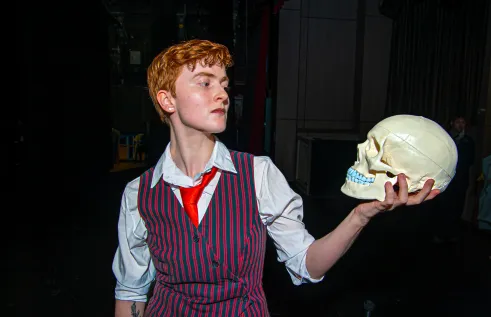
Hamlet gets a contemporary twist in Darwin
Shakespeare’s most famous tragedy will be brought into the modern world in a bold new production of Hamlet at Charles Darwin University Theatre this month.
Read more about Hamlet gets a contemporary twist in Darwin
The good, the bad, and the ugly food: Why religious shoppers are buying bruised veggies
A recent study with Charles Darwin University examines how consumers’ religiosity influences the purchase of “ugly foods”, or foods that are aesthetically imperfect but nutritious.
Read more about The good, the bad, and the ugly food: Why religious shoppers are buying bruised veggies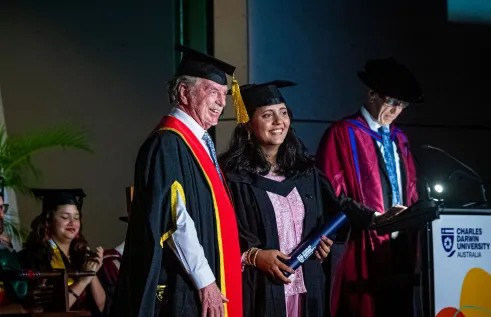
Student Council President celebrates graduation, prepares to pass the torch to new team
After serving as the Charles Darwin University (CDU) Student Council President for two years, Shishtata Bhandari has graduated and is preparing to hand over the reins to the council's next leader.
Read more about Student Council President celebrates graduation, prepares to pass the torch to new team


