News
Chatty batty: Research explores dialect formation in ghost bats
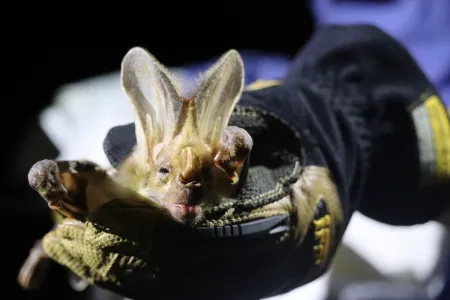
Accents are usually thought of as a human trait, indicating where a person has grown up or the communities they belong – and new research shows the same dialects can also occur in Australia’s largest carnivorous bat.
Research led by Charles Darwin University (CDU) Postdoctoral Research Fellow Dr Nicola Hanrahan investigated the variation in vocalisations recorded at five ghost bat Macroderma gigas (Megadermatidae) colonies in the Northern Territory.
The ghost bat is a threatened species with an estimated population size of fewer than 10,000 individuals. The Northern Territory is home to 20 per cent of this global population of ghost bats.
Academics assessed structural differences within three of the ghost bat social vocalisations: the ‘chirp-trill’, ‘squabble’ and ‘ultrasonic social’; and their ‘echolocation’ call, recorded at ghost bat colonies ranging from ~40km apart to more than 800km apart.
Results showed that dialects were present in all vocalisation types. Genetic, geographic, morphological (physical features associated with producing and receiving sound) have some effect on the structure observed, but the differences involved were largely unexplained.
This raises the possibility that these ghost bat ‘accents’ are also shaped by social processes, much like culturally driven changes in human accents over time.
This study provides the first evidence of dialect formation in megadermatids, or the family of species of medium to large carnivorous bats.
Dr Hanrahan, who is with CDU’s Research Institute for the Environment and Livelihoods, said this gave unique insights into the social behaviour of the species.
“Ghost bats are a very social species and have a range of vocalisations that they use to communicate with each other,” Dr Hanrahan said.
“There is still much for us to learn about the social behaviour of this charismatic species, and further studies are planned to delve further into social communication use in ghost bats.”
“Research into ghost bat dialects is important because it can reveal how colonies are socially structured and highlight isolated populations. Social calls can be useful for monitoring this disturbance-sensitive species without entering roosts, and the more we learn about their structures, the more useful they are as non-invasive monitoring techniques.
“Bats are one of the few mammalian groups with strong evidence of vocal learning and vocal plasticity, which makes them useful models for studying the kinds of biological and social foundations that may have contributed to human language evolution.”
Dialect Formation in Ghost Bats: Genetic, Geographic and Morphological Drivers of Social and Echolocation Call Divergence was published in the journal Ecology and Evolution.
Aligned with the United Nations Sustainable Development Goals
Life on land
Goal 15
Protect, restore and promote sustainable use of terrestrial ecosystems, sustainably manage forests, combat desertification, and halt and reverse land degradation and halt biodiversity loss.
Related Articles
Federal funding for Country-based health and climate resilience
A new research collaboration to support and strengthen Country-based health and climate resilience has received funding through the National Health and Medical Research Council’s Centres of Research Excellence scheme.
Read more about Federal funding for Country-based health and climate resilience
New livestream brings remote Australian arid zone waterhole to the world
A new livestream from a remote waterhole in the Northern Territory is giving people around the world the opportunity to observe wildlife in real time.
Read more about New livestream brings remote Australian arid zone waterhole to the world
Leading scientist recognised for lifetime of dedication to Australian biodiversity and conservation
One of the nation’s most distinguished experts in Australian biodiversity and conservation will be celebrated in an upcoming Charles Darwin University graduation ceremony.
Read more about Leading scientist recognised for lifetime of dedication to Australian biodiversity and conservation


