News
Commission President to highlight challenges in emergency decision-making

Emeritus Professor Rosalind Croucher AM will explore the democratic challenges of emergency decision-making in the 11th Austin Asche Oration in Law and Governance in Darwin.
The Oration, hosted by Charles Darwin University (CDU) and the Australian Academy of Law, honours the service of The Hon. Austin Asche AC KC in the Northern Territory and his contribution to law, tertiary education and the community.
Professor Croucher will explore the lessons that could be learned to ensure the rule of law is respected, while considering how human rights principles can inform decision-making.
The theme stems from executive discretion in the time of the COVID-19 pandemic and promoting, protecting and fulfilling human rights in the public health context.
“It is about the tests to the strength of the separation of powers, especially in times of emergency, and to the need for greater protections of human rights, including through the introduction of a federal Human Rights Act,” Professor Croucher said.
“I am honoured to give this Oration, the name of which recognises the extraordinary contribution made by the Honourable Austin Asche AC KC to the law, to the courts in which he served, and to this Territory.”
Professor Croucher has an extensive career in the law and education, with 25 years in university teaching and management.
Professor Croucher is the President of the Australian Human Rights Commission, beginning her seven-year term on July 30, 2017.
Prior to this, Professor Croucher was the Commissioner of the Australian Law Reform Commission from 2006 to 2009, and later President from 2009 to 2017.
In 2019, Professor Croucher was awarded the Women Lawyers’ Association of New South Wales Lifetime Achievement Award.
The 11th Austin Asche Oration in Law and Governance, which is open to the public, will be held on November 17 from 5pm to 7pm at the Hilton in Darwin.
To register to attend visit here.
Related Articles
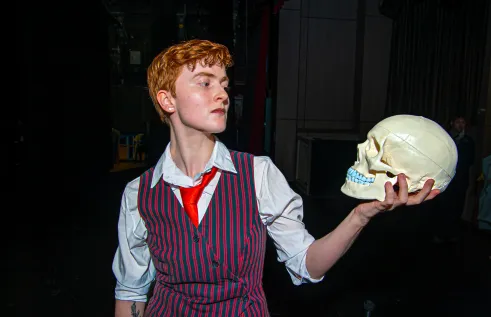
Hamlet gets a contemporary twist in Darwin
Shakespeare’s most famous tragedy will be brought into the modern world in a bold new production of Hamlet at Charles Darwin University Theatre this month.
Read more about Hamlet gets a contemporary twist in Darwin
The good, the bad, and the ugly food: Why religious shoppers are buying bruised veggies
A recent study with Charles Darwin University examines how consumers’ religiosity influences the purchase of “ugly foods”, or foods that are aesthetically imperfect but nutritious.
Read more about The good, the bad, and the ugly food: Why religious shoppers are buying bruised veggies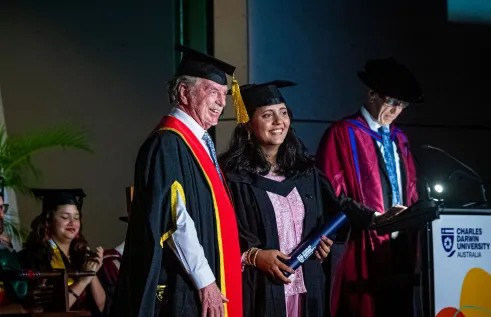
Student Council President celebrates graduation, prepares to pass the torch to new team
After serving as the Charles Darwin University (CDU) Student Council President for two years, Shishtata Bhandari has graduated and is preparing to hand over the reins to the council's next leader.
Read more about Student Council President celebrates graduation, prepares to pass the torch to new team


