News
COVID-19 creates a new marketplace for contract cheating, new CDU study finds

A new study by Charles Darwin University (CDU) academics explores the extent and impact of contract cheating in the global academic community during COVID-19.
CDU Associate Professor in Education Dr Jon Mason and Senior Business Law Lecturer Dr Guzyal Hill have recently published their research into the scope and extent of contract cheating.
Contract cheating can be defined as students paying for a third party to complete their assessments.
Their results show contract cheating is an increasing challenge for the global academic community, especially during COVID-19, transitioning from ghost-writing to ghost-studying.
Adopting a form of action research, one of the researchers went undercover as a student and sought a variety of web-based services from global contract cheating providers.
The method allowed them to analyse some of the most popular providers and to identify the scope of contract cheating services made easily accessible to university students. For example, a Google search of the term ‘assignment help’ returns more than 300 million results in 2021.
The researchers also aimed to alert lecturers and universities to the diversification and prominence of this dangerous practice on a global scale.
Associate Professor Jon Mason said COVID-19 had exacerbated the problem as more students were tempted to “cheat the online system” while learning digitally.
“COVID has led to a whole lot of new services made available to people. It has been a catalyst for so many changes in formal education, creating new experiences for teaching and learning online at universities and schools,” Assoc Prof Mason said.
“But it has also become a trigger for new players in the space. It’s an open frontier and a new marketplace for contract cheating.
“We are interested in knowing what’s happening in terms of online behaviour and what the online environment allows to happen.”
Co-author and Senior Lecturer in Business Law, Dr Hill said there was no winner in contract cheating, a race to the bottom.
“Once the students get into the profession, they cannot perform tasks because they missed out on learning the knowledge and skills, so the professional community is also suffering,” Dr Hill said.
“There are also many cases where students who were promised a plagiarism-free assignment by ghost writers, but that did not deliver. They could not complain due to fear of being reported to the university.
“The purpose of our study is not to catch particular students, but to identify solutions to the issue.”
As Dr Hill explains, the study suggests contract cheating is a global issue, and multi-level solutions involving academics, universities and the global community are required.
“It’s not a single university’s fault or sole responsibility. Lecturers and academics often rely on plagiarism detection tools such as Turnitin, but research finds there are smarter devices that can outsmart these tools,” she said.
“So there needs to be a model of collaboration to address this problem. We all have a responsibility to try to identify and help solve the issue.”
The published journal article can be found here.
Related Articles
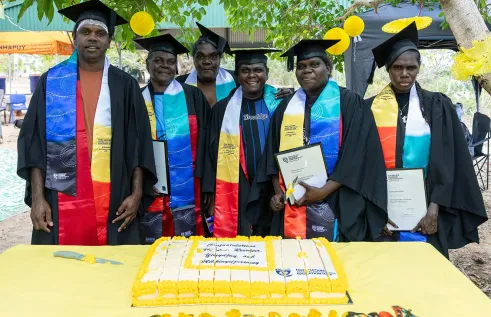
First Nations Training and Teacher Education Hub celebrates first major milestone
As Charles Darwin University's (CDU) First Nations Training and Teacher Education Hub draws closer to the end of its first year, one of its greatest milestones to date was conferring its first six graduates.
Read more about First Nations Training and Teacher Education Hub celebrates first major milestone
Federal funding for Country-based health and climate resilience
A new research collaboration to support and strengthen Country-based health and climate resilience has received funding through the National Health and Medical Research Council’s Centres of Research Excellence scheme.
Read more about Federal funding for Country-based health and climate resilience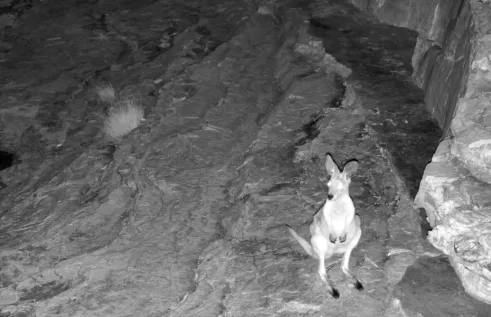
New livestream brings remote Australian arid zone waterhole to the world
A new livestream from a remote waterhole in the Northern Territory is giving people around the world the opportunity to observe wildlife in real time.
Read more about New livestream brings remote Australian arid zone waterhole to the world


