Fire in motion: New animation platform and updates to key bushfire resources
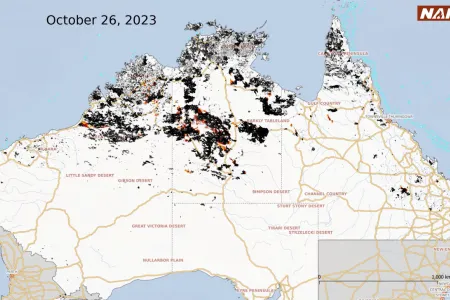
A demand for data to inform fire management has prompted Charles Darwin University (CDU) researchers to develop a tool animating historic bushfires across Australia.
The Landscape Knowledge Visualisation (LKV) Lab at CDU has recently released the Burn Area Animation Tool, a site which animates where bushfires occurred from 2012 to 2024 around Australia.
The site allows users to run animations for each year and download it as a video.
LKV Director and CDU Northern Institute fire researcher Dr Rohan Fisher recently presented the site at the 2025 Savanna Fire Forum in Darwin in front of an audience of hundreds of Traditional Owners, rangers, land managers, pastoralists and more.
Dr Fisher said the site was born out of a demand for data.
“Throughout the year we’re always getting requests to see fire spreading through landscape so land managers and rangers can assess what they’ve done and how their early burning has been effective stopping late season fires,” Dr Fisher said.
“We’re trying to create tools which help people to build an understanding of nature of fire geography and ecology of Australia.”
The animations are produced from data provided by the North Australia & Rangelands Fire Information (NAFI) service.
NAFI data covers 80 per cent of Australia, including all or tropic and desert landscapes. NASA data shows between 2001 to 2023, 99.3 per cent of all fires in Australia occurred across the NAFI coverage region.
The tool coincides with significant updates to two NAFI resources, the NAFI 4 site and the NAFI V2 mobile app.
“The key thing for us is trying to simplify people interact with NAFI,” Dr Fisher said.
“NAFI 4 is a neater, cleaner look. The interface is much slicker and easier to use and find all the tools. It’s also the first significant update of the app interface in seven or eight years.”
The NAFI website is estimated to have more than 250,000 users who access data year-round.
Dr Fisher hoped the latest developments would encourage more Australians to engage with fire monitoring and management.
“As Australians we should have an interest in the country we live in,” Dr Fisher said.
“Fire is the most important ecological tool that’s shaped out continent over many thousands of years. The lack of understanding about where we live is why we’re afraid of fire. We need to engage with it.
“For the last 21 years NAFI has become deeply embedded in the culture of fire and land management across most of Australia. People should engage with the website and app because it’s an excellent way to follow the fire season.
“Start watching from April may through June all the incredible hard work done across remote northern Australia and get an appreciation of what people are doing in the bush.”
Related Articles

The good, the bad, and the ugly food: Why religious shoppers are buying bruised veggies
A recent study with Charles Darwin University examines how consumers’ religiosity influences the purchase of “ugly foods”, or foods that are aesthetically imperfect but nutritious.
Read more about The good, the bad, and the ugly food: Why religious shoppers are buying bruised veggies
Rangers reimagine AI in wildlife monitoring
As workplaces around the world wrestle to integrate Artificial Intelligence in their operations, researchers and rangers in the heart of West Arnhem are successfully embracing this technology in conservation without compromising respect and knowledge.
Read more about Rangers reimagine AI in wildlife monitoring
Partnership with Indonesian university to support education and research
A new partnership with one of East Java’s leading education institutions is aligning Charles Darwin University with priorities to strengthen Australia’s relationship with Indonesia.
Read more about Partnership with Indonesian university to support education and research


