First Nations and CDU research dives deeper into plight of Northern Australia’s turtles, whales and dolphins
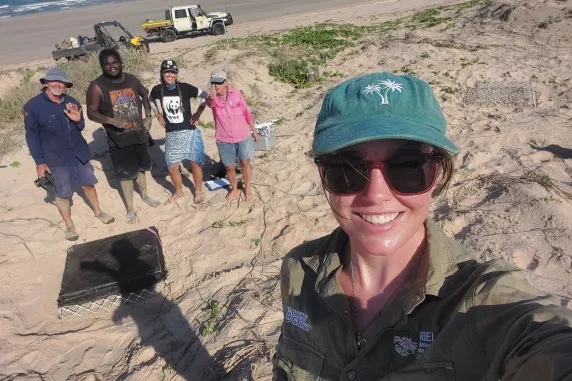
A comparison of aerial surveys of green turtle nests between the 1990s and 2024 shows a decline in turtle nesting sites on Croker Island - a new research project with First Nations Rangers and Charles Darwin University (CDU) is now looking a little deeper.
Marine scientists from CDU are conducting pioneering research on turtles and cetaceans in Australia’s northernmost marine park, advancing conservation and sustainability efforts in the Northern Territory.
The research will identify key foraging and migratory routes in the Arafura Marine Park (AMP) and the Sea Country surrounding Croker Island.
The Australian Government funded project is a partnership between CDU, the WWF and the Garngi and Mardbalk Rangers that is delivering practical outcomes to enhance the health and resilience of our oceans.
Dr. Carol Palmer, Senior Research Associate (Cetaceans and Marine Megafauna) at CDU’s Research Institute for the Environment and Livelihoods (RIEL), said the research was the first-of-its-kind in the Northern Territory.
"We are a hotspot for foraging turtles, dolphins, humpback whales, Bryde’s whales, and little spinner dolphins - it’s really amazing,” Dr Palmer explained.
"But we’re still very much at the bottom of the pile here in Northern Australia because the research is challenging and costly due to the remoteness of the region.
“This type of research has already been conducted on the east and west coasts of Australia, and our ecosystems here are just as important.”
Dr Palmer said the difficulty and cost of access was why aerial surveys had been used in the past to assess the condition of ecosystems.
Natalie Robson a CDU RIEL PhD candidate - whose thesis is focused on the foraging ecology of Green Turtles in the Northern Territory - said local ranger groups held serious concerns for the species’ future.
"Recently, we compared an aerial survey from the 1990s to one we conducted on the same beach this year and found a 78 per cent reduction in Green Turtle nesting," Ms Robson explained.
“A lot of these species are protected and play an important role in the Australian ecosystem, as well as culturally for First Nations people as a source of food.
“Only one in 1,000 hatchlings make it to adulthood, and an increase in sand temperatures has meant a reduction in male numbers - from our work in the NT foraging areas, we’ve found the proportion of adults to be about 71 per cent female compared to 20 per cent male.
"This research will help establish a baseline for sex ratios in our reefs, as well as age classes and mating success, so we can determine what measures are needed to ensure the effective conservation of these animals.”
NLC Chair Matthew Ryan said the collaboration with CDU enables the Garngi Rangers to develop new skillsets - boosting their capacity to protect their Land and Sea Country around Croker Island.
“The Rangers are able to use their cultural knowledge to assist in scientific research; and develop strategies to reduce the feminisation of turtles and protect the eggs from predators such as goannas and feral pigs.
“While they have previously teamed up with CDU scientists, this is the first time their valuable contribution has been acknowledged through a formal funding arrangement - and already the project is paying dividends.”
The project is supported through funding from the Australian Government’s Our Marine Park Grants Program.
Related Articles
Federal funding for Country-based health and climate resilience
A new research collaboration to support and strengthen Country-based health and climate resilience has received funding through the National Health and Medical Research Council’s Centres of Research Excellence scheme.
Read more about Federal funding for Country-based health and climate resilience
New livestream brings remote Australian arid zone waterhole to the world
A new livestream from a remote waterhole in the Northern Territory is giving people around the world the opportunity to observe wildlife in real time.
Read more about New livestream brings remote Australian arid zone waterhole to the world
Leading scientist recognised for lifetime of dedication to Australian biodiversity and conservation
One of the nation’s most distinguished experts in Australian biodiversity and conservation will be celebrated in an upcoming Charles Darwin University graduation ceremony.
Read more about Leading scientist recognised for lifetime of dedication to Australian biodiversity and conservation


