News
First Nations fire knowledge is reducing the severity of Africa’s wildfires and cutting emissions
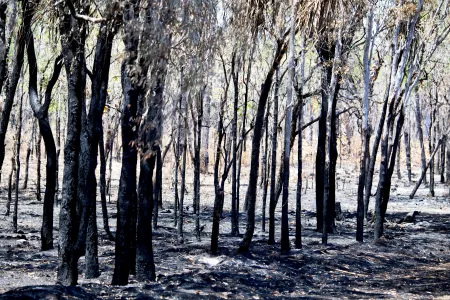
Territory fire experts from Charles Darwin University (CDU) are in Africa applying Australian First Nations fire mitigation to better protect wildlife and flora and reduce wildfire emissions.
While world leaders and environmental experts are gathering in Glasgow for COP26 to discuss cooperation for reducing emissions reduction and mitigating climate change, proven First Nation’s fire management techniques used in Australia’s savannas are having early success in Africa.
As a part of the International Savanna Fire Management Initiative, CDU researchers are conducting fieldwork in Botswana and Zambia where they are working with local communities to reduce late dry season wildfire risks, protect infrastructure and natural environmental assets.
They are also undertaking research towards the development of formal savanna burning emissions abatement accounting methods such as successfully implemented in Australia.
The longer-term aim of the program is to develop market-based fire management projects benefiting local communities, regional environmental sustainability, and global climates.
Late dry season savanna wildfires in Botswana and surrounding countries in southern Africa annually, release huge amounts of greenhouse gases into the atmosphere.
Research recently published in the Journal of Environmental Management, led by researchers from CDU’s Research Institute of the Environment and Livelihoods (RIEL), shows that Australian First Nation’s savanna fire management techniques can significantly reduce wildfire emissions based on preliminary research studies undertaken in Botswana and Mozambique.
CDU fire ecologist Jeremy Russell-Smith said early results from the ISFMI trial in Africa are very promising and has attracted keen interest from other countries in the region and global partners.
“The technical assessment, showing the Australian methods, is working well,” Professor Russell-Smith said.
“The project is in its infancy but now has commitments from Angola, Zambia, and Mozambique governments.”
Professor Russell-Smith said the interest from other southern African governments with extensive savanna environments illustrates that wildfire is recognised as a serious issue across the region.
The second part of the project involves building the capacity of communities to conduct prescribed burns.
Earlier this year, community prescribed burns under relatively benign climatic conditions helped restrict late-season wildfires in the Tsodilo Hills World Heritage area, and fire-vulnerable Forest Reserves, in northern Botswana.
The low-emissions, fire mitigation technique involves burning off with low-intensity fires under cooler early dry season conditions to remove cured grasses and litter without damaging tree canopies.
According to Professor Russell-Smith, savannas are the most fire-prone environments on earth with huge impacts on global greenhouse gas emissions.
“In Southern Africa alone the work we are undertaking is scalable to the 3,000,000km2 miombo woodlands dominated by leguminous trees, extending from the Democratic Republic of Congo and Tanzania in the north, Angola in the west, Mozambique in the east, and Botswana in the south,” he said.
Director of RIEL at CDU Sam Banks said the project was a huge opportunity to share the fire management expertise of North Australia’s First Nations people.
“Savannas cover a lot of the planets land area. There’s an opportunity for better fire management and GHG emissions reduction globally,” Professor Banks said.
“Our researchers and expert fire managers based here in the NT are helping to facilitate that and support it through ecological research and fire mapping tools.”
Related Articles
Federal funding for Country-based health and climate resilience
A new research collaboration to support and strengthen Country-based health and climate resilience has received funding through the National Health and Medical Research Council’s Centres of Research Excellence scheme.
Read more about Federal funding for Country-based health and climate resilience
New livestream brings remote Australian arid zone waterhole to the world
A new livestream from a remote waterhole in the Northern Territory is giving people around the world the opportunity to observe wildlife in real time.
Read more about New livestream brings remote Australian arid zone waterhole to the world
Leading scientist recognised for lifetime of dedication to Australian biodiversity and conservation
One of the nation’s most distinguished experts in Australian biodiversity and conservation will be celebrated in an upcoming Charles Darwin University graduation ceremony.
Read more about Leading scientist recognised for lifetime of dedication to Australian biodiversity and conservation


