First Nations wisdom plays key role in saving critically endangered Philippine eagle
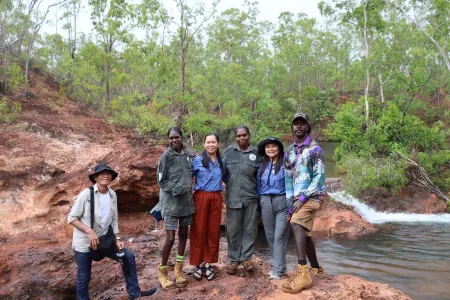
A First Nations conservation and land management program from the Northern Territory is playing a key role in saving the national bird of the Philippines, the critically endangered Philippine eagle.
A group of Philippine rangers and Indigenous leaders have been in Gove this week taking part in extensive field work and learning on Country with Yolŋu rangers from the Dhimurru Aboriginal Corporation (DAC).
Aimed at diversifying approaches to caring for ancestral lands in the Philippines and identifying culture and nature-based enterprise opportunities, the learnings are informing efforts to restore the native habitat of the Philippine eagle and include fire management and wildlife monitoring.
Pushed to the brink of extinction by deforestation and illegal hunting, the eagle is one of the rarest birds in the world, with less than 400 pairs remaining in the wild.
“The forest is very important for the eagle and for Indigenous culture because it’s the foundation of biocultural diversity,” explained Philippine Eagle Foundation (PEF) Director of Operations, Dr Jayson Ibañez.
“Fire management has been an issue on ancestral domains because of climate change and prolonged droughts, but no one is investing in managing the landscape with respect to fire.
“The Dhimurru Rangers will assist us with their knowledge and experience to create proof-of-concept models on indigenous land management that we can take to the Philippine Government and National Commission on Indigenous Peoples to hopefully replicate across as many ancestral domains as possible.”
A trained zoologist and biologist, Dr Ibañez completed his PhD in Natural Resources Management at Charles Darwin University’s (CDU) Research Institute for the Environment and Livelihoods (RIEL) in Darwin in 2015, with this week’s visit marking a full-circle moment in his research career.
“I made a promise to Mandaka Marika (former DAC Managing Director) that I would bring my Indigenous leaders here so they could experience what I’ve experienced and now it’s happening – so it’s very exciting,” he said.
With 80 per cent of remaining Philippine eagle habitat on ancestral lands, Dr Ibañez said biocultural conservation also provided an entry point for more co-benefits, including cultural and financial empowerment.
“That’s where I focused my whole PhD program, finding ways to better engage the knowledge of Indigenous owners, while also making sure that they get equal and tangible benefits from conservation.”
DAC Executive Officer Stephina Salee said the cross-cultural visit had been mutually beneficial, with the lessons imparted by the Philippine rangers and Indigenous leaders set to serve as, “more than just memories.”
“Our Filipino family has instilled in us a deep reverence for the land and sea - an understanding that the soil beneath our feet and the waters that surround us are not just resources, but sacred ties that bind us to our ancestors,” Ms Salee said.
“Through their stories and the teachings passed down through generations, we’ve come to understand that honouring our heritage means honouring the earth and the generations that cared for it long before us.
“These lessons are a living connection to the past that guides us in the present, reminding us of the responsibility we carry to protect and nurture the land and sea for those who will come after us.”
The group of Philippine rangers and Indigenous leaders are in Australia for a month as part of an Australia Awards Fellowship and are being hosted by CDU’s RIEL.
Related Articles
Partnership with Indonesian university to support education and research
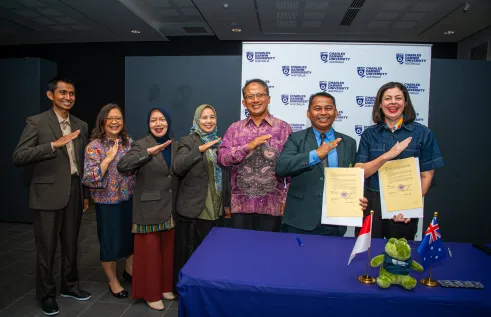
A new partnership with one of East Java’s leading education institutions is aligning Charles Darwin University with priorities to strengthen Australia’s relationship with Indonesia.
Read more about Partnership with Indonesian university to support education and research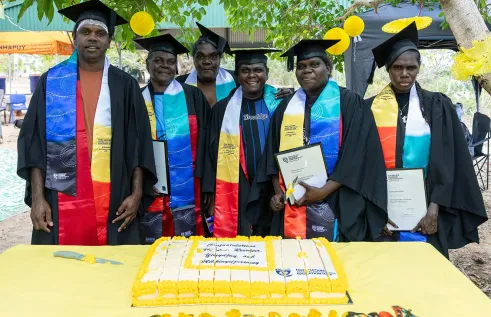
First Nations Training and Teacher Education Hub celebrates first major milestone
As Charles Darwin University's (CDU) First Nations Training and Teacher Education Hub draws closer to the end of its first year, one of its greatest milestones to date was conferring its first six graduates.
Read more about First Nations Training and Teacher Education Hub celebrates first major milestone
Federal funding for Country-based health and climate resilience
A new research collaboration to support and strengthen Country-based health and climate resilience has received funding through the National Health and Medical Research Council’s Centres of Research Excellence scheme.
Read more about Federal funding for Country-based health and climate resilience


