Funding boost for invaluable bushfire mapping service
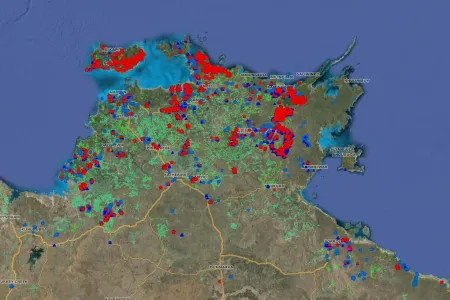
The North Australia and Rangelands Fire Information service (NAFI) at Charles Darwin University (CDU) will continue to guide thousands of people through Northern Australia’s intense fire seasons after being awarded a Federal Government grant for operations.
NAFI received $588,000 through the Disaster Resilience Australia Package to continue operations in 2024/25.
The funding will ensure the fire information web portal is available to land managers and owners, emergency services, governments, councils, and other agencies across Northern Australia for the peak fire weather season.
Since its inception more than 20 years ago NAFI has played a critical role in bushfire prevention and management in Northern Australia, providing users with timely, accurate and easy to access data.
NAFI’s importance was highlighted in 2023 during the Barkly region bushfires, with the service receiving about 180,000 map requests a day for the infernos which ravaged more than 9,300 square kilometres of land and threatened Tennant Creek.
NAFI Service Manager Dr Peter Jacklyn said NAFI had become a key part of land management, with many Traditional Owners, Indigenous rangers, pastoralists, park rangers and more currently using the platform to guide planned burns across their properties.
“This funding will allow this highly valued service to continue delivering fire information to people across large parts of Australia,” Dr Jacklyn said.
“Importantly this funding will also provide resources allowing us to establish a sustainable funding platform for the NAFI service into the future.
“We saw what a vital service NAFI was during the large wildfires in the Northern Territory last year around Tennant Creek, and this funding will allow that service in emergencies to continue.”
CDU Deputy Vice-Chancellor Research and Innovation Professor Steve Rogers said the funding recognised NAFI’s role in protecting the land, wildlife, and people of Northern Australia.
“For decades NAFI has played a crucial role in public safety, land management, and bushfire prevention, mapping, and detection,” Professor Rogers said.
“It is run by a team with decades worth of fire knowledge and experience and has become an invaluable asset as the severity of bushfires increases.
“We appreciate the Federal Government’s support and are proud to continue providing this service to the public, emergency services, government and non-government agencies and more.”
Federal Member for Solomon Luke Gosling OAM MP said the importance of NAFI could not be overstated.
“I’m pleased to see the Albanese Government invest in disaster preparedness in the North,” Mr Gosling said.
“Programs like NAFI are so important for public information, including providing authorities and community members with data of where the fire is and where it’s recently burned.”
Related Articles

Federal funding for Country-based health and climate resilience
A new research collaboration to support and strengthen Country-based health and climate resilience has received funding through the National Health and Medical Research Council’s Centres of Research Excellence scheme.
Read more about Federal funding for Country-based health and climate resilience
New livestream brings remote Australian arid zone waterhole to the world
A new livestream from a remote waterhole in the Northern Territory is giving people around the world the opportunity to observe wildlife in real time.
Read more about New livestream brings remote Australian arid zone waterhole to the world
Leading scientist recognised for lifetime of dedication to Australian biodiversity and conservation
One of the nation’s most distinguished experts in Australian biodiversity and conservation will be celebrated in an upcoming Charles Darwin University graduation ceremony.
Read more about Leading scientist recognised for lifetime of dedication to Australian biodiversity and conservation


