News
A global biodiversity tipping point as first marine fish extinction declared
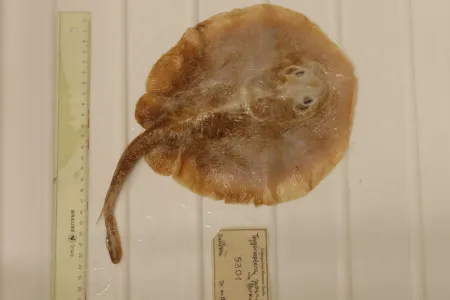
A species of ray, so rare it has only ever been recorded once back in the late 1800s, has been declared extinct after an assessment by an international team led by Charles Darwin University (CDU).
The loss of the Java Stingaree, a small relative of stingrays, is the first marine fish extinction as a result of human activity.
This news comes as the International Union for Conservation of Nature (IUCN) released its updated Red List of Threatened Species today.
The Java Stingaree (Urolophus javanicus) was known only from a single specimen collected in 1862 from a fish market in Jakarta, Indonesia.
The team conducted new modelling encompassing all available information on the species which has revealed the Java Stingaree as extinct.
CDU PhD Candidate and lead assessor, Julia Constance said a range of issues had contributed to the Java Stingaree’s disappearance.
“Intensive and generally unregulated fishing is likely the major threat resulting in the depletion of the Java Stingaree population, with coastal fish catches in the Java Sea already declining by the 1870s,” Ms Constance said.
“The northern coast of Java, particularly Jakarta Bay where the species was known to occur, is also heavily industrialised, with extensive, long-term habitat loss and degradation.”
“These impacts were severe enough to unfortunately cause the extinction of this species,” she said.
As part of the assessment of the plight of the Java Stingaree, the team looked at known threats such as overfishing and habitat loss and whether the species had been recorded in fish markets through surveys.
CDU PhD Candidate Benaya Simeon who is studying threatened rays in Indonesia, said that despite extensive survey efforts since 2001, no additional specimens have been found.
“A range of fish landing sites along the northern coast of Java and across Indonesia have been monitored extensively but they have not recorded the Java Stingaree,” Ms Simeon said.
“The Java Stingaree was a unique dinner plate-sized ray with no similar species in Java and the fact it has not been found during innumerable surveys confirms its extinction.”
CDU’s Research Institute for the Environment and Livelihoods Senior Research Fellow Dr Peter Kyne said there are over 120 Critically Endangered marine fishes in the world and that the loss of the Java Stingaree is a tipping point for marine biodiversity.
“The Java Stingaree being named as extinct is a warning sign for everyone across the world that we must protect threatened marine species,” Dr Kyne said.
“We must think about appropriate management strategies like protecting habitat and reducing overfishing while also securing the livelihoods of people reliant on fish resources.”
The IUCN’s Red List of Threatened Species is the world’s most comprehensive source on the global extinction risk and status of animal, fungus, and plant species.
Established in 1964, the IUCN Red List has identified over 41,200 species threatened with extinction globally.
The IUCN Red List provides information about the range, population size, habitat, ecology, use and trade, threats, and conservation actions that inform necessary decisions and policy changes to help protect species.
“Extinction is forever, and unless we can secure populations of threatened marine species around the globe, the Java Stingaree will only be the tip of the iceberg,” Ms Constance said.
Related Articles

Federal funding for Country-based health and climate resilience
A new research collaboration to support and strengthen Country-based health and climate resilience has received funding through the National Health and Medical Research Council’s Centres of Research Excellence scheme.
Read more about Federal funding for Country-based health and climate resilience
New livestream brings remote Australian arid zone waterhole to the world
A new livestream from a remote waterhole in the Northern Territory is giving people around the world the opportunity to observe wildlife in real time.
Read more about New livestream brings remote Australian arid zone waterhole to the world
Leading scientist recognised for lifetime of dedication to Australian biodiversity and conservation
One of the nation’s most distinguished experts in Australian biodiversity and conservation will be celebrated in an upcoming Charles Darwin University graduation ceremony.
Read more about Leading scientist recognised for lifetime of dedication to Australian biodiversity and conservation


