How one man’s dream opened doors to education access across the world
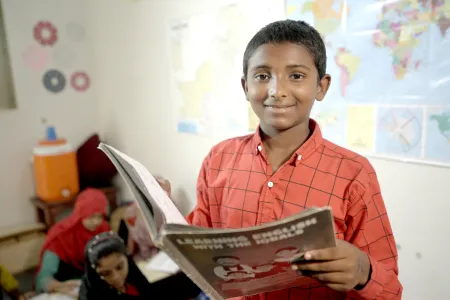
Charles Darwin University (CDU) PhD candidate Faisal Bin Badar never imagined his dream to improve education in his home country of Pakistan would evolve into an internationally recognised mission to build adaptable, sustainable schools across the globe.
Now, Mr Badar has opened 15 schools across Pakistan and Tanzania and is in discussions to expand into India, Bangladesh, Sri Lanka, Malaysia, Indonesia, Philippines, Pacific Islands, Kenya, and Ghana – all before even completing his PhD.
About 32 per cent of children in Pakistan – more than 20 million individuals – are not enrolled in school according to the 2017 Pakistan Social and Living Standards Measurement Survey.
Mr Badar’s research attributed the number of out-of-school children to four factors: cost of infrastructure, availability of teachers in remote and regional communities, attitudes of parents, and effective monitoring.
Equipped with this knowledge, he established the EDvantage Digital Learning System (EDLS) in 2019 to offer a unique learning model called a digitally operated one-room schoolhouse (DOORS).
Mr Badar found one-room schoolhouses – a concept that already existed in some areas of Pakistan – were an economic and scalable option that allowed children of all ages to attend class and learn basic subjects such as maths, local languages, and English from a community member.
But using technology to introduce online learning meant teachers from across the world could overcome the tyranny of distance to teach specialist subjects to eager students.
“We created a very simple and cost-effective model for the local facilitator and students with just one laptop, one monitor, and one camera and other digital accessories per class,” Mr Badar said.
“Through the online classes, we try to match the education content any Australian student would receive, and it’s that centralisation that makes our system unique.
“It's not just functional literacy, or primary school programme, it is much advanced than that and the school day can be catered to meet the needs of any community.”
However, families’ reliance on young children’s employment was one of the biggest enrolment barriers the project faced.
For example, a boy who was interested in attending school also worked in a shoe factory, bringing home his family’s only source of income.
“We went to the boy’s employer and explained the benefits of allowing him to attend school, and worked with them to adapt his schedule,” Mr Badar said.
“Now, that boy studies in the morning and from there he goes to the shoe shop in the afternoons.
“These are the kinds of adjustments we need so that education is accessible to the children while acknowledging the community’s unique needs.”
DOORS include one local facilitator and administrator, which encourages the community to engage with the schoolhouses as opposed to relying on “outsiders” travelling to remote communities.
“This project is founded in my PhD research but has become so much more than that,” he said.
Mr Badar’s research contributes to Goal 4 of the United Nations Sustainable Development Goals, which relates to quality education.
Related Articles

The good, the bad, and the ugly food: Why religious shoppers are buying bruised veggies
A recent study with Charles Darwin University examines how consumers’ religiosity influences the purchase of “ugly foods”, or foods that are aesthetically imperfect but nutritious.
Read more about The good, the bad, and the ugly food: Why religious shoppers are buying bruised veggies
Rangers reimagine AI in wildlife monitoring
As workplaces around the world wrestle to integrate Artificial Intelligence in their operations, researchers and rangers in the heart of West Arnhem are successfully embracing this technology in conservation without compromising respect and knowledge.
Read more about Rangers reimagine AI in wildlife monitoring
Partnership with Indonesian university to support education and research
A new partnership with one of East Java’s leading education institutions is aligning Charles Darwin University with priorities to strengthen Australia’s relationship with Indonesia.
Read more about Partnership with Indonesian university to support education and research


