Industry and students collab to create AI road tech
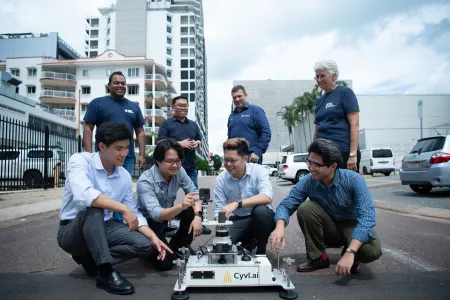
In a single semester, four Charles Darwin University (CDU) students developed an Artificial Intelligence (AI) model which can revolutionise road safety and infrastructure maintenance.
As part of their Master of Data Science, CDU students Cong Do Le, Khai Quang Thang, Van Phuc Vinh Ho and Buu Dang Phan developed technology that accurately detects and classifies road signs.
The model needed to be able to identify these road signs in varying and challenging conditions such as low light, adverse weather and local urban landscapes.
To do this, the students worked alongside national civil engineering provider Civiltech Solutions, which shared videos of Darwin streets recorded by a camera mounted on a bike.
The team extracted 60,000 images from these videos and then narrowed this dataset to about 8000 images, which they fed into the model.
At the end of the project, the students reported the model had a more than 90 per cent accuracy rate for identifying road signs.
Students Khai Quang Thang and Van Phuc Vinh Ho, who are both international students from Vietnam, said the project offered valuable experience.
“The highlights of this project were working in a team, how we managed and overcame problems, learning about this technology but also how to deal with industry professionals,” Mr Ho said.
“At first, we had a lot of trouble, we had little knowledge about sign recognition.
“We improved the model step by step to make it more accurate and faster, and we got expert advice from our lecturers and Civiltech which improved our approach to monitoring and better understanding the real-world applications.
“I have a background in IT and I’m passionate about data science. I was able to learn about data and Artificial Intelligence, and this project has opened my eyes to new experiences.”
Mr Thang, who comes from a business background hopes to pursue a career as a data analyst, said the project was challenging but the opportunity to blend academia and industry was a personal highlight.
“I’ve met a lot of talented people from our professors, my teammates and other talented people at CDU,” Mr Thang said.
“We had to submit our project to the CDU IT Code Fair Research Competition, and this gave me a chance to speak in public. This is important to become a data analyst, because you must work with technology but also communicate with clients.”
At the end of the project, the students reported the model had a more than 90 per cent accuracy rate for identifying road signs.
The legacy of this project will go beyond these four students. Future students who undertake this course will be able to use the technology to develop it for new applications which contribute to the community.
“Projects like this are a foundation for other students in the university to adapt and develop this technology,” Mr Ho said.
“Our project has applications to make self-driving systems, recognise road signs in real-time, and help civil companies map roads.”
CDU Lecturer in Information Technology Dr Thuseethan Selvarajah, who was one of the project’s supervisors, said giving students opportunities to combine academia with industry collaboration was a priority.
“Normally students are used to theoretical studies,” Dr Selvarajah said.
“But they don’t know where and how to apply their knowledge and skills, so it’s important for us to have partners like Civiltech. These opportunities are directly linked with graduate outcomes.”
Civiltech Solutions has been collaborating with CDU staff and students for a few years now across Artificial Intelligence, civil engineering and now data science.
Founder and Chief Executive Leigh Carnall said this recent collaboration allowed for the company’s civil engineers and the data science students to work with and learn from one another.
“We all learn differently and sometimes we are faced with problems in the real world where data science people come in and look at it differently to how civil engineering does it,” Mr Carnall said.
“This experience gave civil engineering exposure to AI, what it can do and to different ways of solving data problems.
“With the data science students, it gives them a way of engaging with professionals to find out exactly what the problem is they’re wanting to solve, go through the process of what’s possible, what the outcomes are and the roadmap of how we could get there.”
Mr Carnall also agreed these partnerships were a great way to showcase the opportunities for students to stay and contribute to the Northern Territory.
“This is a great story for the NT because it encourages CDU students to stay after studies are finished. To enable that, there needs to be an industry that offers careers for graduates to apply their skills in fulfilling, rewarding and interesting work within Northern Territory,” Mr Carnall said.
“This collaboration is an example of industry and academia helping to grow and diversify the Territory economy. It has been a rewarding start to our collaboration and wish the students every success.”
Related Articles
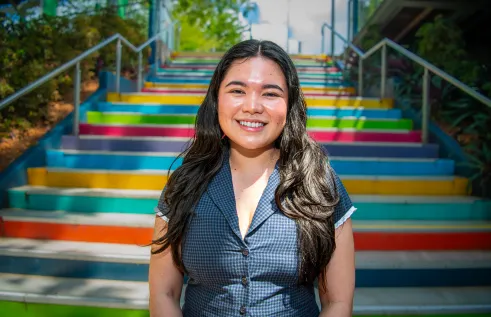
Darwin needs a BBL: Architecture student's vision for the Top End
A vertical promenade designed by a Charles Darwin University (CDU) architecture student and inspired by Singapore's Gardens by the Bay offers a glimpse into Darwin's future facelift.
Read more about Darwin needs a BBL: Architecture student's vision for the Top End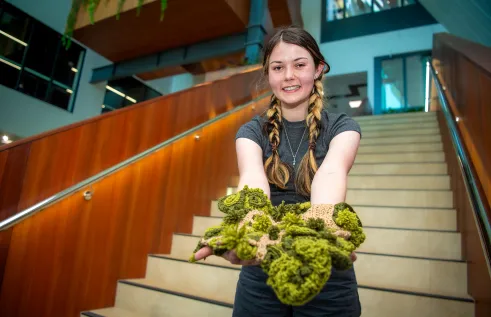
Crocheted landscape takes the gold in architecture competition
When tasked to defy growing reliance on artificial intelligence and create a landscape model without digital tools, Charles Darwin University (CDU) Bachelor of Architectural Design student Jorja Handebo turned to her hobby of the past five years: crochet.
Read more about Crocheted landscape takes the gold in architecture competition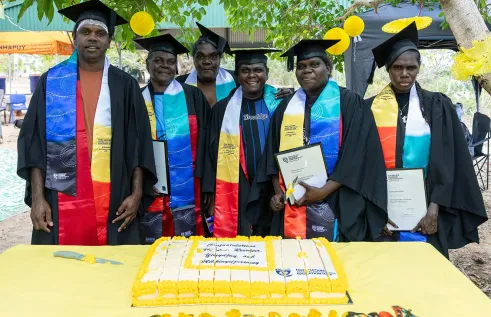
First Nations Training and Teacher Education Hub celebrates first major milestone
As Charles Darwin University's (CDU) First Nations Training and Teacher Education Hub draws closer to the end of its first year, one of its greatest milestones to date was conferring its first six graduates.
Read more about First Nations Training and Teacher Education Hub celebrates first major milestone


