Keeping us current: Push for global network of autonomous surface craft
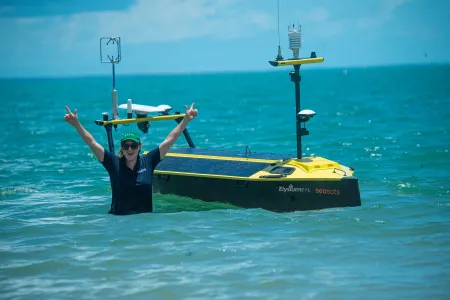
Uncrewed surface vehicles (USVs) could unlock our ocean’s deepest secrets and improve weather forecasting, with plans to develop a global network of this technology set to enhance data collection in previously uncharted waters.
Charles Darwin University (CDU) Research Fellow Dr Ruth Patterson, an oceanographer who heads up Elysium EPL’s Marine Environmental Services, is leading a joint scientific and industry proposal to establish a permanent global USV network within the Global Ocean Observing System (GOOS).
USVs are used around the world for scientific ocean observation but at present there is not a coordinated network that manages data collection and distribution.
There are remote regions of the ocean not covered by this technology, and there is no standard framework for this technology’s quality data standards or best practices.
Dr Patterson, who is already deploying this technology for a range of scientific and commercial applications, said with use of this technology about to become popularised like drones, combined with the importance of USVs in weather and climate forecasting, a global network is now critical.
“This technology is currently booming, and we urgently need to establish a global network to agree on standards and best practices so that USV data can be used to enhance our understanding of the oceans and climate,” Dr Patterson said.
“With USVs you can observe the ocean cost-effectively. For example, five or ten USVs can take to the ocean for the price of one crewed vessel, which means you can collect data in different places at the same time. Until now this has not been feasible – this is a groundbreaking new capability.”
USVs have become a critical part of global oceanographic and atmospheric scientific observations, with the renewable-energy powered technology able to traverse tens of thousands of kilometres unassisted.
USVs can navigate extreme environmental conditions such as tropical cyclones and winter storms, which are typically under sampled because of logistics, high cost and concerns for safety.
“USVs can collect an unprecedented number of environmental and situational data-streams at once, allowing us to improve our predictions of complex phenomena, such as El Nino and La Nina,” Dr Patterson said.
“The platforms can also be used to collect data for environmental impact assessments in offshore energy, improve maritime security awareness and surveying marine wildlife all at the same time.
“The outcomes for the agricultural industry, especially fisheries, has vast potential. We are measuring fish biomass, ocean temperature and weather at the same place and the same time. This is much needed to help with climate resilience planning and future proofing industry.
“This network would improve our weather forecasting. The climate is changing so rapidly that we can’t forecast weather as well anymore because our algorithms are based on old data.”
In April, Dr Patterson will travel to Brest, France to seek the USV global network’s endorsement at the 16th session of Observations Coordination Group. The result will be joining the 16 existing Global Ocean Observing System networks.
“This is strategic and important, and Australians and our region will benefit significantly from this technology,” Dr Patterson said.
“Our network is actively seeking investment so we can provide transformative data and services to populations in some of the most remote and pristine places in the world.”
The proposal is supported by universities and organisations around the world including in the United States, Sweden, Canada, Norway, Japan, South Africa, and United Kingdom.
Related Articles
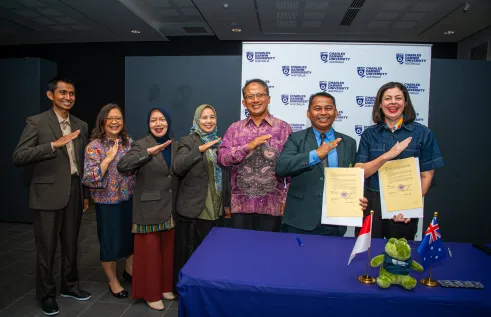
Partnership with Indonesian university to support education and research
A new partnership with one of East Java’s leading education institutions is aligning Charles Darwin University with priorities to strengthen Australia’s relationship with Indonesia.
Read more about Partnership with Indonesian university to support education and research
Federal funding for Country-based health and climate resilience
A new research collaboration to support and strengthen Country-based health and climate resilience has received funding through the National Health and Medical Research Council’s Centres of Research Excellence scheme.
Read more about Federal funding for Country-based health and climate resilience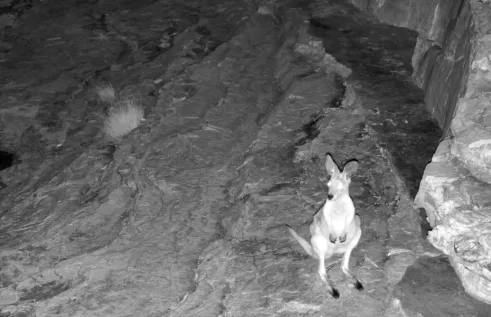
New livestream brings remote Australian arid zone waterhole to the world
A new livestream from a remote waterhole in the Northern Territory is giving people around the world the opportunity to observe wildlife in real time.
Read more about New livestream brings remote Australian arid zone waterhole to the world


