News article
New approach to track returning animals at rehabilitated mine sites
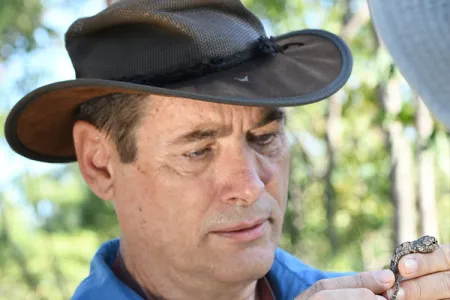
A new approach to setting benchmarks for the return of fauna will allow rehabilitation managers to better assess the success of their restoration efforts on mine sites across Australia’s north.
The research, led by Charles Darwin University’s Professor Alan Andersen in collaboration with scientists from the Flora and Fauna Division of the Northern Territory’s Department of Environment and Natural Resources, provides a template for setting specific targets for the animals expected to be found on a rehabilitated site.
Mine rehabilitation standards specify exactly what needs to be achieved by a rehabilitation project, yet these standards rarely include specific provisions for fauna. In many cases, rehabilitation projects take a “field of dreams” approach to wildlife: it’s assumed that if you build appropriate habitat then the animals will come.
But Professor Andersen said there was evidence this may not be enough for wildlife to recolonise a former mine site.
“One of the rehabilitation aims in areas of high conservation value should be to restore fauna. As for plants, specific targets should also be set for animals as part of the rehabilitation process,” he said.
Yet setting specific targets for animals is a far greater challenge than for plants. The ability of animals to hide – in tree hollows or rocky crevices or underground burrows – makes many species difficult to detect using standard survey techniques.
“Even if a plant is rare, you can say with some confidence that it does or doesn’t occur at a site. Whereas with many animals, if you don’t see them, you can’t necessarily say that they’re not there,” Professor Andersen said.
“There’s little point in setting a rehabilitation target for a species that you cannot confidently know is there.”
Professor Andersen and his colleagues developed the guidance for setting and assessing rehabilitation standards for fauna as part of a project advising the Australian Government’s Supervising Scientist Branch on how to best assess the rehabilitation of the Ranger uranium mine in the Northern Territory. The research was funded by the Australian Government’s National Environmental Science Program.
The research drew on the decades of experience of the Flora and Fauna Division undertaking fauna surveys across the northern savannas.
Division scientist Luke Einoder said the large dataset from long-term fauna monitoring programs in Top End Parks was particularly valuable.
“This allowed us to determine there were 50 vertebrate species that can be reliably detected in those lowland woodland habitats.”
The approach the researchers developed provides guidance for rehabilitation managers on which species to select for monitoring, their attributes to be assessed, the type and number of reference sites to choose, and ensuring that sampling methods are repeatable and robust.
“We have identified five key principles for assessing the rehabilitation of faunal communities in areas of high conservation value. The application of these principles will ensure better rehabilitation outcomes than the current approach that focuses so heavily on restoring vegetation,” Professor Andersen said.
Related Articles
New livestream brings remote Australian arid zone waterhole to the world
A new livestream from a remote waterhole in the Northern Territory is giving people around the world the opportunity to observe wildlife in real time.
Read more about New livestream brings remote Australian arid zone waterhole to the world
Leading scientist recognised for lifetime of dedication to Australian biodiversity and conservation
One of the nation’s most distinguished experts in Australian biodiversity and conservation will be celebrated in an upcoming Charles Darwin University graduation ceremony.
Read more about Leading scientist recognised for lifetime of dedication to Australian biodiversity and conservation
New construction management course to bolster NT’s building industry
A new Master of Construction Management from Charles Darwin University (CDU) is set to bolster the Northern Territory’s building industry.
Read more about New construction management course to bolster NT’s building industry


