News
New Alice Springs demography insights to be unveiled at CDU Open Day
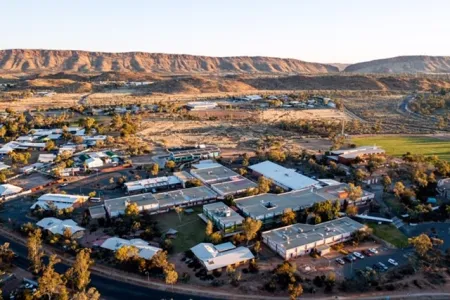
Analysis of the latest demographic data shows the Alice Springs population is larger than previously thought, at 28,601, ageing, female-dominated and increasingly multicultural.
These are some of the findings that Charles Darwin University (CDU) demographers have drawn from the latest population data for Alice Springs.
CDU Northern Institute Demographer Associate Professor Andrew Taylor said important new findings have surfaced from 2021 Census data, all of which help shape the current identity, as well as the future of Alice Springs and its people.
The CDU research findings, applied to government, private sector and non-government organisation (NGO) decision-making, are the focus of a research seminar at the University’s Alice Springs Open Day this weekend.
It is the first Open Day hosted by CDU’s Alice Springs campus in the past 10 years.
“Alice Springs is a fascinating place demographically because of its multicultural makeup, gender ratio and its pathway to population ageing,” Associate Professor Taylor said.
Census data shows the face of Alice Springs is changing, with growth in new migrant communities contributing to an increasingly multicultural demographic, he said.
“There was growth in the town’s communities from India, the Philippines, Nepal and China, which ten years ago, were in smaller numbers.
“Meanwhile, the number of people from the United Kingdom and Australian-born people have declined in Alice Springs.
“Population ageing is also a feature of the town, and the wider Northern Territory, where ageing onset is later than for the rest of Australia.”
Associate Professor Taylor said the data indicates the gender ratio in the Alice Springs population continues to be female-dominated – a status quo that is distinctive, and contrasts with the male-dominated gender balance in the rest of the Northern Territory.
“Data gleaned from the 2021 Census, as a whole, paints a detailed picture of Alice Springs as a town and as a community,” he said.
Adding to this picture are the latest findings from a my Territory Connections survey led by CDU Northern Institute Demographer, Research Associate Fiona Shalley.
"The survey helps us to know more about ourselves and what makes for a good life in the Territory," Ms Shalley said.
Northern Institute researchers surveyed NT residents, 18 years and over, including 366 people in Alice Springs.
Ms Shalley will explore the survey results for Alice Springs in a joint presentation with Associate Professor Taylor from 12pm during the CDU Alice Springs Open Day from 10am-2pm.
The seminar: Hello Alice! Population Change and What Makes for a Good Life in Alice is part of a diverse Open Day program spanning interactive displays, demonstrations, tours, talks, workshops and entertainment.
Some of its many highlights are drone and Royal Flying Doctor Service simulators, make-your-own pinch pots, monoprints, springs rolls and mocktails, Flying Spanner and Roll-a-Swag competitions, 3D printing, a Valiant car display, live music and free children’s activities.
More here.
Related Articles
Federal funding for Country-based health and climate resilience
A new research collaboration to support and strengthen Country-based health and climate resilience has received funding through the National Health and Medical Research Council’s Centres of Research Excellence scheme.
Read more about Federal funding for Country-based health and climate resilience
New livestream brings remote Australian arid zone waterhole to the world
A new livestream from a remote waterhole in the Northern Territory is giving people around the world the opportunity to observe wildlife in real time.
Read more about New livestream brings remote Australian arid zone waterhole to the world
How ants are cashing in on the fight against money laundering
An AI model inspired by ants, bees, and birds could be the key to cracking down on blockchain-based money laundering, new research led by Charles Darwin University (CDU) has found.
Read more about How ants are cashing in on the fight against money laundering


