News
New book highlights how unique First Nations knowledge integrates into engineering education
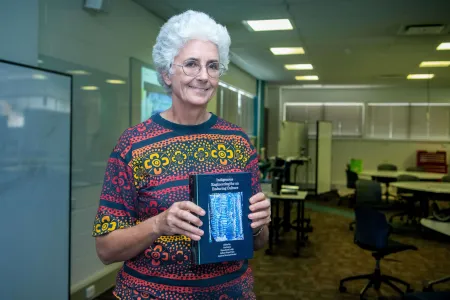
A new book co-edited by a Charles Darwin University (CDU) engineering and IT lecturer, offers a unique collection of engineering projects and engineering programs across First Nations communities in Australia.
CDU College of Engineering, IT and Environment lecturer Dr Cat Kutay is an editor of ‘Indigenous Engineering for an Enduring Culture’, a collaborative work that was written to support the integration of First Nations knowledges into engineering education.
Dr Kutay said the book provides a broad range of projects to reflect diverse perspectives and innovations designed by First Nations peoples, including spinifex nanotechnology, complex fish traps constructed in Victoria and New South Wales, and mining of ochre in Western Australia.
“Until recently, we have seen little material in our technical engineering courses that relates to First Nations communities or their engineering practices, whether in Nhulunbuy or Blacktown,” Dr Kutay said.
“We wrote the book to collect material on some current Australian approaches to First Nations engineering in teaching, research and in the development opportunities available for communities. It is a great collaboration of First Nations authors and others working in this area.
“We hope that providing such a comprehensive text of First Nations engineering inventions will encourage integration of this knowledge into engineering courses across Australian universities, and allow First Nations students to find a valued place in engineering education, research and employment.”
With five CDU academics included as authors and cover art designed by CDU Associate Professor Linda Payi Ford, the book combines community knowledge skills and academic expertise – highlighting collaboration at the intersection of Western and First Nations engineering principles.
According to Dr Kutay, First Nations engineering presents a much-needed challenge to a Westernised perspective on systems thinking.
“The ability to retain a holistic view of the whole system, rather than a specific mechanism or process alone, is inherent in any First Nations engineering practice,” she said.
“First Nations engineering has evolved over tens of thousands of years, grounded in values and practices that emphasise sustainability, reciprocity, respect, and diversity.
“This knowledge is still strong today and impacts our engineering methods which then benefit our research, environmental management and infrastructure development.”
CDU Deputy Vice-Chancellor First Nations Leadership Professor Reuben Bolt said scientific and technical knowledge was generated over the course of many thousands of years and passed down through the generations to a point that First Nations peoples generated a logic based on it.
“Unfortunately, with the colonisation of Australia, and the development of the Nation State mindset grounded in capitalist approaches, First Nations knowledges has never really been taken seriously by the West,” Professor Bolt said.
“Therefore, integrating First Nations knowledges into higher education is a key priority at CDU, whereby First Nations researchers are reclaiming and influencing the disciplines so that this knowledge makes a positive contribution to science and humanity more broadly.
“Their perspectives are critical to expanding our understanding and respect of First Nations peoples, cultures and histories as well as acknowledging many important contributions to society, research and innovation, both nationally and globally.”
The book is co-edited with Dr Elyssebeth Leigh, Associate Professor Juliana Kaya Prpic and Associate Professor Lyndon Ormond-Parker and is available to order here.
Related Articles
Federal funding for Country-based health and climate resilience
A new research collaboration to support and strengthen Country-based health and climate resilience has received funding through the National Health and Medical Research Council’s Centres of Research Excellence scheme.
Read more about Federal funding for Country-based health and climate resilience
New livestream brings remote Australian arid zone waterhole to the world
A new livestream from a remote waterhole in the Northern Territory is giving people around the world the opportunity to observe wildlife in real time.
Read more about New livestream brings remote Australian arid zone waterhole to the world
Leading scientist recognised for lifetime of dedication to Australian biodiversity and conservation
One of the nation’s most distinguished experts in Australian biodiversity and conservation will be celebrated in an upcoming Charles Darwin University graduation ceremony.
Read more about Leading scientist recognised for lifetime of dedication to Australian biodiversity and conservation


