News
New program to upskill arts students with STEM knowledge
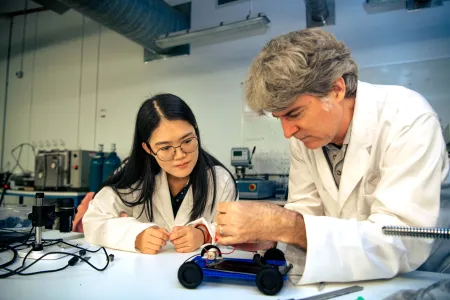
A new STEM program at Charles Darwin University (CDU) is set to entice arts and humanities students into science, technology and innovation, with the start of a new Advances in Science and Technology subject.
CDU will host STEM-based micro-credentials taught with industry partners to upskill undergraduate students currently enrolled in non-STEM courses, improving individual employment outcomes to support a highly skilled workforce.
Project Officer and CDU Master of Information Technology graduate Yunzhu Wang said the program aims to bridge the gap between science and arts subjects and guide students to become STEM-skilled graduates.
“Quite a large number of non-STEM undergraduate students are already taking at least one STEM unit at CDU, but the new program will provide more support to bolster these numbers,” Ms Wang said.
“The program provides students with the foundational scientific knowledge in a certain field, so they can explore new concepts and ideas that are not normally offered in arts and humanities courses.”
The program is part of the Australian Department of Education’s National Priorities and Industry Linkage Fund, which supports enhanced engagement between universities and industry to produce job-ready graduates.
The STEM-skilled graduates component aims to increase the proportion of non-STEM graduates who have completed a STEM unit before the end of 2024, and expand STEM skills across multiple higher education programs.
CDU Science lecturer Stephen Reynolds said the science and technology module will not only provide a solid and topical understanding of a critical research field, but help students to develop vital problem-solving skills.
“We hope to broaden students’ ideas about science, but also increase their understanding of misinformation around issues and trends,” Dr Reynolds said.
“It’s important to help students develop a strong ability to analyse, engage in critical thinking and effectively communicate how things work, because these are great skills that can be applied to a variety of research projects in different scientific fields.”
In this science unit, students will be introduced to physical, chemical and biological processes in science and technology within the context of current environmental issues.
And next semester the program will potentially expand to offer modules in artificial intelligence and science outreach.
CDU Director Student Engagement Sarah Fletcher said the program is keeping up with the rapid growth of industry, and providing effective pathways for students into rewarding careers.
“Globalisation and advances in technology are changing the nature of work, and increasing the number and variety of occupations requiring STEM-skills alongside an advanced understanding of STEM concepts,” Ms Fletcher said.
“Supporting students who undertake this program into STEM industry partnerships will still enable them to use their skills acquired from their arts and humanities courses, but apply this knowledge to research and innovation projects they may not have been interested in otherwise.”
For more information on arts courses at CDU, visit here.
Related Articles

The good, the bad, and the ugly food: Why religious shoppers are buying bruised veggies
A recent study with Charles Darwin University examines how consumers’ religiosity influences the purchase of “ugly foods”, or foods that are aesthetically imperfect but nutritious.
Read more about The good, the bad, and the ugly food: Why religious shoppers are buying bruised veggies
Rangers reimagine AI in wildlife monitoring
As workplaces around the world wrestle to integrate Artificial Intelligence in their operations, researchers and rangers in the heart of West Arnhem are successfully embracing this technology in conservation without compromising respect and knowledge.
Read more about Rangers reimagine AI in wildlife monitoring
Partnership with Indonesian university to support education and research
A new partnership with one of East Java’s leading education institutions is aligning Charles Darwin University with priorities to strengthen Australia’s relationship with Indonesia.
Read more about Partnership with Indonesian university to support education and research


