News
New three-year research project to monitor and conserve marine megafauna in the Territory
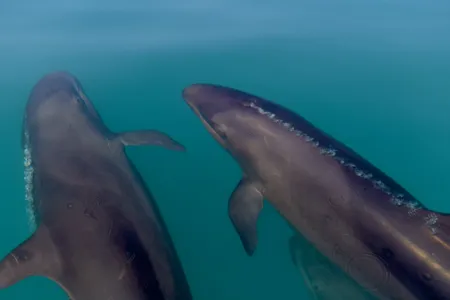
A new three-year Charles Darwin University (CDU) research project is developing new approaches to improve marine and coastal biodiversity monitoring, research, and conservation management.
The Marine Megafauna Project funded by the Australian Research Council, Parks Australia (Kakadu) and Taronga Conservation Society, will see CDU researchers work in partnership and consultation with Traditional Owners, Indigenous rangers and Commonwealth and NT government agencies.
The project will unite western and Traditional science to collect data on coastal dolphins, marine turtles, and a range of other understudied tropical marine megafauna, including false killer whales, baleen whales (humpback and Bryde’s whales) and manta rays.
It will involve identifying critical habitat areas for monitoring Australian snubfin and Australian humpback dolphins and in the Territory will use genetics to quantify population size and trends, and map population connectivity.
Rangers who are skilled in monitoring marine megafauna will provide an improved capacity for research, with the knowledge to aid environmental management led by Indigenous Traditional Owners.
Director of CDU's Research Institute for the Environment and Livelihoods (RIEL), Professor Sam Banks, who is coordinating the project, said the project would provide valuable information and protect the Northern Territory’s marine and coastal environments.
“At present, there is a limited knowledge base for marine biodiversity in many northern Australian coastal waters and this presents a serious barrier to effective conservation management and planning,” Professor Banks said.
“This partnership is an opportunity to broaden our biodiversity knowledge base and improve evidence-based environmental research and management for marine megafauna.”
“This is about providing a simpler, more integrated approach to planning and managing the marine and coastal environment – to address the key challenges into the future.”
CDU Senior Research Associate from RIEL, Dr Carol Palmer, said drawing on local expertise and knowledge from Indigenous communities was improving conservation outcomes.
“This project’s engagement processes tap into the rich local Indigenous communities’ knowledge of important marine megafauna and their environments,” Dr Palmer said.
“This unique and innovative research project is providing valuable lessons in how scientists, rangers groups and Traditional Owners and government agencies engage and collaborate to share knowledge, implement management, and improve conservation outcomes.”
The research project is part of an innovative partnership between Indigenous Ranger organisations including the Gumurr-Marthakal Rangers (Wessel Archipelago), Larrakia Nation Rangers (Darwin region), Kakadu National Park Rangers (Commonwealth) and Garig Gunak Barlu Cobourg Marine Park (Northern Territory Government) as well as Indigenous partnerships and several universities and organisations across Australia.
Related Articles

Federal funding for Country-based health and climate resilience
A new research collaboration to support and strengthen Country-based health and climate resilience has received funding through the National Health and Medical Research Council’s Centres of Research Excellence scheme.
Read more about Federal funding for Country-based health and climate resilience
New livestream brings remote Australian arid zone waterhole to the world
A new livestream from a remote waterhole in the Northern Territory is giving people around the world the opportunity to observe wildlife in real time.
Read more about New livestream brings remote Australian arid zone waterhole to the world
Leading scientist recognised for lifetime of dedication to Australian biodiversity and conservation
One of the nation’s most distinguished experts in Australian biodiversity and conservation will be celebrated in an upcoming Charles Darwin University graduation ceremony.
Read more about Leading scientist recognised for lifetime of dedication to Australian biodiversity and conservation


