News
Plans for NT food manufacturing plant revealed at key agricultural conference
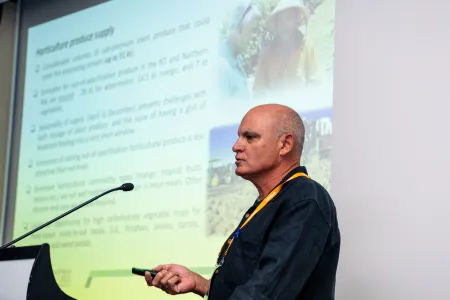
A Charles Darwin University (CDU) research group revealed what is needed for Northern Australia to build its own food manufacturing capabilities at a leading conference on agricultural development in the North.
Northern Australia Food Technology Innovation (NAFTI) project manager Dr Warren Hunt and University of Tasmania Professor Roger Stanley have presented the findings from 15 months of research at the Food Futures Conference, a three-day conference held in Darwin this week.
Dr Hunt said this was big-picture thinking from the team into how we could build a food manufacturing industry in Northern Australia.
“Here in Northern Australia food processing is limited to small niche businesses with most of Australia’s food processing located in Southern Australia,” Dr Hunt said.
“Through this project we have been able to understand the complexities and volumes in Northern Australia’s supply chain.”
“This initiative is aimed squarely at regional value-capture of sub-premium or out-of-specification produce that otherwise would be lost to the food chain.”
“However, there is also strategic angle, as our food supply chains in the north are 3000 to 4000km long and highly vulnerable to interruptions. Regional food stabilisation capabilities to support northern population centres must be given more attention by governments as a matter of urgency.”
“We are now in a position to narrow down the best options in terms of food science and technology that could go into a pilot facility.”
The project has so far highlighted the different types of shelf-stable foods that offer the most potential in being produced here in Northern Australia.
Shelf-stable foods include packaged snacks and convenience foods, pet food, ready meals, red meat and seafood products, tropical juice and wet or dry whole fruit or fruit pieces.
“Our research has showed that the most viable consumer segments are those requiring ready to eat or ready to use food, snacks and ingredients,” Dr Hunt said.
“There is also significant potential for NT-processed shelf-stable red meat products such as ready-to-eat meals as well as functional beef ingredients used in numerous grocery products.”
“We have also determined that there is an opportunity to produce buffalo meat products here in Northern Australia as it is one of the healthiest red meats and is an ideal protein powder source.”
“This study is investigating the function that novel shelf-stable food technologies offer, for example they can deliver food nutritional and sensory outcomes to past processing practices,” he said.
The next stage of the project includes furthering ideas on the development of a small-scale food-grade facility.
The plant would include several different processing lines with the ability to manage multiple feedstocks including red meat, horticulture, and seafood products. It would be dedicated to de-risking future potential commercial expansion by undertaking market and product testing, as well as building a trained workforce in food processing operations.
The Food Futures Conference is a biennial conference organised by the NT Farmers Association and plays an important role in showcasing the opportunities of the north, influencing policy creation and attracting investment to the area.
The conference is on at the Darwin Convention Centre from May 22 to May 25.
Related Articles
Federal funding for Country-based health and climate resilience
A new research collaboration to support and strengthen Country-based health and climate resilience has received funding through the National Health and Medical Research Council’s Centres of Research Excellence scheme.
Read more about Federal funding for Country-based health and climate resilience
New livestream brings remote Australian arid zone waterhole to the world
A new livestream from a remote waterhole in the Northern Territory is giving people around the world the opportunity to observe wildlife in real time.
Read more about New livestream brings remote Australian arid zone waterhole to the world
How ants are cashing in on the fight against money laundering
An AI model inspired by ants, bees, and birds could be the key to cracking down on blockchain-based money laundering, new research led by Charles Darwin University (CDU) has found.
Read more about How ants are cashing in on the fight against money laundering


