Researchers make new guide to help maintain water security in the future
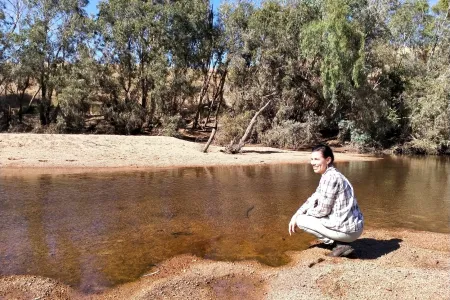
Humanity and the environment’s adaptation to climate change is dependent on water but projecting how water resources will be impacted in the future is difficult.
However, Charles Darwin University (CDU) researchers, supported by experts from CSIRO (AU), GNS Science (now Earth Science NZ), Acclimatised Pty Ltd (AU), have worked to simplify this by developing a guide to making hydrological projections. This guide will help to maintain water security, environmental health, and support climate change adaptation.
Hydrological projections assess how water resources may change in the future based on climate change scenarios. They are complex to develop because they need skills and knowledge spanning climate science, hydrology and numerical modelling.
These projections also often don’t deliver insights that can be directly used for local needs. Their development usually necessitates collaboration between scientists and local decision-makers to ensure that model outputs can answer the relevant questions.
To combat this, PhD candidate Frédérique Mourot from CDU's Research Institute for the Environment and Livelihoods has led the development of a guide to help water practitioners such as scientists, water resource managers, and water-dependent communities and industries, obtain best-practice hydrological projections.
The guide summarises knowledge on climate and hydrological modelling to produce hydrological projections that can be used in local applications. It also explains how to best represent and communicate hydrological projection results, and the large uncertainty often associated with these results.
Nine key recommendations to produce meaningful and informative groundwater-inclusive hydrological projections are made. These include identifying the water and climate change question to investigate, determining the important local drivers to represent in both climate and hydrological models, and giving priority to models that appropriately simulate groundwater processes.
Ms Mourot said this guide could help break down knowledge barriers and empower individuals who work with water resources to make better-informed science-based decisions.
“Water-resource managers, who often ask researchers to produce hydrological projections to assist them in protecting the local water resources, can use this guide to get appropriate hydrological projection results to help them determine sustainable water allocation limits,” Ms Mourot said.
“They need to understand how the water quantity of aquifers and rivers (often fed by aquifers) will change in the future with changes in climatic conditions to adjust these water allocations accordingly, and maintain water security and ecological health.
“Getting the right modelling outputs from the scientists that will allow water resource managers to inform and adapt their policies and water allocation limits is essential.
“This guide can help them understand the process, technical jargon and the basis of the climate and hydrological modelling science to better drive the outputs that scientists will prepare for them.”
Ms Mourot said the guide was valuable because it was designed to help a range of water and even climate practitioners, and because it was rare to find such extensive scientific information combined with end-user-focused recommendations in one place.
This work is funded through the Cooperative Research Centre for Developing Northern Australia (CRCNA)’s Water Security for Northern Australia program. Additional support was also provided by the Australian Government Research Training Program through a scholarship awarded to Ms Mourot.
CRCNA Chief Executive Anthony Curro said the guide was a valuable tool that would help strengthen decision-making across northern Australia.
“Water security is one of the most critical issues for the future of northern Australia,” Mr Curro said.
“This guide gives communities, industries, and policymakers practical tools to plan for changing water conditions and to make informed choices that balance development opportunities with long-term sustainability.
“The CRCNA is proud to support CDU and its partners in delivering this vital work.”
Producing Hydrological Projections under Climate Change: A Groundwater-inclusive Practical Guide was published in the journal Earth’s Future.
Related Articles
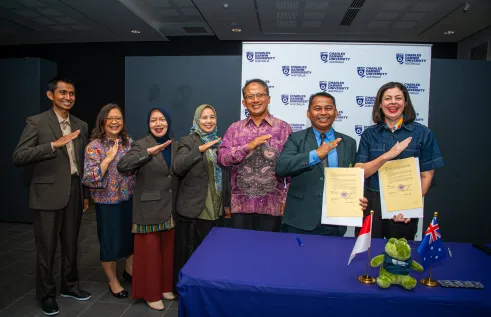
Partnership with Indonesian university to support education and research
A new partnership with one of East Java’s leading education institutions is aligning Charles Darwin University with priorities to strengthen Australia’s relationship with Indonesia.
Read more about Partnership with Indonesian university to support education and research
Federal funding for Country-based health and climate resilience
A new research collaboration to support and strengthen Country-based health and climate resilience has received funding through the National Health and Medical Research Council’s Centres of Research Excellence scheme.
Read more about Federal funding for Country-based health and climate resilience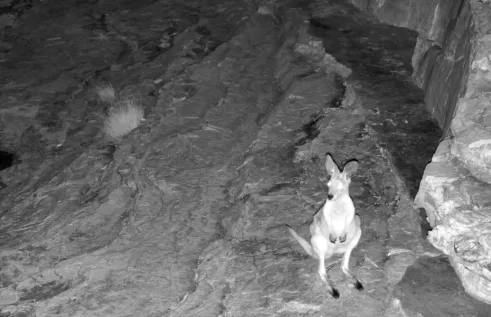
New livestream brings remote Australian arid zone waterhole to the world
A new livestream from a remote waterhole in the Northern Territory is giving people around the world the opportunity to observe wildlife in real time.
Read more about New livestream brings remote Australian arid zone waterhole to the world


