News
Using ‘art as evidence’: Climate change research on display at CDU
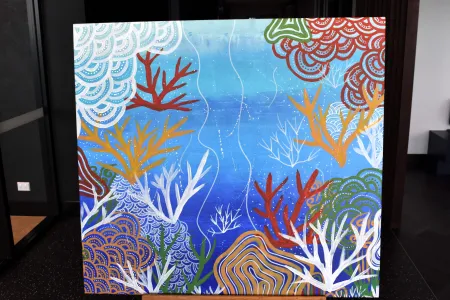
A Charles Darwin University (CDU) research project exploring the impacts of climate change is using “art as evidence”, alongside traditional data, to convey the lived experience of First Nations communities in relation to this global crisis.
Led by academics from CDU’s Northern Institute, Research Fellow Sharna Motlap and Professor Linda Ford, Climate Impacts on Country includes work from seven First Nations artists from Darwin and Mackay.
A proud Mbabaram woman, Ms Motlap said the project aimed to put First Nations voices in the lead when talking about climate action.
“Historically, cultural and communication gaps between Indigenous and non-Indigenous Australians have created significant barriers to improving health and social outcomes,” she said.
“This research adopts a holistic view of climate change, focusing not just on the numeric data we usually see, but on how climate change is also lived and experienced.
“By documenting the specific environmental and cultural losses as seen through the eyes of these artists, we are using art as evidence and capturing strategies and solutions used to reimagine its representation.”
Ms Motlap pointed to the exhibition’s opening timeline as an example of how climate change affects people, not just the environment.
“We had originally organised for this exhibition to happen in November 2025 – one of the artists involved had even flown to Darwin to join us for the event,” she said.
“However, Cyclone Fina struck the day of the exhibition, so Climate impacts on Country needed to be rescheduled due to the very real effects of climate change.”
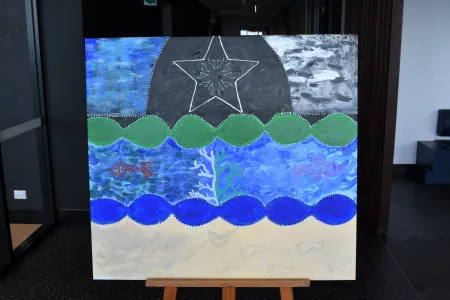
Torres Strait Islander and Mackay artist Jodie Durante – and Ms Motlap’s mother – said her work featured in the exhibition reflects the possible impacts of climate change on her home in Slade Point, Queensland.
Ms Durante said she holds fond memories and a deep connection to the beach and surrounding region.
“Through my art, I hope people can see the beauty of the beach, but also recognise the importance of caring for it, so the land can continue to take care of us,” she said.
“Otherwise, we will start seeing the impacts of climate change — where no one can walk along the beaches, or go fishing, like in my artwork where the footprints in the sand slowly disappear and start seeing the fish skeletons.
“It’s about protecting what we love, so our future generations can experience it the way we have.”
Iman and Kuku-Yalanji artist Andrew Doyle homed in on the topic of coral bleaching through his featured art.
“I wanted people to see the contrast between the reef’s bright colours and the extreme, bleach white – there's a big contrast between the two,” he said.
“Climate change has been felt deeply in the Torres Strait Islands, and I would love for this exhibition to encourage governments and communities to listen, help, and heal our Country.”
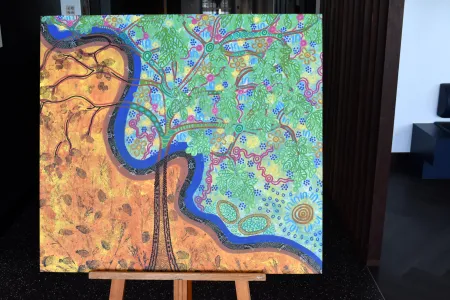
Artist Noelene Madrill lived in Pirlangimpi, Melville Island, until she was six years old, and has family ties to Daly River, and the Tiwi Islands. She now lives in Mackay and has included two pieces of artwork in the exhibition – 10 Mile Country and Billy Goat Plum.
Both pieces feature locations special to her family and how they have changed with time.
“10 Mile Country captures the threat of rising sea levels and the creek slowly cutting into the land, highlighting the fear that our next generation may never see this place and experience beauty, family, bush trips, and gatherings,” she said.
“Billy Goat Plum illustrates how climate change has impacted a significant tree which is a vital source of food and traditional medicine.
“Sharing our knowledge of culture and significance of Country through art gives the wider audience a chance to relate to how climate change is affecting us. It’s a striking medium that comes with a greater depth of understanding.”
The pop-up exhibition will be open from 9am-4pm on April 10, held at the Danala | Education and Community Precinct.
Aligned with the United Nations Sustainable Development Goals
Climate action
Goal 13
Take urgent action to combat climate change and its impacts.
Related Articles
Partnership with Indonesian university to support education and research
A new partnership with one of East Java’s leading education institutions is aligning Charles Darwin University with priorities to strengthen Australia’s relationship with Indonesia.
Read more about Partnership with Indonesian university to support education and research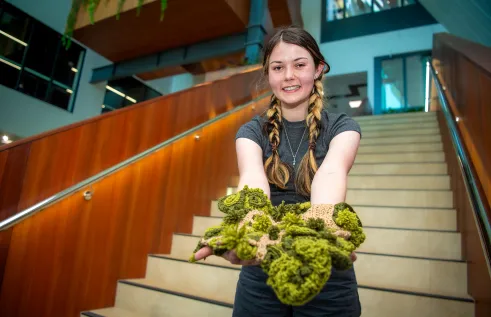
Crocheted landscape takes the gold in architecture competition
When tasked to defy growing reliance on artificial intelligence and create a landscape model without digital tools, Charles Darwin University (CDU) Bachelor of Architectural Design student Jorja Handebo turned to her hobby of the past five years: crochet.
Read more about Crocheted landscape takes the gold in architecture competition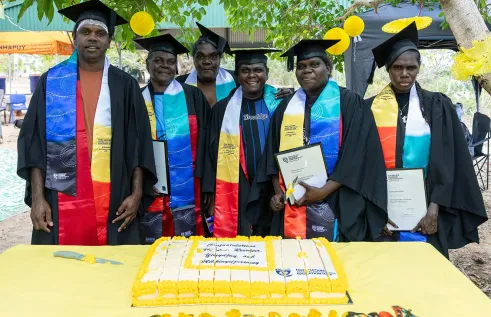
First Nations Training and Teacher Education Hub celebrates first major milestone
As Charles Darwin University's (CDU) First Nations Training and Teacher Education Hub draws closer to the end of its first year, one of its greatest milestones to date was conferring its first six graduates.
Read more about First Nations Training and Teacher Education Hub celebrates first major milestone


