RIEL News
Economic change is possible, but hard: Breaking down economy myths
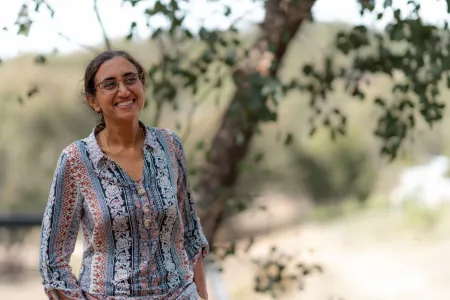
Renowned political economist Dr Katherine Trebeck is set to bust myths about wellbeing economies being anti-business through a public forum involving some of Northern Territory's most vocal thought leaders.
Wellbeing Economy Alliance (WEAll) Co-Founder Dr Trebeck will join a panel discussion alongside NT Opposition Leader Selena Uibo, Nightcliff MLA Kat McNamara, and 2025 independent candidate for Solomon Phil Scott to discuss the economy that prioritises sustainable and socially just development.
Charles Darwin University ecological economist Kamaljit Sangha, who is hosting the panel, said she hoped the event would demonstrate alternative ways of thinking about the Northern Territory’s economy.
“The focus of wellbeing economies is – as in its very name – to enhance people’s wellbeing and open options to diverse income streams, which is the ultimate goal of any economy,” she said.
“The need for change – shifting away from GDP to well-being economy – is urgent, we are already missing the train. The sooner we jump on, the better we will be.”
Dr Trebeck hoped the event, held at CDU’s Casuarina Campus, Building Blue 5.1 on October 30, would generate accessible and interactive information sessions and allow the average Territorian to ask the “big questions” and become part of the movement to mobilise the idea in Australia.
“Change is possible, but hard work, and people in Australia and around the world are increasingly frustrated with the current state of affairs,” Dr Trebeck said.
“The current economy is extractive, it enables wealth to flow to those who already have most resources, its success is measured narrowly.
“On the other hand, a wellbeing economy is deliberately designed, delivered, and measured to meet the needs of people and planet.”
According to the WEAll, these holistic economies have replaced those that use GDP as the key measure of success in Scotland, Finland, Iceland, Canada, and Wales.
The event ran on October 30 and included a screening of Purpose: A Wellbeing Economies Film.
This story was originally published in CDU Uni News November 2025 edition
Related Articles
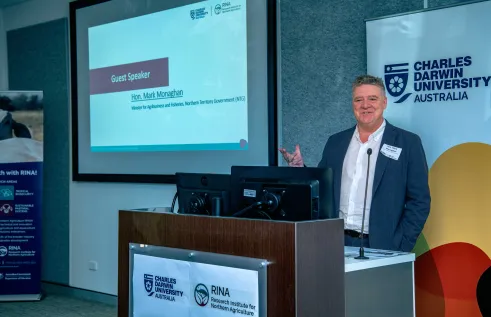
RINA marks official launch
The Research Institute for Northern Agriculture (RINA) celebrated its official launch at Charles Darwin University's (CDU) Casuarina Campus on April 30, 2024. The launch was attended by approximately 50 invited stakeholders and partners, who listened to the guest speaker, the Honourable Mark Monaghan, NT Government Minister for Agribusiness and Fisheries
Read more about RINA marks official launch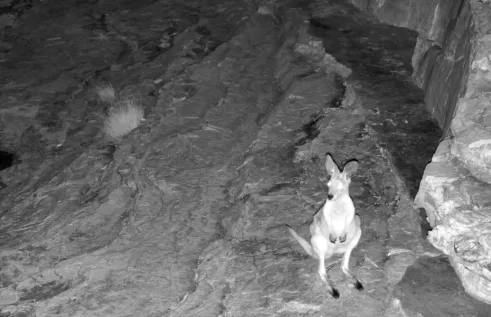
New livestream brings remote Australian arid zone waterhole to the world
A new livestream from a remote waterhole in the Northern Territory is giving people around the world the opportunity to observe wildlife in real time.
Read more about New livestream brings remote Australian arid zone waterhole to the world
Leading scientist recognised for lifetime of dedication to Australian biodiversity and conservation
One of the nation’s most distinguished experts in Australian biodiversity and conservation will be celebrated in an upcoming Charles Darwin University graduation ceremony.
Read more about Leading scientist recognised for lifetime of dedication to Australian biodiversity and conservation


