Tropical aquaculture

Group leader
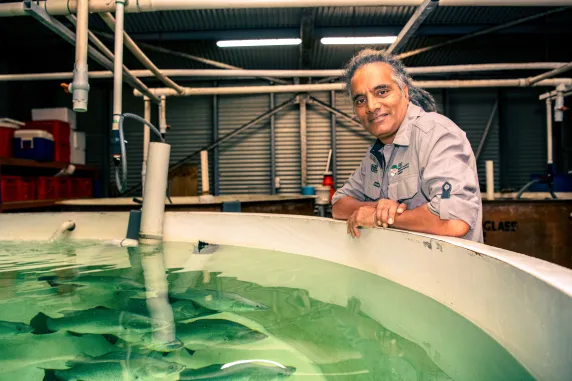
Professor of Tropical Aquaculture, Sunil Kadri has spent more than 30 years working at the interface between academia and the global aquaculture industry, delivering both research outputs and new technologies/approaches to improve efficiencies and increase sustainability in aquaculture. He completed his PhD at the University of Glasgow, Scotland, in 1995, and then focused on the commercialisation of aquaculture technologies, while continuing to pursue his research interests via honorary academic positions at the Universities of Glasgow and Stirling in Scotland, and later the Universidad Austral de Chile.
While his research interests are broad, he has had a particular focus on applications of animal behaviour and animal welfare studies to aquaculture, including the deployment of monitoring technologies. He continues to pursue these fields of research in Northern Australia and the wider region, alongside his passion for supporting Indigenous aquaculture ambitions.
Besides his research, Sunil provides strategic advice and governance to European, American, and Australian start-ups in the AI/machine learning, animal health, and alternative protein spaces, respectively, as well as to a Maori fisheries and aquaculture company in his home country, Aotearoa/New Zealand.
Our focus
We study biology, animal behaviour, and animal welfare as applied to tropical aquaculture systems, and provide support to both industry and Indigenous communities in developing and growing aquaculture sustainably. We have diverse expertise across these areas, with a history of research focused upon examination of individual differences within cultured populations and their implications for animal welfare, production, and sustainability; as well as deployment of specialist technologies for behavioural and production monitoring within aquaculture systems. Our research in tropical aquaculture encompasses new species development, environmental enrichment, climate change adaptation, and bioremediation.
Importance of this research
Understanding the biological patterns and processes that support tropical aquaculture systems is fundamental to the sustainable management and growth of both established and new species cultured in the region.
Current projects
The goldlined rabbitfish S.lineatus: farming down the food chain for resilient, low trophic, Indigenous aquaculture.
This project provides a unique opportunity for a suitable PhD candidate to work in a remote Indigenous community within a program developing a blue economy to safeguard the future of one of Australia’s largest islands. The project will develop production methods for a herbivorous marine fish, to enable a more sustainable and climate-resilient future for Australian finfish aquaculture. The enhanced capacity of a strong collaboration between Charles Darwin University, an Aboriginal Corporation and the CSIRO, working alongside Anindilyakwa traditional owners, will yield a better understanding of Goldlined Rabbitfish propagation techniques. This will ultimately improve Groote Aqua’s production efficiency and, consequently, food security, revenues, and employment prospects on Groote Eylandt, which are key milestones for the Aboriginal Corporation to prepare for and facilitate the transition from six decades of mining to self-sufficiency.
Media highlight: This project was featured in a CDU media release highlighting its innovative integration of aquaculture research, Indigenous leadership, and economic transition planning to support the development of a sustainable blue economy in northern Australia.
Harvesting and transporting marine fingerlings finfish: Status of farmed fish welfare practicing in hatcheries in Nha Trang, Vietnam
This project investigates current harvesting and transportation practices for juvenile (fingerling) sub-nose pompano in the Nha Trang Bay region, with a focus on improving fish welfare and industry sustainability. The research involves in-depth, face-to-face interviews with 28 hatchery farmers using semi-structured questionnaires to gather insights into fish size, stocking densities, water and health management, feeding practices, harvesting and transport methods, and nursing procedures. The study also examines farmers’ understanding of fish welfare, including stress, injury, and potential suffering, alongside general farm characteristics such as scale, education levels, and access to government support. Complementing this fieldwork, laboratory-based experiments will simulate current transport conditions — varying densities, temperatures, and durations — to assess survival rates, physiological stress, behaviour, and overall fitness. By integrating industry insights with experimental evidence, the project aims to identify gaps in current practices and develop practical, evidence-based guidelines to enhance fish welfare and promote more humane and sustainable sub-nose pompano aquaculture.
Media highlight: This research aligns with CDU's media coverage in the release “Changing tide: New project aims to shift attitudes around fish welfare practices,” which highlights efforts to improve fish welfare standards and strengthen sustainable aquaculture practices in the region.
Development of hatchery and nursery protocols for black jewfish Protonibea diacanthus: A new candidate for aquaculture in Northern Australia
There is growing commercial interest in black jewfish, Protonibea diacanthus, and aquaculture in northern Australia. It is an endemic, fast-growing fish with established markets for its meat and high-value swim bladder (est. at $750-$1000 per kg). However, little is known about black jewfish biology, and there is no published aquaculture knowledge available. The project entails the development and optimisation of husbandry procedures across different life stages. As hatchery-produced fish reach harvest size, they will also be assessed for end-product quality and marketability. Development of this native species for aquaculture will support the growth of northern Australia’s aquaculture industry. The project benefits from its direct alignment with a core R&D project of the Cooperative Research Centre for Developing Northern Australia, aimed at closing the life cycle for this species.
Co-funded by the Department of Agriculture and Fisheries (DAF) of the Northern Territory Government (NTG) and the Cooperative Research Centre for Developing Northern Australia (CRCNA).
Welfare and behaviour implications of virtual fencing in Northern beef cow-calf systems
This project investigates the use of virtual fencing in northern Australian cow–calf beef systems. While virtual fencing has proven effective in managing grazing when all cattle wear neckbands, its application in cow–calf operations presents unique challenges, as calves cannot safely wear neckbands before weaning. Limited research currently exists on how uncollared calves may influence fence effectiveness, animal behaviour, or welfare outcomes. This study will evaluate the efficacy, behavioural responses, and welfare implications of virtual fencing in cow–calf systems, providing evidence to support informed adoption and future regulatory decisions in northern beef production systems.
Media highlight: This project has been featured in a CDU media release highlighting how virtual fencing could shape the future of sustainable cattle management in northern Australia.
Perceptions of farmed fish welfare by different stakeholders: a focus on small-scale fish farms in Mekong Delta, Vietnam
This project will provide insights into knowledge, practices, and attitudes related to farmed fish welfare within the small-scale aquaculture supply chain in the Mekong Delta, Vietnam. Snakehead aquaculture will be used as a model for small-scale aquaculture in the region. The outputs of the project will provide the current status of attitudes toward and understanding of fish welfare among small-scale farmers and the downstream supply chain, indicating potential areas for future projects. Sampling water quality and information from snakehead aquaculture will also provide initial evidence of whether current practices adequately incorporate considerations of fish welfare. Overall, the welfare perception in small-scale aquaculture will be elucidated to contribute to future improvements in fish welfare in the region.
Strengthening Bilateral Ties: Advancing Tropical Primary Production Collaboration between Australia and China through Academic Exchanges and Collaborative Initiatives
Fostering Australia-China collaboration in primary production, this project connects Charles Darwin University with Shantou and Hainan Universities. Through mutual visits and communication, researchers aim to cultivate partnerships, share insights, and develop collaborative research for sustainable growth in aquaculture and cropping.
Media highlights:
This project has been featured in a CDU media release highlighting the strengthening of Australia–China research partnerships to advance sustainable primary production.
This collaboration has also been featured in a CDU media release, “Nanoplastics hindering cognitive abilities in fish, international research shows,” showcasing the global impact of joint Australia–China research on aquatic systems and environmental sustainability.
Contact the tropical aquaculture group
Suni Kadri
Group leader
08 8946 7752
sunil.kadri@cdu.edu.au
CDU Casuarina Campus, Yellow 1, Level 1, Room 17