Aims
- Understand the structure and key components of a systematic review, from introduction to conclusion
- Develop the skills to read, evaluate, and synthesise evidence effectively using organised note-taking and clear academic writing
- Apply good writing practices, such as paraphrasing, referencing, and objective synthesis, to produce a coherent and evidence-based review
An overview of systematic reviews
The main goal of a systematic review is to identify, evaluate, and synthesise all relevant research on a specific question using a transparent and replicable process to produce reliable, evidence-based conclusions.
Self-analysis
Before you continue, reflect on your previous experience with systematic reviews. How would you rate your ability in the following skills? Rate your confidence level from “very confident” to “not very confident".
Introduction to systematic reviews
Watch the video below for a quick introduction to systematic reviews.
Structuring your review
Systematic reviews usually follow a standard structure, similar to a research report. Each section has a clear purpose, and together they show a transparent and reproducible process.
Overall structure of systematic reviews
| Section | What it does | Writing tip |
| Introduction | Explains the background, rationale, and aims of your review. | Keep it brief and focused on why the review matters. |
| Methods | Describes exactly how you searched, selected, and analysed studies. | Draft this section early while details are still fresh. |
| Results | Summarises which studies were included and what they found. | Use tables or figures (like a PRISMA flow diagram) for clarity. |
| Discussion | Interprets your findings, explores patterns, and explains limitations. | Link results to the bigger picture and discuss implications. |
| Conclusion | Highlights the main takeaways and recommendations. | Keep it short and linked back to your aims. |
Resources
- The 2020 PRISMA Checklist provides a detailed structure for systematic reviews.
- Chapter III of Cochrane Handbook outlines a common structure for reviews.
- The Cochrane Handbook for Systematic Reviews of Interventions is a detailed guide covering all aspects systematic reviews.
Check your understanding
Reading other reviews
One of the best ways to understand what’s expected in a systematic review is to read published examples in your discipline. Seeing how others write can help you understand both the structure and the academic tone used in this type of writing.
- Structure: Notice how authors organise each section and link them together.
- Language: Pay attention to objective, evidence-based phrasing.
- Synthesis: Observe how studies are compared, grouped, and interpreted.
Resources
- Cochrane Library: a leading global database for systematic reviews in health and medicine
- JBI EBP via OvidSP: an evidence-based practice database from the Joanna Briggs Institute, with systematic reviews and guidelines across health disciplines
- MEDLINE Complete: a comprehensive biomedical database indexing journal articles, many of which include systematic reviews and meta-analyses
- PROSPERO: a registry of systematic review protocols, useful to see current and ongoing projects
Example article: PRISMA 2020 Explanation and Elaboration Paper (includes worked examples of reporting)
Practice
- Task: Spotting the feature. Read the excerpt below and decide which section it belongs to.
Note-taking strategies
Systematic reviews involve handling large volumes of studies, so it’s important to record information consistently. Well-organised notes make it easier to compare studies and write your synthesis later.
Review grids and matrixes
Review grids record key study details (author, year, participants, intervention, outcomes, key results). This makes it easier to compare studies side by side.
Appraisal notes
Appraisal notes track methodological strengths and weaknesses of each study. You can adapt critical appraisal checklists from sources like:
Your turn
- Task: Notetaking fields. Drag and drop the words into the correct boxes.
Academic writing skills for systematic reviews
Good writing communicates evidence clearly, objectively, and concisely. In a systematic review, your job is to present and synthesise evidence, not to argue a personal viewpoint.
Write objectively
Your role is to present and synthesise evidence, not to advocate for one side. Avoid emotive language and personal opinions.
Resource: Academic Style in Writing (CDU Study Skills).
Use cautious language (hedging)
Systematic reviews rarely prove something beyond doubt. Use phrases like “the evidence suggests”, “this may indicate”, or “findings are consistent with”.
Resource: Academic Phrasebank – Manchester University (helpful phrases for cautious language and academic tone).
Be concise and clear
Long, complex sentences can obscure meaning. Use shorter sentences with one main idea each.
Use consistent terminology
Stick to the same words for key concepts (e.g., “adolescents” vs “youth”). This improves clarity and reduces confusion for readers.
Resource: Vocabulary (CDU Study Skills).
Structure paragraphs effectively
Begin with a clear topic sentence, provide supporting evidence (from your extracted notes), and end with a linking or concluding sentence.
Resource: Paragraphs (CDU Study Skills).
Reference accurately
Paraphrase appropriately and use a reference manager to stay organised.
Resource: CDU Referencing Guides.
Synthesising evidence
Synthesis does not equal summary. Summarising describes individual studies, but synthesis brings studies together to show patterns, differences, and overall meaning.
| Descriptive (summary) | Synthesised (integration) |
| Study A found X. Study B found Y. | While Study A found X, Study B found Y, suggesting that context influences the results. |
Tip: When taking notes, look for relationships between studies; where they agree, disagree, or fill different gaps in the evidence.
Resources
- Cochrane Handbook: Preparing for Synthesis
- Synthesis Without Meta-analysis (SWiM) in systematic reviews: reporting guideline
- Summarising, synthesising, paraphrasing and quoting (CDU Study Skills)
Check your understanding
- Task: Description or synthesis analysis. Read the sentences and decide whether they are an example of effective synthesis or simply descriptions.
Additional information
Paraphrasing in a systematic review demonstrates your understanding of the studies you include and allows you to integrate their findings clearly and cohesively into your synthesis. Accurate referencing ensures proper attribution, maintains academic integrity, and enables readers to trace the original sources of evidence that support your conclusions.
Paraphrasing
When writing your review, you’ll need to describe other people’s studies in your own words.
Paraphrasing isn’t just changing a few words; it’s about rewriting ideas accurately and clearly to show your understanding.
Strong paraphrasing shows that you:
- understand the source study
- can integrate its ideas into your synthesis
- can maintain the original meaning without copying
Resource: Summarising, synthesising, paraphrasing and quoting (CDU Study Skills)
Referencing
Every paraphrase must be referenced to credit the original authors and let readers trace your evidence. In a systematic review, references also show the breadth and reliability of your research base.
It is a good idea to:
- Use a consistent referencing style (e.g., APA 7th) following CDU guidelines.
- Keep your reference list updated as you go.
- Use a reference manager (e.g., EndNote, Zotero, or Mendeley) to store and cite sources accurately.
- Check that every in-text citation matches a reference list entry.
Resources:
Support and resources
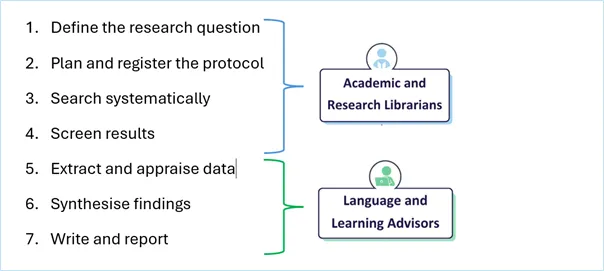
See below who can help you with your systematic review at CDU, and valuable resources to help you in your review writing journey.
Who can help at CDU
Key resources
- CDU’s Guide to Systematic Reviews (LibGuides)
- Book an appointment with an Academic and Research Librarian
- Book an appointment with a Language & Learning Advisor
Over to you
Reflect on what you have learned in this material and consider how you can use it in your own work.
- Revisit the self-analysis quiz at the top of the page. How would you rate your skills now?
- Remember that writing is a process and mistakes aren't a bad thing. They are a normal part of learning and can help you to improve.