News
First Nations ranger knowledge reveals the threats facing NT’s green turtles
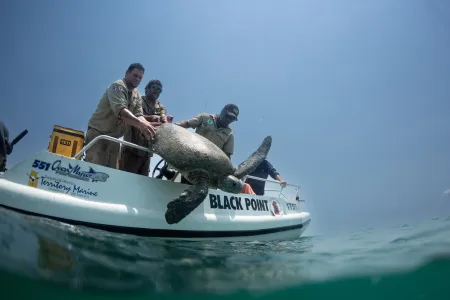
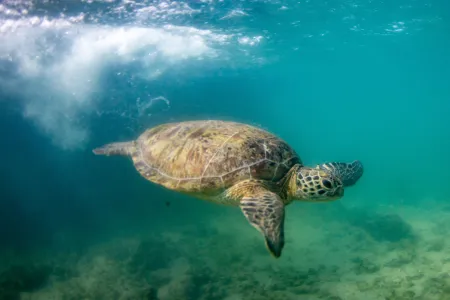
First Nations ranger groups working in protected areas such as national or marine parks identified illegal commercial fishing as a major concern for the Northern Territory’s green turtle populations, a study led by Charles Darwin University (CDU) and James Cook University (JCU) has found.
The study mapped six anthropogenic hazards – climate change, commercial fisheries, industrial development, coastal development, commercial shipping, and nest predation – in the NT’s turtle-occupied areas, with nest predation, rising sea levels, traditional hunting, and industrial pollution identified as posing the highest threats.
Darwin Harbour had the highest concentration of overlapping anthropogenic hazards, including artificial light, recreational vessels, oil and gas infrastructure, commercial shipping and industrial development.
Channel Island had the highest relative risk for foraging turtles.
Lead author Dr Natalie Robson, a recent PhD graduate from the CDU Research Institute for the Environment and Livelihoods (RIEL), said the research stood out from similar studies due to the extensive involvement and insights of eight First Nations ranger groups.
Dr Robson said while threats such as plastic pollution and climate change were expected, insights from the ranger groups brought less obvious issues to light, including illegal commercial fishing.
“Getting that in-person local knowledge of what’s actually happening on the ground is really important in these assessments,” Dr Robson said.
“The ranger groups cited commercial fisherman doing the wrong thing as one of their main concerns, and the places they said these activities were happening were protected areas such as Kakadu and Garig Gunak Barlu.
“Usually, we can model where people’s fishing grounds are, but if their tracking data is turned off when they’re going into marine parks, it won’t be picked up. However, with insight from ranger groups, we’ve been able to find things like prawn trawlers deep inside these parks, which pose a problem.”
Kakadu Country Conservation Manager Alex Tomlinson said it was a great outcome to see the Kakadu rangers – through Parks Australia – support research that will improve understanding and conservation of green turtles.
“Kakadu rangers have a lot of knowledge of Country and the species that live here, and we are proud to share what we’ve learnt and contribute to greater scientific outcomes for the marine environment,” Mr Tomlinson said.
“Green turtles are a valuable part of our marine environment and are also culturally significant to First Nations people. Research like this helps bring together Indigenous knowledge and western science to better understand the threats turtles face and how we can protect them.
“It’s exciting to see the knowledge and experience of Indigenous rangers being recognised as an important part of conservation research. We’re proud of Kakadu’s role in working to protect green turtle populations.”
Dr Robson said the results of her PhD study, including the risk assessment, were available as a dashboard online for rangers and community groups to use.
“This information is really useful for land managers and government entities when planning different projects,” she said.
“It’s a great way for rangers to communicate what their primary concerns are, particularly to higher levels of management who might not be familiar with the complexities for the Territory’s unique context and environment.”
A participatory spatial risk assessment of green turtles (Chelonia mydas) with indigenous rangers in northern Australia was published in Biodiversity and Conservation.
Aligned with the United Nations Sustainable Development Goals
Life below water
Goal 14
Conserve and sustainably use the oceans, seas and marine resources for sustainable development.
Partnerships for the goals
Goal 17
Strengthen the means of implementation and revitalize the Global Partnership for Sustainable Development.
Related Articles
New livestream brings remote Australian arid zone waterhole to the world
A new livestream from a remote waterhole in the Northern Territory is giving people around the world the opportunity to observe wildlife in real time.
Read more about New livestream brings remote Australian arid zone waterhole to the world
Leading scientist recognised for lifetime of dedication to Australian biodiversity and conservation
One of the nation’s most distinguished experts in Australian biodiversity and conservation will be celebrated in an upcoming Charles Darwin University graduation ceremony.
Read more about Leading scientist recognised for lifetime of dedication to Australian biodiversity and conservation
‘Ecological engineers’ an existential threat to wildlife of iconic wetland
A study examining how feral water buffalo interact with landscapes has uncovered how the pest is having disastrous impacts on northern long-necked turtles in the Top End’s tropical wetlands.
Read more about ‘Ecological engineers’ an existential threat to wildlife of iconic wetland


