News
Shell yeah: PhD project gives critical insights into vulnerable species
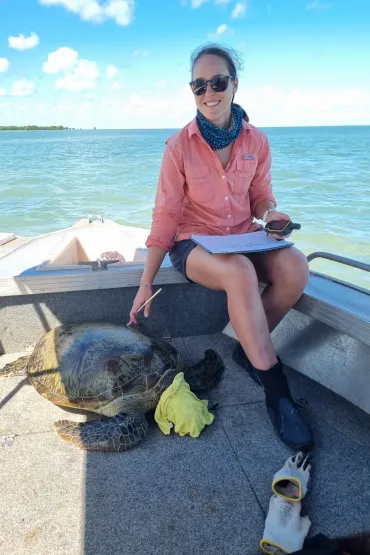
A study into the foraging habits of green turtles in the Northern Territory has used an innovative surveying technique which could become a critical tool in monitoring marine habitats in remote and challenging environments.
Green turtles are listed as a vulnerable species in Australia and are the subject of Natalie Robson’s recently completed PhD with Charles Darwin University’s (CDU) Research Institute for the Environment and Livelihoods (RIEL).
This study aimed to map the foraging habits of green turtles across two areas, Trepang Bay (Garig Gunak Barlu Marine Park) and Field Island (Kakadu National Park), using ground-truthed remote sensing techniques.
Ground-truthing is the process of verifying and gathering real-world data on site to confirm the accuracy of data collected remotely, in this project Sentinel-2 satellite imagery, and was the first time this method was used for mapping subtidal habitats in the Northern Territory.
The result was efficient, accurate and cost-effective monitoring which revealed a diverse array of marine habitats in these areas including coral reefs, algal reefs and seagrass meadows.
Dr Robson said the technique offered unique insights into the foraging habits of these creatures, and filled in significant gaps of knowledge for scientists and Traditional Owners.
“I’d heard rumours that we only had really patchy seagrass out here, and when I got down to it some of the sites had some really beautiful seagrass meadows,” she said.
“We found that turtles aren’t necessarily using those big seagrass areas as much as we would think being herbivores, and that they seem to be feeding on the coral reef sections of those shallow areas. Their diet seems to be quite diverse up here.
“They’ve adapted and are feeding over a broad range of habitats, which is quite different to what’s been found in other areas.”
This paper is one part of the research project, which focused on working in partnership with eight Indigenous ranger groups across the Northern Territory to study how green turtles move, where they feed, and what threats they face, to understand the habitat use and genetics of these creatures.
The result of this effort was the collection of a significant and much-needed baseline of habitat mapping data, which can be found on the national habitat repository Seamap Australia, publications, and the project’s website.
The website features maps and results, distilling the information to be used as a resource for rangers.
Dr Robson said aside from building this database, one of the project’s key outcomes and a highlight was to help build the capacity of marine rangers to conduct habitat mapping and support their knowledge of turtle behaviour with science.
“One of the guys I worked with put it really well and said it was like filling in the pieces of the puzzle,” Dr Robson said.
“They understood these things were important and they were connected, but it was figuring out the why. Science helped to fill those gaps a bit and help those connections.
“A highlight was getting a much deeper understanding of the importance of turtles to Indigenous people, not just through food but culturally as well. Because we did Ranger exchanges, I got to hear a lot of cool stories told from different perspectives and how those were similar or different across the region. I learned so much just from sitting and listening.”
Dr Robson, who has worked with turtles for more than 10 years, said the knowledge gained from this project could be used to provide insights into other species, and for conservation.
“We have biologically important areas for foraging turtles, so I’m hoping to add our data into that, so these areas get assigned as biologically important,” she said
“The rest of the project was looking at all the threats and understanding and what are the threats, how they're impacting the habitats that we have, and then what can we do? What kind of monitoring and ongoing management can be done?”
Marine habitat mapping of green turtle (Chelonia mydas) foraging grounds in the Northern Territory, Australia was published in Marine & Freshwater Research.
Aligned with the United Nations Sustainable Development Goals
Life below water
Goal 14
Conserve and sustainably use the oceans, seas and marine resources for sustainable development.
Partnerships for the goals
Goal 17
Strengthen the means of implementation and revitalize the Global Partnership for Sustainable Development.
Related Articles
Federal funding for Country-based health and climate resilience
A new research collaboration to support and strengthen Country-based health and climate resilience has received funding through the National Health and Medical Research Council’s Centres of Research Excellence scheme.
Read more about Federal funding for Country-based health and climate resilience
New livestream brings remote Australian arid zone waterhole to the world
A new livestream from a remote waterhole in the Northern Territory is giving people around the world the opportunity to observe wildlife in real time.
Read more about New livestream brings remote Australian arid zone waterhole to the world
Leading scientist recognised for lifetime of dedication to Australian biodiversity and conservation
One of the nation’s most distinguished experts in Australian biodiversity and conservation will be celebrated in an upcoming Charles Darwin University graduation ceremony.
Read more about Leading scientist recognised for lifetime of dedication to Australian biodiversity and conservation


