News
Conservation starts in your own backyard when it comes to protecting Australia's biodiversity
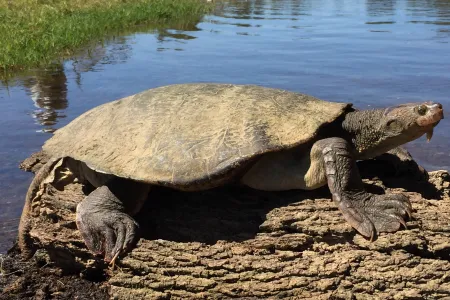
Knowledge about where and why vulnerable species choose habitats to live is vital when driving and supporting community conservation, a Charles Darwin University (CDU) expert says.
CDU’s Research Lecturer Dr Mariana Campbell showed just how vital community engagement was in a study of one of Australia’s most vulnerable turtles, the Mary River turtle (Elusor macrurus).
“Tiaro and District Landcare Group protected over 630 turtle nests from predation against native and introduced predators, such as dogs, foxes, goannas, and pigs,” Dr Campbell said.
“They have also worked towards habitat restoration and head-starting juvenile turtles to a size that might be strong enough to survive in the river and continue investigating in-stream causes of turtle mortality.
“The long-term collaboration between community and academia has ensured research findings were incorporated into local water resource planning, infrastructure projects, and economic development.
“There has also been increased awareness of the turtle and its plight,” she said.
More than 100 community members were involved in the turtle conservation program, with the initiative involving generating funds, assisting with nest protection, improving ecological knowledge, and increasing community awareness.
The community members have assisted scientists in monitoring, as well as gaining experience and knowledge in identifying turtle species, handling turtles, taking scientific measurements, downloading data and tracking animals.
“The collaboration between the local community and scientists to undertake conservation-driven research has transferred knowledge and skills that will likely have implications beyond turtle management,” Dr Campbell said.
“The researchers have benefited by having continuous on-ground support, local advice, and a small but stable funding revenue over many years.”
While there are a few success stories, most species do not recover enough to be taken off the vulnerable, endangered, and critically endangered lists.
“Government spending for protecting and recovering threatened species is not enough without community involvement,” Dr Campbell said.
“Our local communities play such an important role in conservation. The level of participation seems ever more critical to many threatened species' survival, and community-scientist collaborations are being recognised as essential drivers of conservation success.”
Dr Campbell has spent the last 15 years working with the local community around the Mary River catchment area to save the local turtle.
The Mary River catchment is on the northern fringe of the southeast Queensland region and the Mary River turtle is one of six freshwater species that inhabit this area.
Australia has diverse freshwater turtle fauna; however, almost half of Australia’s freshwater turtles are listed as vulnerable or worse.
This rate is concerning because freshwater turtles are considered important to the overall health of freshwater ecosystems as well as playing a significant cultural role for First Nations people.
Dr Campbell said many other community-researcher collaborative conservation projects across Australia are aiding the conservation of freshwater turtles.
“The 1 Million Turtles is a national community conservation citizen science program aimed at increasing the survival rates of freshwater turtles. They do a fantastic job increasing knowledge of freshwater turtle distributions across Australia,” Dr Campbell said.
“Also, the Turtles Forever program looks at the conservation of the Bell's turtle in NSW.”
“Community groups are a key part of the conservation of threatened species across Australia, and the Mary River turtle research shows a small evidence of its potential.”
Related Articles
Federal funding for Country-based health and climate resilience
A new research collaboration to support and strengthen Country-based health and climate resilience has received funding through the National Health and Medical Research Council’s Centres of Research Excellence scheme.
Read more about Federal funding for Country-based health and climate resilience
New livestream brings remote Australian arid zone waterhole to the world
A new livestream from a remote waterhole in the Northern Territory is giving people around the world the opportunity to observe wildlife in real time.
Read more about New livestream brings remote Australian arid zone waterhole to the world
Leading scientist recognised for lifetime of dedication to Australian biodiversity and conservation
One of the nation’s most distinguished experts in Australian biodiversity and conservation will be celebrated in an upcoming Charles Darwin University graduation ceremony.
Read more about Leading scientist recognised for lifetime of dedication to Australian biodiversity and conservation


