Origin of salties caught in Darwin Harbour revealed
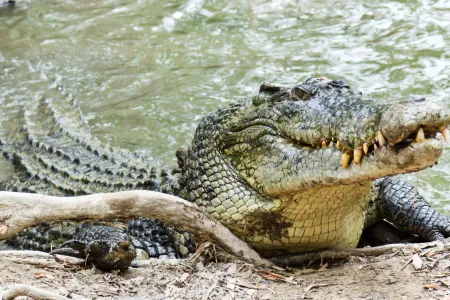
Problem saltwater crocodiles are typically travelling between 100km and 200km to Darwin Harbour potentially in search of new resources or territories, according to a new study on the migration of the reptiles.
The researchers used a crocodile DNA database that they developed by collecting saltwater crocodile tissue samples from across northern Australia and Southeast Asia from between 1997 and 2022.
CDU Research Institute for the Environment and Livelihoods Director and one of the study’s authors Professor Sam Banks described this as a ‘genetic reference map’ to identify the origins of problem crocodiles captured in Darwin or elsewhere.
“This gives us a crocodile equivalent of the ancestry testing that people can pay for to find out the history of their own DNA, except that it allows us to work out with quite high accuracy where a crocodile was born right across Australia and Southeast Asia,” Professor Banks said.
"It's really exciting to have crocodiles at the forefront of DNA technology for wildlife management. This is a resource that we can use into the future to help with better monitoring and management of crocodiles in the NT, across northern Australia and overseas.”
Typically, more than 250 crocodiles per year are captured in Darwin Harbour. Most are immature males between 150cm and 180cm.
The results showed that Darwin Harbour crocodiles almost exclusively come from within the Northern Territory and most of these came from the region encompassing the Adelaide River, Mary River, and Kakadu.
NT Government Department of Environment, Parks and Water Security wildlife scientist and lead author Yusuke Fukuda said that most crocodiles captured in Darwin Harbour had travelled between 100km and 200 km while a few travelled up to 700 km.
While most of them came from the Adelaide River, Mary River and Kakadu National Park rivers, which have prime breeding habitat for saltwater crocodiles, about 20 to 30 per cent of crocodiles caught were from the Daly, Finniss and Reynolds rivers region.
The Tiwi Islands had the third largest source - about 15 to 20 per cent - of crocodiles caught in Darwin Harbour.
“One of the reasons we did the study was that it might tell us whether there are other ways of managing the problems caused by crocodiles migrating to Darwin Harbour,” Mr Fukuda said.
“For instance, if crocodiles were only coming to Darwin from a small number of catchments close to Darwin, we could target management (e.g. egg collection) to those places to reduce the number of young crocodiles moving along the coast to look for a home. However, the results reinforce the need for management in Darwin Harbour rather than targeting source populations of problem crocodiles, as they can reach Darwin from a long way away. ”
The study was conducted by the NT Department of Environment, Parks and Water Security, Charles Darwin University, the Australian National University, Griffith University, Namchul Photography, Wildlife Management International, Parks Australia and the WA Department of Biodiversity, Conservation and Attractions.
Natal origin and dispersal of problem saltwater crocodiles in the Darwin Harbor, Australia was published in The Journal of Wildlife Management.
Related Articles
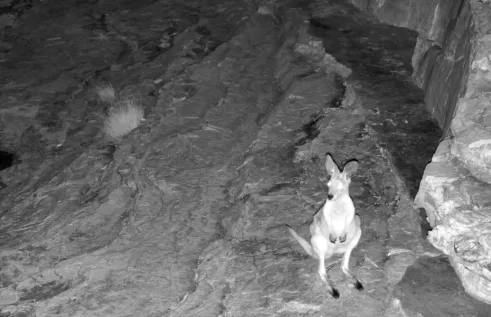
New livestream brings remote Australian arid zone waterhole to the world
A new livestream from a remote waterhole in the Northern Territory is giving people around the world the opportunity to observe wildlife in real time.
Read more about New livestream brings remote Australian arid zone waterhole to the world
Leading scientist recognised for lifetime of dedication to Australian biodiversity and conservation
One of the nation’s most distinguished experts in Australian biodiversity and conservation will be celebrated in an upcoming Charles Darwin University graduation ceremony.
Read more about Leading scientist recognised for lifetime of dedication to Australian biodiversity and conservation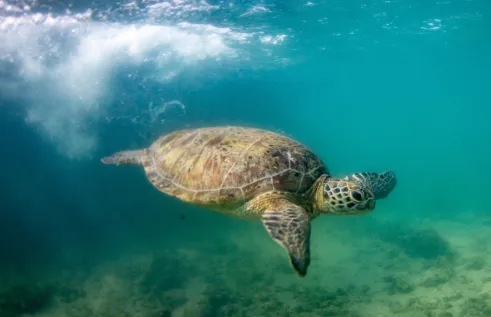
First Nations ranger knowledge reveals the threats facing NT’s green turtles
First Nations ranger groups working in protected areas such as national or marine parks identified illegal commercial fishing as a major concern for the Northern Territory’s green turtle populations, a study led by Charles Darwin University (CDU) and James Cook University (JCU) has found.
Read more about First Nations ranger knowledge reveals the threats facing NT’s green turtles


