News
Rangers trial drones to track rare rock-wallaby
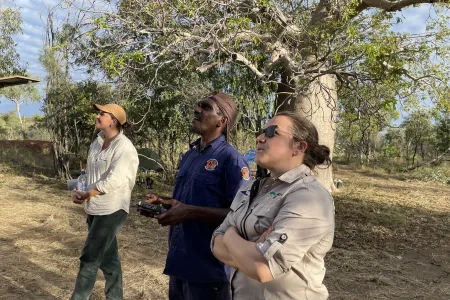
First Nations rangers are trialling thermal imaging drones to track one of Australia’s rarest and most secretive wallaby species in the Kimberley region of Western Australia.
The endangered black-footed rock-wallaby, or wiliji as it is known by Traditional Owners in the area, is a small and extremely agile animal that darts among rocky outcrops and caves, making it challenging to find and track.
A population once thought to be more than 2,500 strong has plummeted to an estimated 500 due to the impact of introduced predators and indiscriminate wildfires.
The Nyikina Mangala Rangers have been successfully monitoring the elusive wallabies using sensor cameras since 2013. However, it takes months to process imagery and model data as cameras are retrieved weeks after deployment.
A partnership between Walalakoo Aboriginal Corporation (WAC), Charles Darwin University (CDU), and the World Wide Fund for Nature-Australia (WWF-Australia) is seeking to solve this problem using a combination of traditional knowledge and cutting edge technology.
Rangers and researchers are seeing if multirotor drones can provide a more timely and cost-efficient method to capture population data. It is the first time drones have been used to monitor wiliji.
CDU researchers have provided drone training to Nyikina Mangala Rangers like William Watson so they can continue to conduct surveys.
“We’ve been handpicked to represent our tribe and protect our Country, which means we need to work together with modern-day science now. We’re here to do a job for our old people and our young people,” Mr Watson said.
“Modern science and traditional techniques work hand-in-hand to get a better outcome.”
Contracted by WAC, postdoctoral research fellow at CDU’s Research Institute for the Environment and Livelihoods (RIEL), Rebecca Rogers has been on field trips with a CDU Bachelor of Environmental Science student Aliesha Hvala to the Erskine Range near Broome to gather drone data.
“We want to find out how many black-footed rock-wallabies are in the area, where they go and what other animals they might be interacting with,” Ms Rogers said.
Ms Rogers said in initial trials, the thermal camera installed on the drones was able to detect the heat signature of the wallabies and could cover a large area in a short period of time.
“We were also able to detect feral cats on the plateau, which are a potential threat to this species,” she said.
“We hope this information will help rangers to better manage predator populations and protect the black-footed rock-wallaby from the threat of extinction.”
WWF-Australia’s WA Species Conservation Manager Dr Leigh-Ann Woolley said it is vital to understand this culturally important species so rangers can monitor population response to any management interventions they apply, such as fire and feral cat management.
“The thermal imaging drones could be a game-changer,” Dr Leigh-Ann Woolley said.
“They allow us to monitor the wiliji when they leave their rocky outcrops and caves at night. And if the drone survey method proves to be accurate and reliable, it has the potential to be applied to other rock-wallaby populations across Australia.”
Related Articles
Federal funding for Country-based health and climate resilience
A new research collaboration to support and strengthen Country-based health and climate resilience has received funding through the National Health and Medical Research Council’s Centres of Research Excellence scheme.
Read more about Federal funding for Country-based health and climate resilience
New livestream brings remote Australian arid zone waterhole to the world
A new livestream from a remote waterhole in the Northern Territory is giving people around the world the opportunity to observe wildlife in real time.
Read more about New livestream brings remote Australian arid zone waterhole to the world
Leading scientist recognised for lifetime of dedication to Australian biodiversity and conservation
One of the nation’s most distinguished experts in Australian biodiversity and conservation will be celebrated in an upcoming Charles Darwin University graduation ceremony.
Read more about Leading scientist recognised for lifetime of dedication to Australian biodiversity and conservation


