news article
Research focuses on East Point rainforest rehabilitation
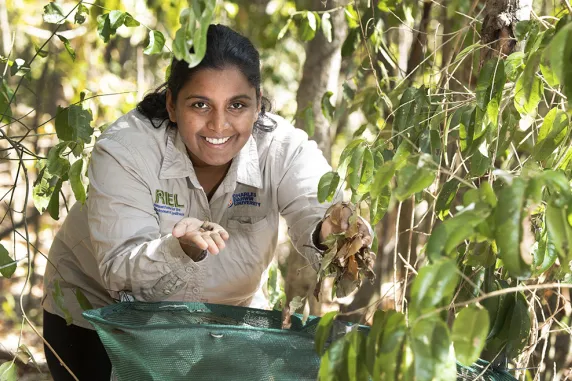
The rehabilitation of dry seasonal rainforest at East Point Reserve in Darwin, which was devastated during World War II and Cyclone Tracy, has been the focus of research by a Charles Darwin University PhD graduand.
Dr Vidushi Thusithana, who will receive a PhD at CDU’s virtual graduation ceremony this Friday, explored how the reserve has recovered since rehabilitation began on the area in 1975.
“My research aimed to understand the regeneration ecology of the native species that belong in the dry rainforest,” Dr Thusithana said.
“Initially East Point was entirely covered by this type of rainforest, but it was disturbed by construction activities during World War II and by Cyclone Tracy.”
She said that rehabilitation began in 1975, with species planted based on the availability of seeds and plants from local nurseries.
“This meant species belonging to the remnant rainforest of the area were underrepresented,” she said.
“There were further stages of rehabilitation in areas of the rainforest in the 1980s and ’90s, and in the mid-2000s.
Dr Thusithana discovered that while most of the species planted as part of the rehabilitation were native to the Northern Territory, they were not native to the East Point rainforest area.
“I wanted to find out if the species that belonged to the remnant rainforest would regenerate in the rehabilitated forest and if it would resemble the old forest, or if it would turn into a different type of forest,” Dr Thusithana said.
“I studied the regeneration and wanted to know if the seeds of the native species were getting dispersed to the rehabilitation sites and if the other native species were growing among the planted species.”
Dr Thusithana’s study concluded that the rainforest canopy of the oldest rehabilitated patch was dominated by the planted species.
“But the seedlings of the native species belonging to the remnant rainforest were also popping up at the oldest rehabilitated site, so in around 20-40 years’ time we will see a rainforest featuring species belonging to the remnant rainforest as well as the planted species," she said.
Find out more about CDU's higher degree by research and scholarship opportunities here.
Related Articles

Federal funding for Country-based health and climate resilience
A new research collaboration to support and strengthen Country-based health and climate resilience has received funding through the National Health and Medical Research Council’s Centres of Research Excellence scheme.
Read more about Federal funding for Country-based health and climate resilience
New livestream brings remote Australian arid zone waterhole to the world
A new livestream from a remote waterhole in the Northern Territory is giving people around the world the opportunity to observe wildlife in real time.
Read more about New livestream brings remote Australian arid zone waterhole to the world
How ants are cashing in on the fight against money laundering
An AI model inspired by ants, bees, and birds could be the key to cracking down on blockchain-based money laundering, new research led by Charles Darwin University (CDU) has found.
Read more about How ants are cashing in on the fight against money laundering


