AI could free up time to solve the world’s problems
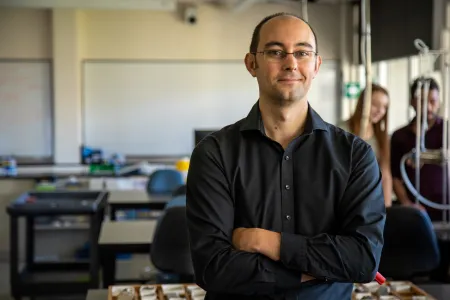
A Charles Darwin University (CDU) water expert who uses ChatGPT to analyse hydrological data in a fraction of time says Artificial Intelligence (AI) could allow researchers to dedicate more time to the world’s most pressing problems.
CDU groundwater hydrology expert Dr Dylan Irvine, alongside Dr Landon Halloran and Dr Philip Brunner from the University of Neuchâtel in Switzerland, have discussed the opportunities and limitations from using new capabilities of ChatGPT for hydrological analyses in a recently published paper.
The paper explores the results of using ChatGPT to translate between coding languages, plot data, generate codes and analyse data in a hydrological science setting.
The authors found people with limited or no coding ability can conduct data assessments with ChatGPT in either the free version, or with the Advanced Data Analysis plugin in the paid version, and time could also be saved through the speed at which ChatGPT can analyse data.
Other benefits include the ability for ChatGPT to suggest data analysis options, summarise academic papers and reports, troubleshoot and debug code, and generate, edit and test code.
The authors found while the benefits were numerous, users needed to check the accuracy of results and tweaks prompts because ChatGPT is prone to errors.
Dr Irvine, who began experimenting with AI tools to analyse data, said integrating AI into his processes has become a significant asset to his work.
“Computer codes that used to take me days to write can now be written in an hour or less. Solving problems and overcoming issues is much quicker now,” Dr Irvine said.
“It used to be that if I wanted to lean a new technique, such as something in machine learning, I'd often have to spend a long time reading, and trawling the web for examples. Often there was one part that was hard to set up and without it, the entire code doesn't work.
“Now, fixing errors or learning new approaches is much easier. I'm expanding my skillset into adjacent disciplines. I'm a groundwater researcher by training but I can now do a lot more surface water-related work.”
Dr Irvine said carefully and appropriately incorporating AI to automate low-level tasks could have a positive impact on the hydrological sciences by freeing up time to focus on complex problems common in the field.
“I'm an earth and environmental scientist. It's amazing to get to study how the world works, and the work that we do is as important now as ever,” Dr Irvine said.
“However, we struggle to convince students to study earth science, and/or water resources. This shortage basically means that there's more work to do than we have capacity for. Automating basic tasks using AI can free up time so that we can focus on more challenging tasks.”
‘Opportunities and limitations of the ChatGPT Advanced Data Analysis plugin for hydrological analyses’ was published in Hydrological Processes.
Related Articles
New livestream brings remote Australian arid zone waterhole to the world
A new livestream from a remote waterhole in the Northern Territory is giving people around the world the opportunity to observe wildlife in real time.
Read more about New livestream brings remote Australian arid zone waterhole to the world
Leading scientist recognised for lifetime of dedication to Australian biodiversity and conservation
One of the nation’s most distinguished experts in Australian biodiversity and conservation will be celebrated in an upcoming Charles Darwin University graduation ceremony.
Read more about Leading scientist recognised for lifetime of dedication to Australian biodiversity and conservation
First Nations ranger knowledge reveals the threats facing NT’s green turtles
First Nations ranger groups working in protected areas such as national or marine parks identified illegal commercial fishing as a major concern for the Northern Territory’s green turtle populations, a study led by Charles Darwin University (CDU) and James Cook University (JCU) has found.
Read more about First Nations ranger knowledge reveals the threats facing NT’s green turtles


