News
AIMS@CDU to strengthen and support the Territory’s marine science research community
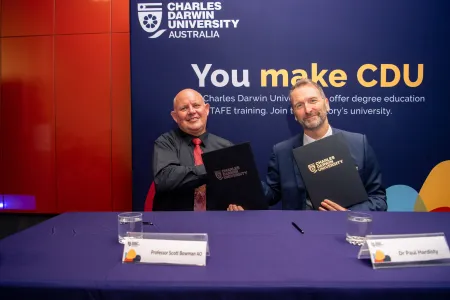
A new agreement between Charles Darwin University (CDU) and the Australian Institute of Marine Science (AIMS) will boost the Northern Territory’s marine science research capabilities.
The AIMS@CDU Partnership agreement co-signed today by CDU’s Vice-Chancellor Professor Scott Bowman and AIMS CEO Dr Paul Hardisty formalises an alliance between CDU and AIMS with the purpose of undertaking a range of joint ventures that will benefit the marine science research community.
Professor Bowman said the alliance would bring together skilled researchers from both organisations to strongly benefit the Territory’s marine science community.
“This agreement will help form a strong bond between our two organisations and help us to conduct much needed marine science research here in the Territory,” he said.
“At CDU we are committed to working with like-minded organisations and we look forward to collaborating in a greater capacity with our colleagues at AIMS.”
The alliance called AIMS@CDU will leverage the co-location of CDU and AIMS marine researchers and will enable the organisations to undertake joint tasks such as research projects, funding applications, appointments, post-doctoral research fellowships and supervision of HDR Students.
Through the agreement, researchers located at either organisation will also be eligible to be awarded Adjunct status at the other organisation.
Dr Hardisty said the partnership would strengthen marine science in the Top End.
“This new alliance shows our commitment to building the marine science talent pipeline in the Northern Territory. We already have strong ties with Charles Darwin University and this partnership will further extend our capacity and capabilities to research in this unique region,” Dr Hardisty said.
“The waters of the Top End are among the most biodiverse in the world and culturally significant. But there remain significant knowledge gaps about the oceans in this incredible part of the world, which this partnership will address to aid the protection and management of the marine estate in northern Australia.”
CDU’s Pro Vice-Chancellor Research and Innovation Steve Rogers said the alliance would see key research conducted in a variety of marine science fields.
“This exciting partnership will help to enhance CDU’s existing research capabilities and put a much-needed focus on marine science here in Northern Australia,” Professor Rogers said.
“Through this partnership CDU and AIMS will be able to conduct research into sustainable Northern Tropical marine management including biodiversity, fisheries, blue carbon, with a key focus on engagement with First Nations peoples and traditional custodians.”
AIMS, Australia’s tropical marine research agency, plays a pivotal role in providing large-scale and long-term research to help governments, industry and the wider community make informed decisions about the management of Australia’s tropical marine estate.
Related Articles
Federal funding for Country-based health and climate resilience
A new research collaboration to support and strengthen Country-based health and climate resilience has received funding through the National Health and Medical Research Council’s Centres of Research Excellence scheme.
Read more about Federal funding for Country-based health and climate resilience
New livestream brings remote Australian arid zone waterhole to the world
A new livestream from a remote waterhole in the Northern Territory is giving people around the world the opportunity to observe wildlife in real time.
Read more about New livestream brings remote Australian arid zone waterhole to the world
Leading scientist recognised for lifetime of dedication to Australian biodiversity and conservation
One of the nation’s most distinguished experts in Australian biodiversity and conservation will be celebrated in an upcoming Charles Darwin University graduation ceremony.
Read more about Leading scientist recognised for lifetime of dedication to Australian biodiversity and conservation


