News
CDU researcher makes ABC Top 5 Science
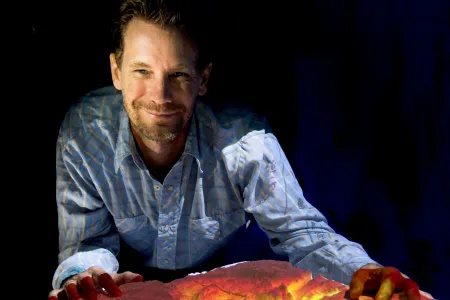
A Charles Darwin University (CDU) researcher is one of only five academics across Australia to be chosen to attend this year’s prestigious ABC Top 5 Science media residency.
CDU’s Northern Institute Researcher, Dr Rohan Fisher has been chosen to attend the two-week media residency facilitated by ABC RN, which will see him spend time alongside the country’s best specialist journalists and broadcasters.
Throughout the program, Dr Fisher will have the opportunity to gain hands-on learning and engage with teams across ABC radio, TV, digital and social media.
Dr Fisher said attending the residency will help to develop his professional skills and further his work.
“I applied not expecting to be selected so I was excited to learn that I would be attending this program,” Dr Fisher said.
“I am looking forward to gaining a better understanding of the way media works to help build my skills and capacity in this area to better promote my research in the future.”
“This residency will assist me in making better connections so that I can get more traction when engaging with significant organisations about the work that I am doing.”
Dr Fisher’s research work is focused on using technology to support knowledge exchange in the complex cross-cultural landscape of remote Australia.
His interests involve working with Indigenous Land Managers in the remote Northern Territory to use satellite data to help develop fire management practices.
Inspired by this work, Dr Fisher has developed Projection Augmented Landscape Models (PALM) that use environmental modelling, cultural mapping and simulations of landscape processes projected onto 3D-printed landscapes.
He has used this hybrid digital-tactile landscape visualisation technology around the world for a broad range of applications.
This includes fire management, climate change adaptation and, most recently, to support areas of mine site rehabilitation where it has facilitated the clear articulation of mine closure processes.
“I am exploring new ways of communicating science to create shared knowledge,” Dr Fisher said.
“Science generally prioritises the creation of data and information, but rarely does it strive to create knowledge and a shared understanding beyond those within a community of experts, so my work is trying to change this.”
Director of the Northern Institute Professor Kim Humphery congratulated Dr Fisher on this achievement saying it is a wonderful opportunity to learn more about the media and how it can assist in promoting research.
“I want to congratulate Rohan on being chosen to attend this highly respected media residency. It is wonderful to see one of CDU’s researchers being recognised in this way,” Professor Humphry said.
“Media is a very powerful tool in helping to promote the wonderful work we do at CDU, and we look forward to hearing from Rohan about what he learns and how this can help him to further the practical and public impact of his work.”
The media residency will run from September 4 to September 15 with attendees spending a week at ABC’s Sydney offices before undertaking a further week of online training.
See here for more information on Dr Fisher’s work and more information on the ABC Top 5 Science media residency can be found here.
Related Articles
Federal funding for Country-based health and climate resilience
A new research collaboration to support and strengthen Country-based health and climate resilience has received funding through the National Health and Medical Research Council’s Centres of Research Excellence scheme.
Read more about Federal funding for Country-based health and climate resilience
New livestream brings remote Australian arid zone waterhole to the world
A new livestream from a remote waterhole in the Northern Territory is giving people around the world the opportunity to observe wildlife in real time.
Read more about New livestream brings remote Australian arid zone waterhole to the world
How ants are cashing in on the fight against money laundering
An AI model inspired by ants, bees, and birds could be the key to cracking down on blockchain-based money laundering, new research led by Charles Darwin University (CDU) has found.
Read more about How ants are cashing in on the fight against money laundering


