Opinion
Expert alert: What eight new emergency response drones mean for the NT
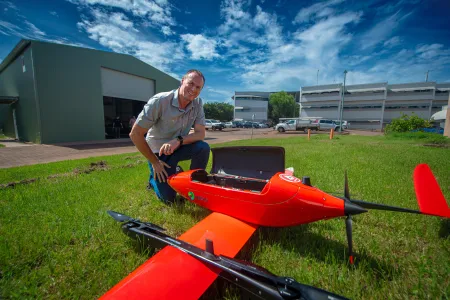
Expert: Charles Darwin University's (CDU) North Australian Centre for Autonomous Systems (NACAS) Director Professor Hamish Campbell.
Topics:
- Considerations for getting the most out of the NT Government’s new $650,000 drone fleet in emergency scenarios
- The challenges of using drones in emergency response management
- How UAVs have been used successfully in other jurisdictions
“The Northern Territory Government's investment in a new drone fleet is great news, as uncrewed aerial vehicles (UAV) have been demonstrated to improve situational awareness and disaster response around the world. However, there is a big difference between owning the technology and running effective unmanned aerial operations.
"NT Fire and Emergency Service (NTFES) will need to invest not only in the aircraft themselves, but also in the capability required to use them safely and consistently in real incident environments. That includes training for pilots and operators, as well as incident management processes, maintenance and safety management, and the standard operating procedures needed to integrate UAV outputs into operational decision-making.
"It also requires solving regulatory and compliance challenges, including approvals, operating boundaries, documentation, and risk management frameworks that can be relied on during deployments. Just as importantly, there is an analytical challenge: collecting data is only useful if it can be processed, interpreted, and delivered in a form that commanders and responders can act on quickly and confidently.
"New South Wales Fire and Rescue has been very successful in its adoption of UAVs by partnering with organisations that can conduct flights in operational environments and by establishing research pathways with universities to develop sensors and data analytics. I hope that NTFES will pursue a similar approach, including clear investment in training, regulatory readiness, and the analytical capability needed to turn UAV data into operational outcomes, rather than treating UAV use purely as a technology acquisition exercise."
Disclaimer: This is an opinion piece. The views and ideas discussed in this story are solely those of the author and it is not the position of the University. CDU is a university the nurtures the sharing and debating of ideas and issues for a better world.
Related Articles

Indigenous land management practices can deliver improved conservation outcomes, study notes
Indigenous fire management in Australia sets one of the best practice examples globally of how traditional methods can protect the fire-prone environments, and this inclusive approach should be prioritised in modern conservation, according to research led by Charles Darwin University.
Read more about Indigenous land management practices can deliver improved conservation outcomes, study notes
Study tracks Rum Jungle Mine’s metal legacy through Finniss River food web
The environmental legacy of a uranium-copper mine continues to impact the ecosystem of a major Top End river system more than 50 years since the site was closed, a first-of-its-kind study led by Charles Darwin University (CDU) has found.
Read more about Study tracks Rum Jungle Mine’s metal legacy through Finniss River food web
Federal funding for Country-based health and climate resilience
A new research collaboration to support and strengthen Country-based health and climate resilience has received funding through the National Health and Medical Research Council’s Centres of Research Excellence scheme.
Read more about Federal funding for Country-based health and climate resilience


