News
Mudbricks hold strong potential to combat pervasive housing issues in remote NT communities
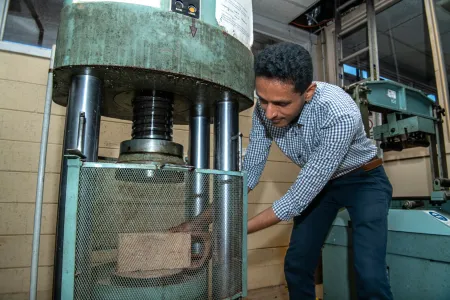
Research from Charles Darwin University (CDU) has identified a way to improve the structural integrity of mudbricks, with the potential for expanded use across remote NT communities to help address housing issues.
Overcrowding, poor housing conditions and a severe housing shortage impact existing infrastructure within some remote communities, and there is a need to train local tradesmen and source sustainable construction materials to reduce building costs.
Charles Darwin University (CDU) researcher Vick Sumanasena provided a stepping stone for increasing the use of mudbricks across the NT, as a durable and locally-resourced construction material which could ease some housing issues for remote communities.
“Mudbricks are already being produced in civil works by Bawinanga Aboriginal Corporation in Maningrida, and it’s supporting local incomes, practical skills and use of natural resources,” Mr Sumanasena said.
“By testing compressive strength and erosion resistance of mudbricks made of laterite soil, the most abundant soil we have here, we found there’s potential to extend the use of mudbricks in future remote housing.”
“If we also add a little cement, they could hold strong against a range of harsh weather conditions.”
While blockwork is the common construction practice used to build remote housing, mudbricks are less expensive, easier to make on-site and increase community engagement by providing local jobs.
CDU Engineering Lecturer Dr Ali Rajabipour and Dr Cat Kutay from the College of Engineering, IT and Environment supervised Mr Sumanasena’s study.
Dr Rajabipour said the research was part of a broader study being done at CDU, with several students currently running experimental studies on mudbrick.
“Our research on mudbrick stems from our view on working with communities, not for them. We share our views through our publications and technical events and would love to receive feedback from the community.”
CDU College of Engineering, IT and Environment Dean, Professor David Young, said the research reflects CDU’s commitment to collaborating with First Nations communities.
“Constructing sustainable and structurally-sound houses in remote NT communities is an ongoing engineering challenge, and one that CDU is pursuing diligently with great research capabilities.”
“It will be exciting to see CDU research outputs create beneficial housing outcomes for communities across the Territory.”
The paper was published in Case Studies in Construction Journal.
Related Articles
Federal funding for Country-based health and climate resilience
A new research collaboration to support and strengthen Country-based health and climate resilience has received funding through the National Health and Medical Research Council’s Centres of Research Excellence scheme.
Read more about Federal funding for Country-based health and climate resilience
New livestream brings remote Australian arid zone waterhole to the world
A new livestream from a remote waterhole in the Northern Territory is giving people around the world the opportunity to observe wildlife in real time.
Read more about New livestream brings remote Australian arid zone waterhole to the world
Leading scientist recognised for lifetime of dedication to Australian biodiversity and conservation
One of the nation’s most distinguished experts in Australian biodiversity and conservation will be celebrated in an upcoming Charles Darwin University graduation ceremony.
Read more about Leading scientist recognised for lifetime of dedication to Australian biodiversity and conservation


