Northern Institute
'They couldn't break me': Don McLeod, champion for Aboriginal justice in the Pilbara
| Presenter | Dr Jan Richardson | |
|---|---|---|
| Date/Time |
to
|
|
| Contact person |
Northern Institute
|
|
| Location |
Level 2, Library & Archives Northern Territory Danala | Education and Community Precinct 54 Cavenagh Street, Darwin City, NT 0800 |
|
| Open to | Public | |
About the Seminar:
From my perspective, the word that best describes the pastoral workers’ extraordinary strike and their desire for adult literacy is Independence - Jan Richardson
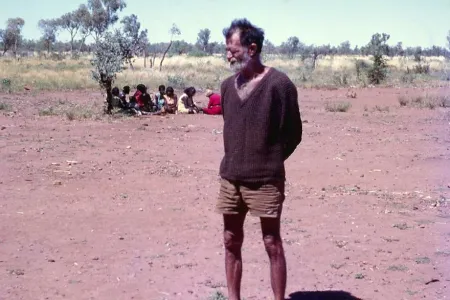
Join us for a powerful presentation on the life of Don McLeod, a white man and a miner who became a key ally to Aboriginal pastoral workers in Western Australia’s Pilbara region. In the 1940s, McLeod encouraged and supported nearly 800 Aboriginal workers to undertake what became Australia’s longest industrial strike (1946–1949), led by senior Lawmen from coastal and desert tribes.
McLeod went on to live and work alongside the strikers, helping them establish alluvial mining operations, gain economic independence, purchase their own station, and build culturally grounded schools, health services, and housing. He lived with the community until he died in 1999.
The seminar will be presented by Dr Jan Richardson, who, together with her late husband Stan Davey, worked with Don McLeod and the Nyangumarta people in 1969. Their later community development work across the Kimberley informed Jan’s PhD research and now she will publish his biography this year.
About the Presenter:
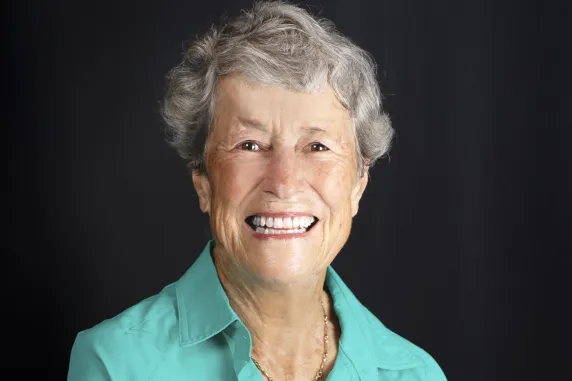
Jan Richardson is a retired CDU lecturer and University Fellow, Faculty of Arts and Society. Practising community development philosophy, she has lived and worked for 15 years with Indigenous communities in remote areas of Western Australia’s Pilbara and Kimberley regions and in the NT. To theorise this work, she completed research master’s thesis at NTU on the Indigenous women’s work to establish family support systems, 1975-1980, and her role as collaborator. To examine some activists’ work and its effects, she completed a PhD at CDU researching community transformation strategies in the Kimberley, 1975-1980. Focusing on the role of activists, she undertook a PhD at Monash University researching the life of Don McLeod
She is now about to publish the biography of Don McLeod and is researching and writing a biography of Stan Davey, co-founder of the Victorian Aborigines Advancement League, and co-founder and General Secretary of FCAATSI (Federal Council for the Advancement of Aborigines and Torres Strait Islanders), for which he worked for over ten years in each organisation.
Behind the Camera:
While working in the Pilbara, Jan had the opportunity to record many of the stories of the workers and Don McLeod in the form of photographs. Here are just some of the many stories she had to share.
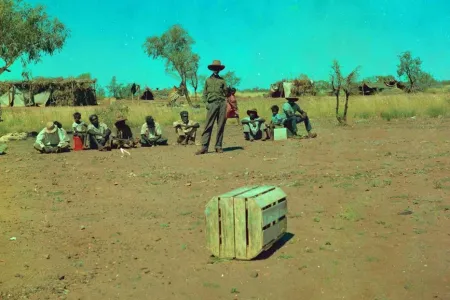
A striker stands to present his point of view at a camp meeting held on Country carefully prepared for the occasion. The gathering takes place in a wide-open space within the work camp, large enough for women and men to sit separately in accordance with custom, yet close enough for all to hear each speaker. Brush huts surround the meeting ground, offering protection from the harsh daytime sun and the cold desert nights. Boys have cleared the area of sharp stones and scrub, sweeping the ground smooth, while a simple wooden crate marks the centre of the gender divided circle. One by one, speakers rise to share their views. When all who wish to speak have spoken, the meeting disperses, and the Top Committee withdraws to deliberate. From these discussions comes the decision to pursue literacy classes across the three mining camps, recognising that the ability to read and write English is inseparable from independence, self determination, and freedom from reliance on others for power.
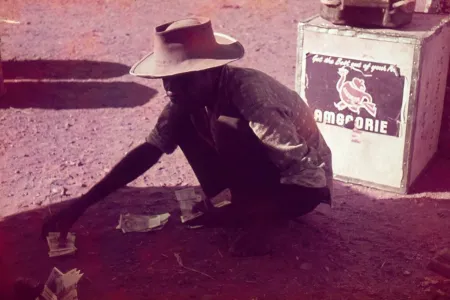
In June 1969, a formal meeting was convened at the strikers’ headquarters mining camp at Wodgina, about 113 kilometres from Port Hedland. The occasion was to decide whether the strikers would allow Stan Davey and Jan Richardson to join them and live and work among their community. Although many people already knew Stan from earlier visits, this was a serious and ceremonial gathering where every viewpoint had to be openly expressed and heard before a decision could be reached by consensus.
The people sat on the ground in family groups, separated by gender according to custom. The leader opened the proceedings, then asked Don McLeod to speak. McLeod introduced Stan and Jan, explaining to the gathering how he believed they could be of use to the strikers. The leader then invited Stan to address the meeting himself, asking him to explain his reasons for wanting to live with and work for the strikers, before deliberations would later be taken up by the Top Committee, the Lawmen.
This seminar is presented in partnership between the Northern Institute and Library & Archives NT.
Registration for the event:
In-person: RSVP here
Please RSVP here to attend in person—limited seating.
Online registration: Register here
Once you register, you will receive an individual link from Zoom no-reply@zoom.us
Getting there:
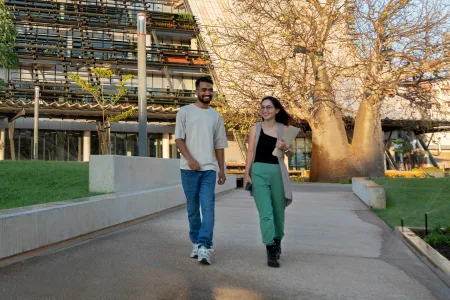
Level 2, Library & Archives Northern Territory
Danala | Education and Community Precinct
54 Cavenagh Street, Darwin City, NT 0800
Related Events
Deadly Research
Celebrating NAIDOC Week, the Northern Institute proudly presents ‘Deadly Research’, in collaboration with the Library and Archives NT. Honouring this year's National NAIDOC Week theme, ‘50 Years of Deadly’, this special event shines a spotlight on the incredible contributions of First Nations academics.
Read more about Deadly Research
The Dr Bilawara Lee OAM (Aunty B), Faculty of Health Public Lecture
Bernard Salt explores how the aging baby boomer generation and a post-pandemic shift toward wellness will drive unprecedented demand and consumer expectations within Australia’s healthcare sector and "care economy" through 2036.
Read more about The Dr Bilawara Lee OAM (Aunty B), Faculty of Health Public Lecture
Freedom of Political Communication and Social Cohesion
The 15th Austin Asche Oration features The Hon. Justice Marcus Solomon SC, who will examine how debates surrounding free speech, rising prejudice, and declining social cohesion are reshaping Australia's legal and political landscapes.
Read more about Freedom of Political Communication and Social Cohesion


