News
Researcher investigating the barriers and low numbers of First Nations women working in mining in the Territory
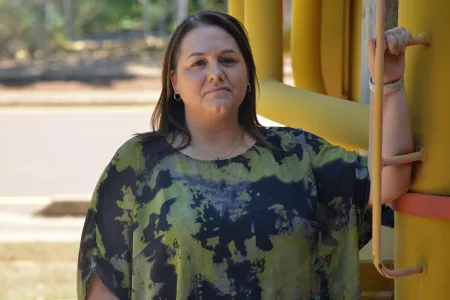
A Charles Darwin University (CDU) researcher is seeking to understand why there is a disproportionately low number of First Nations women in the mining industry in the Northern Territory and to better understand their experiences.
CDU Northern Institute PhD candidate Jodi Cowdery is seeking First Nations women who work or who have previously worked at mine sites to share their stories to help understand the problem.
As part of the research, Ms Cowdrey will be speaking to different First Nations women working on mine sites to understand some of the barriers and realities of their on-site work. Participants in the study will be asked to complete 20-minute survey about their working life and experiences. The research will focus on Indigenous female workers at the six major mining companies operating in the NT.
“Most mining takes place on the lands of First Nations peoples, so it has such a big impact on First Nations peoples’ livelihoods, especially those whose communities are near mining projects,” Ms Cowdery said.
“Yet, mining employment - which is considered a benefit of mining and often used to promote and justify mining projects - is enjoyed mainly by non-First Nations men not from nearby communities.”
In the 2016 census, about 1.5 per cent of the Australian mining workforce identified as First Nations women, and in the Northern Territory the number was lower than the Australian average.
This is despite the much higher First Nations population in the NT, where a third of the population are First Nations, and 12 per cent of all people of working age are First Nations women.
“Part of the reason for focusing on the big mine sites was so that the findings, and any recommendations from the study, could be implemented across the globe. Mining companies in the NT also have mines everywhere from Australia to Africa to South America, just to name a few,” she said.
Ms Cowdery said low representation of First Nations women is not isolated to the Northern Territory, or even Australia.
Canadian research organisation MinErAL is supporting her research as part of a larger Knowledge Network Mining Encounters and Indigenous Sustainable Livelihoods project being conducted in Canada, Fennoscandia, New Caledonia, and Australia.
Ms Cowdery said workforce diversity was an issue for many large mining companies around the world.
“Most companies have initiatives to attract more First Nations people into the workforce, and more women into the workforce, as distinct groups, but the nuanced experiences of First Nations women have not received the same attention,” she said.
Anyone interested in being involved in the study, should visit here for more information.
All participants in the survey will remain anonymous and there are no questions about where participants work or the name of the company participants work for, so they cannot be identified.
The first 30 people to complete the survey will receive a pair of pandanus earrings, valued at $50 created by renowned First Nations female artists from the Buku-Larrnggay Mulka Arts Centre at Yirrkala.
Related Articles
Federal funding for Country-based health and climate resilience
A new research collaboration to support and strengthen Country-based health and climate resilience has received funding through the National Health and Medical Research Council’s Centres of Research Excellence scheme.
Read more about Federal funding for Country-based health and climate resilience
New livestream brings remote Australian arid zone waterhole to the world
A new livestream from a remote waterhole in the Northern Territory is giving people around the world the opportunity to observe wildlife in real time.
Read more about New livestream brings remote Australian arid zone waterhole to the world
How ants are cashing in on the fight against money laundering
An AI model inspired by ants, bees, and birds could be the key to cracking down on blockchain-based money laundering, new research led by Charles Darwin University (CDU) has found.
Read more about How ants are cashing in on the fight against money laundering


