Student stories
Finding Community in CDU

For first-year Bachelor of Environmental Science student Alcyonie Markus, studying at Charles Darwin University (CDU) is about more than earning a degree – it's about building the knowledge and skills to help protect some of the world's most unique environments.
Driven by a passion for conservation and sustainable land management, Alcyonie enrolled in CDU's Bachelor of Environmental Science with a clear vision for her future.
"I want to work in conservation both in the Northern Territory and internationally," she says. "I'm particularly interested in working to develop conservation strategies that support both local environmental and cultural outcomes."
It's a goal that aligns closely with CDU's unique position in northern Australia, where students can learn about environmental management in one of the world's most ecologically and culturally diverse regions.
Inspired by the people who came before
Alcyonie's passion for the environment was shaped in part by her grandmother, a teacher who worked in the Kimberley region of Western Australia.
Her grandmother's appreciation for northern Australia, education and community inspired Alcyonie's own love for Darwin and the natural environment.
Today, that inspiration continues to motivate her as she works towards a career dedicated to protecting landscapes and supporting communities.
Studying where conservation happens
From tropical savannas and wetlands to desert ecosystems and Indigenous Protected Areas, the Northern Territory provides a living laboratory for environmental science students.
For Alcyonie, studying environmental science at CDU means learning in a place where conservation challenges and opportunities are part of everyday life.
The course combines environmental theory with practical skills in ecology, land management, sustainability, conservation and environmental monitoring. It prepares graduates for careers in environmental consulting, conservation, natural resource management, research, government and community-based environmental programs.
Flexibility that fits real life
Like many university students, Alcyonie balances study alongside work and other commitments. One of the reasons she enjoys studying at CDU is the flexibility built into the learning experience.
"If I can't attend a class, I can access lectures and study materials online when it suits me," she says.
She currently studies while working part-time, structuring her days to complete study in the morning before cycling to work for an afternoon shift.
"Making sure your study load is manageable is really important. It's about understanding what you can realistically take on."
That flexibility allows students to continue progressing towards their goals while maintaining employment, family commitments and personal wellbeing.
Support that goes beyond the classroom
Having previously studied at other institutions, Alcyonie says CDU stands out for the support available to students, both academically and socially.
"The teachers are incredibly supportive," she says. "They're always willing to answer questions and help you understand the content."
Her positive experience began during orientation, where staff made an effort to connect with students from day one.
"One of my lecturers made a personal connection based on my name. It sounds small, but it made me feel welcomed and recognised as an individual."
Beyond the classroom, CDU offers a wide range of free student support services designed to help everyone succeed throughout their studies.
Students can access academic support, study skills workshops, learning advisers, counselling and wellbeing services, career advice, disability support, mentoring programs and dedicated assistance for students transitioning into university life. The university also provides tailored support for defence personnel, veterans and their families, ensuring students from all backgrounds have access to the help they need to thrive.
More than just a degree
For Alcyonie, one of the biggest surprises about CDU has been the vibrant student community and the number of free activities available throughout the year.
"CDU is constantly offering things for students," she says.
From free workshops and cultural events to wellbeing activities, career development sessions and social gatherings, students have plenty of opportunities to get involved outside of their studies.
Popular student events include Toastie Tuesday and Waffle Wednesday in the student lounges, lunchtime workshops with free pizza, employability and resume-building sessions, social sports activities such as badminton and table tennis, and events hosted by student clubs and societies.
Students can also participate in public workshops and cultural activities, attend research events and networking opportunities, or simply spend time connecting with fellow students in the campus student lounges.
Compared with previous universities she has attended, Alcyonie believes CDU places a stronger emphasis on creating a genuine sense of belonging.
"It feels like CDU invests in the student experience, not just academics."
Building a future in conservation
As she progresses through her studies, Alcyonie is excited about the opportunities ahead and the chance to contribute to meaningful environmental outcomes.
She hopes her future career will allow her to work alongside Traditional Owners, government agencies and conservation organisations to develop solutions that protect ecosystems while respecting cultural knowledge and connection to Country.
For students considering environmental science, Alcyonie's message is simple: find a university that supports both your goals and your wellbeing.
At CDU, she's found both.
"You're supported as a student, but you're also supported as a person. That makes a huge difference."
Whether it's through flexible study options, dedicated academic support, free student activities or a welcoming campus community, CDU is helping students like Alcyonie turn their passion for the environment into a meaningful career.
Related Articles
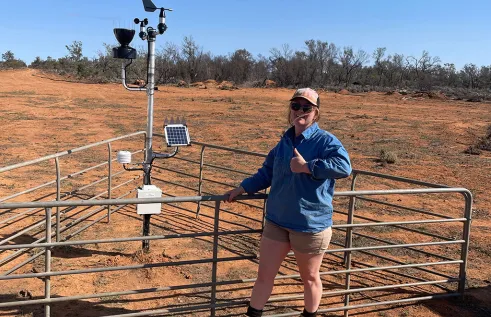
Following the flock: Samantha’s research could revolutionise water point placement
When Samantha first moved to South Australia's harsh outback, she was confronted by what she saw.
"Having recently moved to arid pastoral South Australia, I was struck by the hot, dry climatic conditions," she says. "I found myself questioning what made these landscapes so resilient, how livestock production could thrive in such conditions and whether this relationship was truly sustainable."
Read more about Following the flock: Samantha’s research could revolutionise water point placement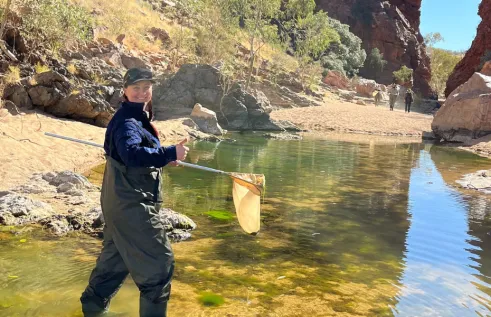
The NT inspired Kate to become an environmental scientist
A road trip around Australia sparked a huge career change for Kate. The recent Bachelor of Environmental Science graduate switched gears from real estate to environmental science after falling in love with the uniqueness of the Northern Territory.
Read more about The NT inspired Kate to become an environmental scientist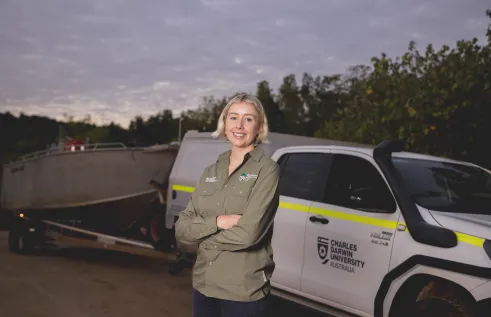
Julia's unexpected road to species-saving research
Julia is researching sharks and rays here in the Top End at Charles Darwin University, a world away from her upbringing in north-western NSW. She's working to ensure some of Australia's most threatened species are around for many generations to come.
Read more about Julia's unexpected road to species-saving research


