Increasing on-farm labour productivity in Timor-Leste

Introduction
In Timor-Leste, current farming methods are generally manual and labour-intensive, and on-farm labour supply continues to decline as people seek other opportunities. The remaining farmers must produce more per day to sustain household production. This project will focus on increasing yield or reducing labour input, or both. CDU is working on this ACIAR-funded project with To’os Servisu Kma’an (TOSKA), Universidade Nasional Timor Lorosa’e (UNTL), the Ministry of Agriculture, Forestry and Fisheries and Dom Bosco Technical Institute, in six participating communities in Timor-Leste to increase on-farm labour productivity.
The project places six participating communities at the centre of the research:
- Loro and Bemetan (Betano, Manufahi) in the Southern Rainfed Zone
- Raebuti Udo (Ainaru Villa) and Gorema (Maubisse) in the Upland High Altitude Zone
- Saraida (Quelicai, Baucau) and Caihula (Venilale, Baucau) in the Inland Irrigable Watersheds Zone
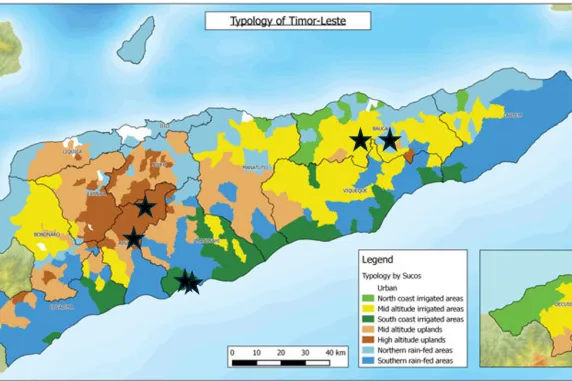
The participating communities guide the choice of research questions, assess how trialled innovations could be adopted or adapted, and guide refinements throughout the project.
Research questions will cover:
- Identifying the limiting nutrient(s) in cropping systems
- Testing the benefits of ‘micro-dosing’ low rates of fertiliser
- Improving weed management with or without herbicides
- Applying protected cropping for reliable vegetable production
- Trialling forage preservation for improved livestock health and production
- Mechanising land preparation, seeding, weeding and harvest
- Calculating labour productivity gains from the above
- Measuring gains in nutritional yield from the above
The project findings should free-up household time; more time to earn income, gain skills or improve lifestyle.
This is a 4-yr project that commenced in August 2024 and will conclude in June 2028.
Funding body
Australian Centre for International Agriculture Research (ACIAR)
Key personnel
Dr Johnvie Goloran, Research Program Manager, Soil and Land Management
Commissioned Organisation
Charles Darwin University (CDU)
Key personnel
Dr Penny Wurm (Project Lead), Senior Research Fellow - Food Systems, Research Institute for Environment and Livelihoods penny.wurm@cdu.edu.au WhatsApp/Mobile +61 419 854 147
Associate Professor Beth Penrose (Project Livestock Lead; Project Nutritional Yield Lead), Pastoral Production Systems & Sustainability, Research Institute for Northern Agriculture beth.penrose@cdu.edu.au
Professor Stephen Cheng-Yuan Xu (Project Cropping Lead) Professor Tropical Broadacre Cropping Systems Research Institute for Northern Agriculture Stephen.xu@cdu.edu.au
Research partners
Universidade Nasional Timor Lorosa’e (UNTL)
Key personnel
Dr Graciano Gomes, Faculty of Agriculture, graciano_gomes@yahoo.com
To’os Servisu Kma’an (TOSKA)
Key personnel
Ms Marcia e Silva (Country Manager), marcia.esilva@toskatl.com
Ms Livia de Jesus (Research Coordinator)
Ms Joaninha Soares (Field Research Officer)
Mr Adriano Prada Silva (Monitoring and Evaluation Officer)
Ms Antonia Amaral Cardoso (Business manager)
Ministry of Agriculture, Livestock, Forestry and Fisheries (MALFF), Timor-Leste
Key personnel
Mr Marcos Correia Vidal (Researcher, Cropping), marcos.soltimor@gmail.com
Dom Bosco Technical Institute
Key personnel
Key project activities
Cropping
- Nutrient omission trials
- Nutrient rate trial
- Nutrient type trial
- Rice variety trial
- Tunnels
Mechanisation
- Hand tractors
- Seeders
- Brush-cutters
Livestock
- Silage production trial
- Silage feeding trial with Bali cattle
Monitoring and Evaluation
- Labour productivity gains through cropping and mechanisation innovations
- Nutrient yield gains through cropping innovations
- Long term adoptability and adaptability of innovations by the participating communities and their neighbours
Publications and resources
Media releases
Key project contacts
Dr Penny Wurm (Project lead), Charles Darwin University, penny.wurm@cdu.edu.au
Dr Graciano Gomes, Dean, Faculty of Agriculture, UNTL, graciano_gomes@yahoo.com
Mana Marcia e Silva (Country Leader), TOSKA, marcia.esilva@toskatl.com