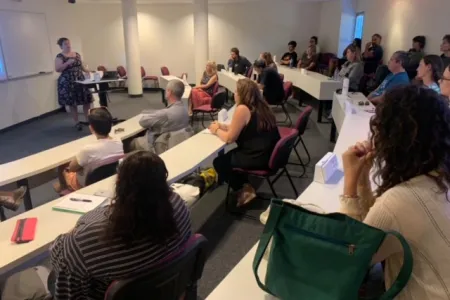
The annual RIEL Seminar Series presents exciting new research findings and updates on environmental sciences. Our presenters include a wide range of researchers from RIEL and CDU, as well as representatives of other universities and other research organisations.
Most seminars are available both in person – at CDU's Casuarina Campus – and online via Zoom. Students, staff, and the public are all welcome.
In 2026, the RIEL Seminar Series will be held at 9.15am‑10.15am on Fridays, on an approximately fortnightly basis from February to November with a mid-year break.
Contact the team at RIEL.Outreach@cdu.edu.au to propose a seminar topic or to find out more.
Subscribe to our mailing list to be notified of future seminars
Subscribe to our YouTube channel to watch videos of our seminars as they are uploaded.
Upcoming seminars
| Date | Title | Presenter | Information |
|---|---|---|---|
| Friday 30 October 2026 | PhD showcase: Fins, feathers, fur and futures | Larissa Potter, Ned Ryan-Schofield, Amy McAlpine, Lara Slivensky-Graf, Benaya Simeon, Nur Isiyana Wianti (Yanthi), Nilanjana Biswas, Candy Duff, Matilda Southgate, and Adam Moloney | Read more |
Past seminars
| Title and presenter | Date | Recording |
|---|---|---|
Monitoring to inform effective management decisions – Insights from Warddeken IPA by Dr Cara Penton, Suzanna Nabulwad, and Alexandria Namarnyilk In this seminar, Cara, Suzanna, and Alexandra present on an Indigenous-led monitoring governance approach used on Warddeken Country. This approach ensures monitoring is guided by Traditional Owners, scientifically robust, culturally grounded, and directly applied to management planning, implementation and evaluation. | 16 October 2026 | YouTube video |
Australia’s Ecosystems at Scale: TERN Data, Collections and Drone Observations by Dr Donna Lewis (TERN) Dr Donna Lewis showcases the Terrestrial Ecosystem Research Network's (TERN) program capabilities, with a focus on the Ecosystem Surveillance program — including long-term monitoring data, biological collections and environmental samples, and drone-based observations. | 2 October 2026 | YouTube video |
Mangroves and the rising tide by Dr Madeline Goddard Madeline is a senior project coordinator with the Terrestrial Ecosystem Research Network (TERN) and a recent graduate of Charles Darwin University’s Research Institute for the Environment and Livelihoods and the Australian National University. In this seminar, Madeline discusses how long-term monitoring of mangrove surface elevation provides critical insight into the long-term persistence of mangroves and the ecosystem services they provide under rising sea levels. | 18 September 2026 | YouTube video |
MAGNT’s role in biodiversity and conservation research, education and industry by Dr Kirsti Abbott (Museum and Art Gallery of the Northern Territory) Kirsti is Head of Science at MAGNT, and is also an adjunct member of RIEL at Charles Darwin University. MAGNT operates seven sites across the Northern Territory and cares for objects, artefacts and specimens across 12 collections. In this talk, Kirsti walks through MAGNT’s role in supporting biodiversity and conservation research, and how researchers can access the collections for their research. | 4 September 2026 | YouTube video |
The AVISTEP tool: Giving birds a seat at the table for renewable energy planning by Dr Golo Maurer (Birdlife Australia) Golo is Director of Bird Conservation Strategy at BirdLife Australia. Almost every bird conservation problem in Australia would be easier to solve without the negative impacts of climate change on top. Renewables can address climate change at the source, but they need to be planned and managed carefully to minimise risks to birds. AVISTEP is an online environmental planning tool using data collected by Birdata volunteers, created by BirdLife Australia with BirdLife International and others. | 21 August 2026 | YouTube video |
Marine science in the NT: From research and monitoring to stock assessment by Dr Danilo Malara, Dr Deepak Pazhayamadom, Dr Laura Smith and Dr Alex Basford (NT Fisheries) Danilo, Deepak, Laura and Alex are fisheries researchers specialising in stock assessment, fisheries monitoring, aquaculture, and applied research to support sustainable fisheries management in the Northern Territory. They work with the Fisheries Division of the Northern Territory Government Department of Agriculture and Fisheries. This seminar showcases current research projects, emerging challenges, and the role of science in supporting sustainable fisheries. | 7 August 2026 | YouTube video |
Last refugium of a critically endangered species: Three decades of conservation by Dr Mochamad Indrawan (University of Indonesia’s Research Centre for Climate Change) Dr Mochamad Indrawan is a trained ecologist and conservation biologist with more than three decades of field experience. He works with the Research Center for Climate Change and the Department of Geography at Universitas Indonesia and is also a 2026 CDU Visiting Fellow. In this seminar, Indrawan shares conservation efforts for one of the world’s most threatened endemic species, the Banggai Crow, documenting the species' distribution, habitat, and main threats, including forest loss, farm-land expansion, and limited public awareness. | 23 July 2026 | No video |
The Macroderma Initiative: Conserving ghost bats in a changing landscape by Dr Nicola Hanrahan (RIEL at Charles Darwin University) Nicola is a postdoctoral research fellow at RIEL at CDU. The Macroderma Initiative is an Australian Research Council Linkage-funded project investigating ghost bat roosting and foraging habitat requirements, population dynamics, and conservation needs. In this seminar, Nicola presents some of the team's work to date and outlines future objectives aimed at improving conservation outcomes for the species. | 12 June 2026 | YouTube video |
Documenting diversity, preserving knowledge and informing science by Nick Cuff and Lou Elliott (Northern Territory Herbarium) Nick is the chief botanist and Lou is a botanist at the NT Herbarium, which is part of the Flora and Fauna Division of the NT Government’s Department of Lands, Planning and Environment. The NT Herbarium houses a large collection of preserved plant specimens across two facilities in Darwin and Alice Springs. It provides information on the taxonomy, naming, ecology and classification of the NT’s flora, and is a key asset in working toward improving the overall understanding of the NT’s flora. | 29 May 2026 | YouTube video |
Genomics-based monitoring of ants and termites for ecosystem change by Allyson Malpartida (RIEL at Charles Darwin University) Allyson is a PhD candidate and a Genomics Research Assistant within RIEL at CDU. Terrestrial invertebrates are valuable bioindicators in land management, but their wider use is limited by the time required for morphological identification and the shortage of taxonomic expertise. During this seminar, Allyson presents her PhD research exploring how DNA metabarcoding and environmental DNA (eDNA) can help overcome this challenge in northern Australia. | 15 May 2026 | YouTube video |
The hidden value in crocodile carcasses: Collagen as the NT’s next bioindustry by Dr Padraig Strappe (CDU Menzies Medical Program) Padraig is a teaching-research academic with the CDU Menzies Medical Program. He is actively engaged in teaching biomedical sciences within the CDU Faculty of Health and in developing science, technology, engineering and mathematics (STEM) and outreach activities. In this seminar, Padraig outlines a streamlined process for purifying collagen from crocodile carcass material – an underutilised byproduct of the Northern Territory’s aquaculture sector. | 1 May 2026 | YouTube video |
Can sensory deterrents reduce shark and ray bycatch in Australia's gillnet fisheries? by Emily Taljaard (RIEL at Charles Darwin University) Emily is a PhD candidate within RIEL at CDU. Her PhD focuses on assessing and reducing shark and ray bycatch in commercial fisheries. In this seminar, Emily presents findings from laboratory and field research investigating whether visual and electrosensory deterrents can reduce shark and ray interactions with gillnets. | 17 April 2026 | YouTube video |
Behavioural drivers of Indonesian transboundary fishing in Australian waters by Prof Natasha Stacey (RIEL at Charles Darwin University) Natasha is a marine social scientist and the leader of the Communities and Livelihoods Group at RIEL at CDU. In this seminar, Natasha shares results of a collaborative Australian-Indonesian research study on the drivers of high levels of illegal Indonesian transboundary fishing in northern Australian waters since the beginning of the COVID-19 pandemic. | 20 March 2026 | YouTube video |
Trophic dynamics of free-flowing tropical rivers by Colton Perna Colton is a PhD candidate with RIEL at CDU. In this seminar, Colton presents key findings from his PhD research exploring how river flows and flooding shape freshwater fish communities. | 6 Mar 2026 | YouTube video |
Applying a gene knockout approach to cane toad management and research by Alex Funk (Macquarie University) Alex is a PhD candidate at Macquarie University whose research blends herpetology, invasion biology, and conservation. The ability to cheaply and efficiently “knock out” genes with CRISPR-Cas9 gene-editing technology has the potential to revolutionise conservation efforts worldwide. In this seminar, Alex discussed the pros and cons of knockout-based conservation and research before detailing the development and validation of a novel, knockout-based method for cane toad control that exploits the cannibalistic nature of invasive toad tadpoles in Australia. | 20 Feb 2026 | No video |
2025
| Title and presenter | Date | Recording |
|---|---|---|
Improved fire management and ecosystem services by Prof Jeremy Russell-Smith with the Darwin Centre for Bushfire Research team (Charles Darwin University) Jeremy Russell-Smith is a research director and professor at Charles Darwin University who has led the Darwin Centre for Bushfire Research since 1997, focusing on developing tools and research for improved fire management and land manager livelihoods across Northern Australia. | 7 Nov 2025 | YouTube video |
Inclusive research at RIEL: examples from fisheries by Dr Jenny House and Nilanjana Biswas (RIEL's Gender Equity and Inclusion Committee) In the seminar ‘Inclusive research at RIEL: examples from fisheries’ heard from two researchers from Charles Darwin University’s Research Institute for the Environment and Livelihoods (RIEL) whose work focuses on gender and fisheries in the Northern Territory. | 24 Oct 2025 | YouTube video |
The role of remote sensing in the Nature Repair Market by Dr Richard Crabbe (Charles Darwin University) Dr. Richard Crabbe, an Earth observation scientist at Charles Darwin University, presented a seminar on how remote sensing, using drones and satellites, can assist with vegetation monitoring and biodiversity management in Indigenous Protected Areas in Western Australia's Kimberley region. | 10 Oct 2025 | YouTube video |
Entomophagy, cultural entomology, and insect biodiversity loss in Africa by Dr Caswell Munyai (University of KwaZulu-Natal) Caswell Munyai, a Senior Lecturer in invertebrate biology at the University of KwaZulu-Natal, discussed the history and global distribution of edible insects, with a focus on entomophagy and entomotherapy in Africa. | 26 Sept 2025 | YouTube video |
An eDNA/Omics Strategy for the Ranger Uranium Mine by Dr Andrew Harford (Environmental Research Institute of the Supervising Scientist) Improving efficiency, scalability, and safety using the OSS omics strategy, integrating tools like iDNA and eDNA, genomics, and metabolomics into existing chemical, biological, and radiological monitoring at the Ranger Uranium Mine. | 12 Sept 2025 | YouTube video |
Informing conservation planning for threatened river sharks by Julia Constance (Charles Darwin University) Join CDU phD candidate Julia Constance exploring the Northern Territory's river sharks—the Northern River Shark (Glyphis garricki) and the Speartooth Shark (G. glyphis) | 29 August 2025 | YouTube video |
Molecular entomology in species conservation, management and beyond by Dr Sonu Yadav (NT Department of Agriculture and Fisheries) Dr Sonu Yadav (Principal Molecular Scientist in the Department of Agriculture and Fisheries, Northern Territory Government) presented her research on using genetics and genomics datasets to address key questions in insect conservation, management, and evolutionary biology. | 15 August 2025 | No video |
Savanna fire and biodiversity: findings from a long-term field experiment by Prof Alan Andersen (Charles Darwin University) In the seminar Prof Alan Andersen (CDU) described the findings and lessons for management from the Burning for Biodiversity experiment at the Territory Wildlife Park, a 20-year collaboration between CDU, CSIRO and the NT Government. | 1 August 2025 | YouTube video |
Applying pyrogeography to achieve sustainable coexistence with wildfire by Prof David Bowman (Fire Centre) Prof David Bowman (Director of the Fire Centre University of Tasmanaia) reflected on the experience of running a complex codesigned ‘applied pyrogeographic’ research program, explaining how such multipronged research is critical for sustainable coexistence with wildfire. | 27 June 2025 | YouTube video |
Machine learning and Traditional Knowledge to map wetland change by Porni Mollick (Charles Darwin University) A discussion with Porni Mollick (PhD candidate with the Research Institute for the Environmental and Livelihoods at CDU) around a study that used satellite imagery and Indigenous Knowledge to assess wetland changes in the Daly River catchment between 2015 and 2024. | 13 June 2025 | No video |
After the volcano: building a field station in Montserrat, West Indies by Dr Sarah Snyder (Bard College at Simon's Rock) Montserrat is a small British Overseas Territory in the Lesser Antilles with an active volcano which began erupting in 1995. For its size, Montserrat supports a wide range of habitats and many island endemics, making it an excellent location for ecological research. | 30 May 2025 | YouTube video |
Ecosystem services and emerging market opportunities by Assoc Prof Kamalijit K. Sangha Recently, governments and policymakers have become increasingly aware that economies are approximately 50% directly dependent on nature and that the decline in the health and functioning of natural systems threatens economic output. | 16 May 2025 | YouTube video |
The eDNA revolution: advancing biodiversity monitoring while navigating challenges by Prof Maxine Piggot In this seminar, Maxine gave an overview of how eDNA has been used for monitoring biodiversity and invasive species, showcasing when it works well and when it doesn’t. | 2 May 2025 | No video |
Shark and ray conservation in northern Australia and Asia by Samuel R. Amini and Adriana Gonzalez Pestana In this seminar we heard from two emerging researchers from the Northern Shark and Ray Research Group at Charles Darwin University’s Research Institute for the Environment and Livelihoods (RIEL). | 4 April 2025 | YouTube video |
Boring beetles and super models: mapping the distribution of a new invader by Dr Andrew Coates The polyphagous shot-hole borer (PSHB) is a tiny beetle with a mouthful of a name, but it’s been making headlines as a new invasive species in Australia. PSHB was first detected in Perth three years ago and has since devastated trees across the city. There are concerns about what its further spread could mean for urban, agricultural and natural environments. | 21 March 2025 | YouTube video |
Groundwater: Hidden wonder of the Northern Territory by Steven Tickell (NT DLPE) The seminar ‘Groundwater: Hidden wonder of the Northern Territory’ was presented in two parts. First, Steven provided a basic explanation of what groundwater is and concepts of how groundwater systems operate. He then gave an NT-wide view of groundwater properties and processes. | 7 March 2025 | YouTube video |
2024
| Title and presenter | Date | Recording |
|---|---|---|
'Culture-based conservation' approach to supporting governance of Indigenous territories by Dr Jayson Ibañez (Philippine Eagle Foundation) Indigenous Peoples are crucial for the long-term persistence of the Earth’s biodiversity and ecosystem services. In the Philippines, the Indigenous Peoples Rights Act of 1998 protects Indigenous rights to own and manage territories. The forests of Indigenous territories are habitats of the Philippine eagle – a forest eagle that is endemic to the Philippines where it is a national bird and an apex forest predator. | 22 November 2024 | YouTube video |
Models for interpreting ecosystem change by Dr Anna Richards (CSIRO) Dr Anna Richards describes a set of regional ecosystem accounts, developed in collaboration with the Australian government, for the gulf region in Queensland. To interpret change in the accounts, including ecosystem extent, condition, biodiversity and services over time, we collaborated with regional experts to develop a set of conceptual models – state and transition models – to show graphically how ecosystems work. | 8 November 2024 | YouTube video |
The critical role of groundwater for wetlands in a warming world by Prof Jenny Davis Water is the basis of all life on Earth, but groundwater (the water stored beneath the Earth’s surface) is often ‘out of sight and out of mind’, despite its importance to life in northern Australia. In this seminar, Jenny describes the multiple research approaches needed to understand and manage this critical resource in a warming world facing increasing water scarcity. | 25 October 2024 | YouTube video |
Researcher perspectives on the Middle Arm industrial precinct by Stephen Enciso, Billee McGinley, and Colton Perna The planning of a major industrial precinct at Middle Arm – a coastal peninsula located within Darwin Harbour – has garnered significant attention from both sides in recent years, but what does the research say? | 27 September 2024 | YouTube video |
How can we prepare for the future and develop our regions with nature-based solutions? by Dr Ingrid Coninx (Wageningen Research) Many regions worldwide face interconnected challenges: economic decline, vulnerability to climate change and environmental degradation, decreased quality of life, biodiversity loss, degradation of soil and water quality, among others. Addressing these issues requires innovative approaches. | 13 September 2024 | YouTube video |
Carbon and water adventures in north Australia by Prof Lindsay Hutley With climate change and increasing land use pressures there is more and more demand for knowledge of carbon dynamics and water use as well as water resource management. Lindsay’s research is focused on providing better understanding of the biophysical environment of tropical land and water systems. | 30 August 2024 | YouTube video |
From CCTV to AI: A journey of discovery, below the surface, using cutting-edge tech by Prof Sunil Kadri Fish farms have historically been a black box in terms of understanding the behavioural needs and preferences of the fish within them, as the only chance to assess what they are up to is when they break the surface. Sunil has been monitoring fish behaviour below the surface of farms for 35 years. | 16 August 2024 | No video |
Hidden emissions: Greenhouse gases from tropical freshwaters by Dr Clément Duvert In this seminar, Clément presents results from a new database of greenhouse gas (GHG) concentrations and fluxes in tropical freshwater systems. He highlights the extreme variability in GHG concentrations and fluxes across the tropics, and the role of small streams, ponds and riparian wetlands as globally significant hotspots of GHG emissions. | 2 August 2024 | YouTube video |
Why Darwin is the air pollution capital of Australia: Unpacking human health and savanna fire management trade-offs by Prof David Bowman and Prof Fay Johnston Darwin has the worst air quality of any capital city in Australia. This pollution has demonstrable public health harms, including contributing to the burden of chronic diseases and premature deaths in the region. | 19 July 2024 | YouTube video |
'Calling the wind': Blue whales, climate and whale tourism in Timor-Leste by Prof Karen Edyvane (Universidade Nacional Timor Lorosa’e) Previous studies have identified the major economic potential for whale watching in the developing nation of Timor-Leste. In this seminar, Karen outlines efforts in developing a whale and dolphin ecotourism industry. | 7 July 2024 | YouTube video |
Marine megafauna research across the remotest sea country in the NT by Natalie Robson and Dr Carol Palmer Natalie and Carol discuss the Australian Research Council funded Marine Megafauna Project, which focuses on sea country partnerships with eight Indigenous Ranger groups across the Top End of the Northern Territory (NT). The project encompasses work on sea turtles, dolphins and whales. | 28 June 2024 | YouTube video |
Understanding the movement and dispersal of saltwater crocodiles around Australia by Yusuke Fukuda Yusuke Fukuda examines the little-known patterns in the movement and dispersal by saltwater crocodiles within and around Australia by looking at their DNA. | 7 June 2024 | YouTube video |
Loss of Earth’s old, wise and large animals by Dr Keller Kopf In this seminar, Keller outlines that humans have caused a decline in old age-classes of wild animal populations whereby many of Earth’s oldest, often largest, and most experienced individuals have been eliminated from ecosystems. | 24 May 2024 | YouTube video |
A biome approach to plot-based vegetation classification in northern Australia Dr Donna Lewis In this seminar, Donna presents a floristic plot-based classification of the Australian tropical savanna biome using a composite of vegetation plot-based data sourced from the Queensland, Northern Territory and Western Australia governments, TERN, and non-government organisations. | 10 May 2024 | YouTube video |
Host–pathogen–microbiome interactions: A look at tortoises and songbirds Dr Chava Weitzman Chava discussed the relative ease and challenges of studying emerging diseases in two groups of hosts, tortoises and house finches, each impacted by a bacterial Mycoplasma pathogen. | 19 April 2024 | No video |
Spectacled flying-foxes: A Wet Tropics specialist and endangered keystone species Dr Noel Preece The endangered spectacled flying-fox is possibly the most important distributor of rainforest fruits in the Wet Tropics and is considered a keystone species. It has suffered a 75% decline over the past 15 to 20 years, but little action has been taken to help it recover. Now, a new recovery team has prepared a new recovery plan, and is intent on taking necessary action. | 5 April 2024 | YouTube video |
Unveiling the hidden world below: Nematodes in agriculture Dr Yujuan (Jady) Li Jady takes us into the tiny world of nematodes. We learn about the basics of nematode biology and their impact on agriculture ecosystems, and discover the importance of plant-parasitic nematodes through Jady’s research. | 15 March 2024 | No video |
Research to support biodiversity and sustainable management of fisheries resources in the NT Dr Jo Randall, Dr Brien Roberts and Eliza Kimlin (NT Fisheries) NT Fisheries team present on major research projects and how they support the sustainable management of natural fish populations in NT waters. | 1 March 2024 | YouTube video |
So, you want to use AI to assist your research? A discussion on what works and what doesn’t Dr Dylan Irvine Dr Dylan Irvine presents a discussion on artificial intelligence (AI) in academic research, designed to explore practical AI applications and debunk common misconceptions. This seminar showcases real-world examples where AI is helpful, and rabbit holes that are best to avoid. | 16 February 2024 | YouTube video |
The world is your oyster, when oysters are your world Dr Samantha Nowland This seminar addresses current challenges and possible solutions facing remote Aboriginal communities farming native rock oysters. It will focus on learnings from Indigenous-led aquaculture ventures. | 2 February 2024 | YouTube video |
2023
| Title and presenter | Date | Recording |
|---|---|---|
Chytridiomycosis and the mechanism of skin disruption By Dr Nicholas Wu (Western Sydney University) Chytridiomycosis, a lethal skin disease, is responsible for many amphibian declines worldwide. Dr Nicholas Wu discusses his work on understanding the causal mechanisms and how sloughing can help mitigate or exaggerate the disease. | 24 November 2023 | YouTube video |
Monitoring threats to Australian threatened birds By Prof Stephen Garnett Most biodiversity monitoring globally tends to concentrate on trends in species’ populations and ranges rather than on threats and their management. This seminar reviews the estimated impact of threats and the extent to which their management is understood and implemented for all threats to all Australian threatened bird taxa. | 17 November 2023 | YouTube video |
LiDAR remote sensing of riparian vegetation: Deriving structural and functional tree information By Dr Rafael Bohn Reckziegel Before now, understanding of forest resources has been restricted to the simplicity of tree measurement techniques. In recent years, terrestrial LiDAR has gained attention as a means for a more accurate and non-destructive assessment of tree and plot scale biomass (also woody volume and carbon), while uncovering tree form with a level of detail not realised by competing technologies. | 10 November 2023 | YouTube video |
Impact of fortified biochar on sustainable food crop production and income generation in a vegetable-rice cropping sequence in Timor-Leste By Acacio da Costa Guterres Acacio da Costa Guterres is an agronomist with a research practice that includes soil management, agronomy, weed management, food security, postharvest management, agricultural and livelihood applications. He is a Senior Lecturer and Researcher at the Faculty of Agriculture, National University of Timor Lorosa’e in Timor-Leste. | 3 November 2023 | YouTube video |
Ground-level governance of Arnhem Land Fire Abatement savanna burning projects: fire for the future By Taegan Calnan Based on an analysis of interviews with leaders from four organisations operating savanna fire management projects in Arnhem Land, this presentation explores what project outcomes drive engagement with the projects, what barriers exist to these outcomes, and what the future priorities are for project outcomes. | 3 November 2023 | No video |
Conservation benefit-sharing framework in the Greater Serengeti Ecosystem, Tanzania By Juma Kegamba The Greater Serengeti Ecosystem (GSE) is critical to the economy of Tanzania but living as a neighbour to the protected areas of the region can be extremely difficult. This research has been assessing the effectiveness of benefit-sharing and compensation mechanisms that conservation institutions operate with local people living in and around the GSE. | 27 October 2023 | YouTube video |
Groundwater dependent ecosystems By Dr Tanya Doody (CSIRO) Groundwater dependent ecosystems (GDEs) are complex and dynamic ecosystems that have varying temporal and spatial dependency on groundwater. Altered connectivity between GDEs and groundwater results in ecosystem decline leading to irreversible change over extended periods. This seminar illustrates different types of GDEs, characteristics of groundwater dependency and knowledge gaps in their management. | 27 October 2023 | YouTube video |
The Water Towers Project in Moneragala District, Sri Lanka By Dr Kamy Melvani This seminar describes the rehabilitation of a degraded 4.9 ha landholding in the Maragala Oya watershed using the forest gardens approach. | 20 October 2023 | No video |
Habitat Use and Genetics of Foraging Green Turtles (Chelonia mydas) in the Top End By Natalie Robson Natalie Robson's PhD aims to sample green turtles resident to foraging areas in the Top End, to identify their natal origins, migratory corridors and their breeding and foraging areas in order to inform on-ground management plans. This presentation is an overview of Natalie's PhD aims, methods, and a brief summary of the results collected so far. | 22 September 2023 | YouTube video |
Spatial analysis for planning ecological sustainable development of utility-scale solar and wind energy in the Northern Territory By Billee McGinley The research being undertaken is using Geographic Information Systems to build a spatially enabled multi-criteria evaluation (MCE) framework to plan for sustainable regional development of onshore utility-scale solar and wind energy projects in the NT. This presentation unveils spatial data that will be incorporated into the MCE model. Spatial analysis of regional ecosystem that could be impacted, within a bioregional framework, is also reviewed to evaluate confidence in regional planning for positive sustainability outcomes. | 22 September 2023 | YouTube video |
Behavioural and conservation ecology of purple-crowned fairy wrens By Dr Nikki Teunissen Dr Niki Teunissen's research broadly covers the behavioural ecology of purple-crowned fairy-wrens in the Kimberley, as well as some of the key conservation threats to this endangered species. Niki's research explains why these birds live in social groups and help with cooperative tasks such as feeding young and defending against predators. Niki's team has shown how the recent invasion of cane toads has altered predator-prey dynamics at their field site, in turn affecting predation of fairy-wren nests. Additionally, they showed how fire in the riparian zone impacts the density, survival, movement, and reproduction of these riparian specialists. | 21 September 2023 | YouTube video |
Seasonal Change Causes Shifts in Water Loss, but not Preferred Temperatures, of Top End Geckos By Kade Skelton Reptiles lose a significant proportion of body water through evaporative water loss (EWL) which can present challenges to survival in arid environments. This seminar will look at whether EWL rates and thermal preferences differed across species, were associated with climate, and could shift to adapt to local conditions. | 8 September 2023 | YouTube video |
Estimation of soil suction from leaf temperature using UAVs By Associate Professor Atsushi Sakaguchi (Ibaraki University, Japan) Since leaf temperature observations in the field have become easier due to the development and popularisation of unmanned aerial vehicles (UAVs), new regional irrigation management systems can be developed based on a crop water stress index (CWSI) map created using UAV thermal images. | 1 September 2023 | No video |
Mountain plant diversity in the Anthropocene (Online only) By Professor Jian Zhang (East China Normal University) Biodiversity patterns along elevation and latitude have attracted much attention from ecologists and biogeographers. Mountains cover about a quarter of all land area on Earth, and contribute disproportionately to the terrestrial biodiversity. | 25 August 2023 | YouTube video |
Positive welfare: the next step for farmed fish By Prof. Sunil Kadri In recent years both scientists and society in general have come to increasingly accept that fish are capable of pain, and possibly even suffering. Interventions to improve fish welfare in aquaculture have focused on removing negative welfare, but we have begun to look at how to provide positive welfare for these animals in our care. This seminar covers what that means, what we know, and where we are going in this field. | 11 August 2023 | YouTube video |
Short talk: Evaporative water loss in cane toads of the world By Prof. Keith Christian Like other “typical” frogs, toads have very high rates of water loss – similar to a free surface of water with the size and shape of a toad. However, a recent publication reported significant resistance to evaporative water loss in cane toads from some populations, but not others. This raised the question – Is this the first instance of the evolution of resistance to water loss in any toad in the world – or is there some other physiological process related to these measurements? We travelled to Queensland to measure toads from different locations, and now we know the answer to that question. | 14 July 2023 | YouTube video |
Short talk: Linking terrestrial-aquatic carbon fluxes to rectify the Australian carbon balance By Dr Francesco Ulloa In this seminar, Francesco Ulloa, a post-doctoral researcher at RIEL specialising in freshwater biogeochemistry, presents the strategies that have been adopted to integrate terrestrial and aquatic carbon flux measurements across diverse biomes of Australia by leveraging TERN ecosystem observatories. The seminar provides insights into the approaches employed in advancing our understanding of carbon dynamics in Australian ecosystems. | 14 July 2023 | YouTube video |
| The importance of arid zone waterholes for terrestrial wildlife in a warming world By Prof. Jenny Davis | 30 June 2023 | YouTube video |
| Research and development to improve smallholder livelihoods in Timor-Leste: What research questions should we ask? By Prof. Andrew McWilliam, Marcia Exposto e Silva, and Dr Leigh Vial | 9 June 2023 | YouTube video |
| Are there useful generalisations about climate change & physiological plasticity? By Prof. Keith Christian | 2 June 2023 | YouTube video |
| Australia's State of the Climate By Blair Trewin (Bureau of Meteorology) | 26 May 2023 | YouTube video |
| HDR talks By Alex Carey and Angga Rachmansah | 19 May 2023 | |
| Inspiring Science – Opportunities in Science Engagement and Outreach in the NT and beyond By Dr Carla Eisemberg | 5 May 2023 | YouTube video |
| Species discovery and conservation priority in the Australian Monsoonal Tropics By Craig Moritz (ANU) | 27 April 2023 | No video |
| Kruger National Park: The RIEL experience By Alan Andersen, Ellen Rochelmeyer, Angga Rachmansah, Allyson Malpartida and François Brassard | 21 April 2023 | No video |
| Friends or foes? The social behaviours and system of estuarine crocodiles By Dr Cameron Baker | 24 March 2023 | YouTube video |
| From a single tree to ecosystem-atmosphere feedbacks: the use of thermal remote sensing for tree physiology research By Pavel Alekseychik PhD | 24 February 2023 | YouTube video |