CDU event
TERN it up
| Presenter | Prof. Lindsay Hutley | |
|---|---|---|
| Date/Time |
to
|
|
| Contact person | E: riel.outreach@cdu.edu.au | |
| Location | CDU Casuarina Campus Yellow 1.1.39 and online | |
| Open to | Public | |
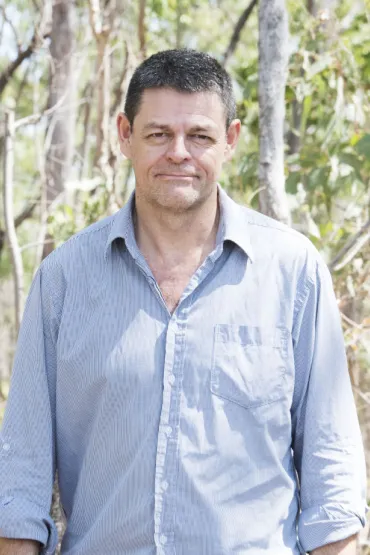
The seminar is the second in a series on TERN and follows Dr Donna Lewis’s seminar last month on TERN Ecosystem Surveillance. This talk will focus on the TERN Ecosystem Processes (EP) facility, its goals, approaches and progress in delivering monitoring data on Australian ecosystems.
TERN EP is primarily tasked with managing infrastructure that provide data to quantify responses and resilience of Australian ecosystems to climate change, disturbance and land management. These data enable the assessment of fundamental processes controlling carbon and water budgets through to impacts on biodiversity. TERN EP works in conjunction with the Ecosystem Surveillance, Landscapes (remote sensing) and Data Services to develop tools for integration across scales and for upscaling site-level measurements.
RIEL currently manages 5 TERN EP sites across the north-south rainfall gradient in the NT, all in collaboration with the University of Western Australia. From this we have been investigating savanna carbon source-sink dynamics, impacts of fire, and water use efficiencies. What can we learn from long-term (20 years) measures of mass and energy exchange and local climate. Is this long enough to detect systematic change, and is there a response to climate change already?
Lindsay Hutley is a plant physiologist with expertise in plant ecology, ecophysiology, ecohydrology, land-atmosphere exchange and soil science. Lindsay completed his PhD in forest hydrology/botany at the University of Queensland. Lindsay held several post-doctoral fellowships at Charles Darwin University and is now an Associate Professor in the Research Institute for the Environment and Livelihoods. His recent work has focused on quantifying fluxes of carbon, water and energy balance from a range of ecosystems, including mangroves, temperate old-growth forests and Eucalypt-dominated tropical savanna ecosystems of north Australia.
Related Events

The Dr Bilawara Lee OAM (Aunty B), Faculty of Health Public Lecture
Bernard Salt explores how the aging baby boomer generation and a post-pandemic shift toward wellness will drive unprecedented demand and consumer expectations within Australia’s healthcare sector and "care economy" through 2036.
Read more about The Dr Bilawara Lee OAM (Aunty B), Faculty of Health Public Lecture
Freedom of Political Communication and Social Cohesion
The 15th Austin Asche Oration features The Hon. Justice Marcus Solomon SC, who will examine how debates surrounding free speech, rising prejudice, and declining social cohesion are reshaping Australia's legal and political landscapes.
Read more about Freedom of Political Communication and Social Cohesion
Razzle Dazzle Your Research!
Want to improve the way your research is seen, cited, and funded? Increase the visibility and discoverability of your research without adding to your workload?
In this 45 minute workshop, learn how small, strategic tweaks to keywords, research profile details and even Field of Research (FoR) —taking only minutes—that can significantly boost how your research is discovered and valued
You will walk away with a clearer understanding of how your research is picked up by and 'seen' and counted in various systems like Scival, search engines and more.
This isn’t about compliance—it’s about visibility, impact, and career advantage and how just a few minutes can make your research count in a much bigger way.
Read more about Razzle Dazzle Your Research!


