RIEL News
Ecosystem services research informs sustainable development pathways
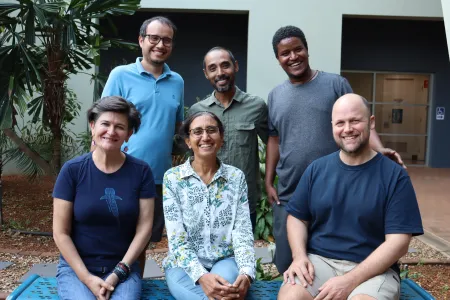
Ecological economics is an area of research involving an integrated understanding of environmental, social and economic issues, mainly from Indigenous perspectives. This includes the use, valuation, and management of natural resources; linking ecosystem services and the wellbeing of Indigenous peoples; and integrating science with policy decision-making.
RIEL is home to the Ecosystem Services Research Group which is carrying out groundbreaking trans-disciplinary work in this area, highlighting the importance of Ecosystem Services for Indigenous well-being and informing policy. Ecosystem services are the benefits people obtain from natural systems. The team’s global collaborations, including the development of Payments for Ecosystem Services and contributions to major international platforms, are transforming both academic research and policy. The team’s work on linking Indigenous natural resource management and peoples’ wellbeing has been and continues to be transformative for the science-policy interface.
The group has demonstrated leadership in research to support the development of economic opportunities for Indigenous peoples that are aligned with environmental management. The team offers a scientific and economic perspective of the holistic living that many Indigenous peoples practice across northern Australia and globally. The main focus of the work is on understanding and assessing the role of Indigenous land management for enhancing peoples’ wellbeing, informing relevant public policies – such as ‘Closing the Gap’, ‘Developing the North’, or bushfire management in northern Australia – and transitioning toward sustainable economies at a global scale.
Group leaders Assoc Prof Kamaljit Sangha and Prof Jeremy Russell-Smith, who have decades of research experience in this field, are involved in high-level international initiatives, including those led by the United Nations Environment Program and the International Union for Conservation of Nature. They have also supported the development of international research partnerships with benefits for communities and researchers in Australia and overseas.
From 2020 to 2024, the group secured significant national and international research grants for this work, and also attracted and mentored at least 12 HDR students who will continue ecosystem services research into the future. The team works collaboratively with Indigenous peoples and local communities across northern Australia, India, Tanzania, and the Asia-Pacific region. Alongside Assoc Prof Sangha and Prof Russell-Smith, in 2024 the team included Dr Andrew Edwards, Jay Evans, Dr Ronju Ahammad, Dr Veronica Toral-Granda, Dr Juma Kegamba, Dr Hari Paramjyothi, Samy Leyton-Flor, Oscar Metcalfe, Srishti Badola, Getahun Kassa Mengesha and Othusitse Lekoko, each working on diverse topics.
The group was awarded a Vice Chancellor’s Award for research impact in late 2024, recognising how this work is advancing Indigenous-led land and sea management practices and the wellbeing of landscapes and livelihoods. The team’s work is highly cited in policy documents from 10 different countries. Demonstrating the strength of its academic leadership and global networks, the team was also entrusted with hosting the 11th Ecosystem Services Partnership World Conference in Darwin, slated for June 2025.
This story was originally published in RIEL Annual Report 2024
Related Articles
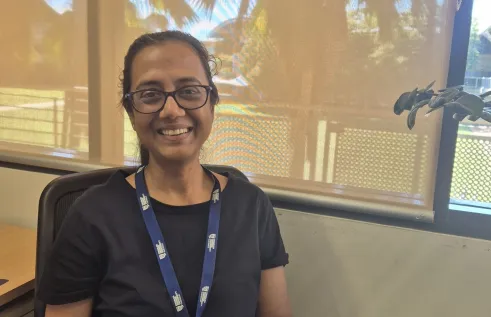
Project examines fisheries and aquaculture work through gender lens
Nilanjana Biswas’s PhD project explores the under-researched role of women in the NT’s commercial seafood sector. Using a gender lens and mixed methods, it examines historical contributions, structural barriers, and policy impacts, making it one of Australia’s first studies in this field.
Read more about Project examines fisheries and aquaculture work through gender lens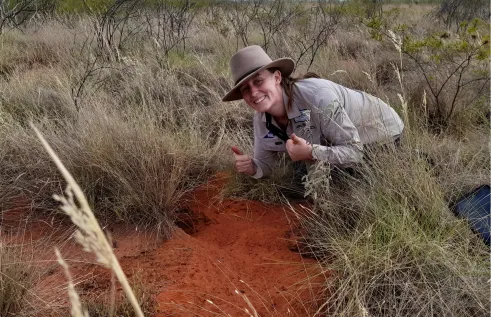
Producing practical recommendations for bilby conservation
Over a multi-year journey, Hayley Geyle completed a valuable PhD project focused on the ecology of the greater bilby. The work centred on improving understanding of the ecology, distribution, and abundance of the bilby in arid and semi-arid Australia, particularly in the NT which is one of the species’ last remaining strongholds.
Read more about Producing practical recommendations for bilby conservation
Preserving genetic diversity of endangered rabbit-rats
Bryn Pickering focused closely on brush-tailed rabbit-rats (Conilurus penicillatus) during his honours year. In particular, he aimed to evaluate the viability of a population of rabbit-rats that were translocated from mainland Cobourg Peninsula onto Greenhill Island, within Garig Gunak Barlu National Park in the NT.
Read more about Preserving genetic diversity of endangered rabbit-rats


