RIEL News
Producing practical recommendations for bilby conservation
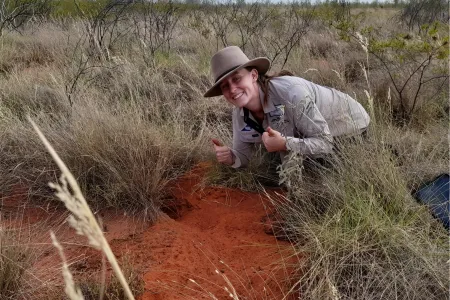
Over a multi-year journey, Hayley Geyle completed a valuable PhD project focused on the ecology of the greater bilby. The work centred on improving understanding of the ecology, distribution, and abundance of the bilby in arid and semi-arid Australia, particularly in the NT which is one of the species’ last remaining strongholds.
Dr Geyle investigated how fire and predation by introduced species affect bilby populations, using a combination of field surveys, genetic sampling, ecological modelling, and Indigenous knowledge. The research produced practical recommendations for bilby conservation and highlighted the value of collaborative approaches that integrate Indigenous knowledge with ecological science.
She submitted her PhD — titled ‘Conservation ecology of the greater bilby (Macrotis lagotis)’ and supervised by RIEL’s Prof Sam Banks with Assoc Prof Christine Schlesinger, Prof Brett Murphy, the University of Sydney’s Prof Chris Dickman, and TNRM’s Dr Kelly Dixon — in late 2024. Prior to commencing her PhD in 2021, Dr Geyle also worked as an assistant researcher at RIEL for several years.
“One of the best parts of being at RIEL was the support and camaraderie from other students,” said Dr Geyle. “Being based in the NT also meant I could work on practical conservation issues in collaboration with Indigenous rangers, which really shaped my research.”
During her candidature, Dr Geyle presented at several conferences, both in Australia and overseas. She notes that a particular highlight was co-presenting with North Tanami Ranger Helen Wilson at the 2024 Ecological Society of Australia Conference, where they received the Bush Heritage Award for Best Spoken Presentation Demonstrating Right-Way Science. Alongside such achievements, the project also had its share of challenging moments.
“If I’d known in advance how challenging my PhD would be, I might have thought twice about starting it — but I’m glad I didn’t. The skills, relationships, and perspectives I gained throughout the project and my time at RIEL made every challenge worth it,” she said.
Dr Geyle is now continuing work that she began during the PhD in a hybrid role that combines applied conservation and research with TNRM and the Northern Institute. This allows her to stay involved in on-ground projects while also contributing to research that supports cross-cultural approaches to ecological conservation.
This story was originally published in the RIEL Annual Report 2024
Related Articles
Project examines fisheries and aquaculture work through gender lens
Nilanjana Biswas’s PhD project explores the under-researched role of women in the NT’s commercial seafood sector. Using a gender lens and mixed methods, it examines historical contributions, structural barriers, and policy impacts, making it one of Australia’s first studies in this field.
Read more about Project examines fisheries and aquaculture work through gender lens
Preserving genetic diversity of endangered rabbit-rats
Bryn Pickering focused closely on brush-tailed rabbit-rats (Conilurus penicillatus) during his honours year. In particular, he aimed to evaluate the viability of a population of rabbit-rats that were translocated from mainland Cobourg Peninsula onto Greenhill Island, within Garig Gunak Barlu National Park in the NT.
Read more about Preserving genetic diversity of endangered rabbit-rats
Study finds groundwater is warming due to climate change
Groundwater is considered critical for life on Earth. However, relatively little is known about how groundwater responds to rising temperatures on the surface. A new assessment has shed light on this vast underground resource.
Read more about Study finds groundwater is warming due to climate change


