RIEL seminar series
Last refugium of a critically endangered species: Three decades of conservation
| Presenter | Dr Mochamad Indrawan (Universitas Indonesia) | |
|---|---|---|
| Date/Time |
to
|
|
| Contact person | T: 08 8946 7131 E: riel.outreach@cdu.edu.au | |
| Location |
Red 9, Level 1, Room 48 at CDU Casuarina Campus, and online via Zoom (see below for Zoom link) All times are ACST |
|
| Open to | All International audience, CDU staff and students, Public | |
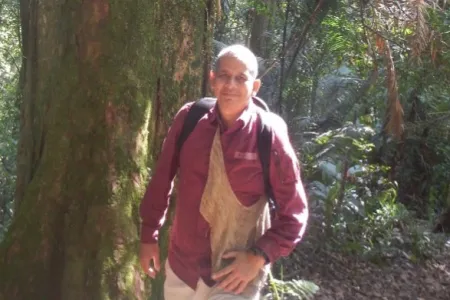
Dr Mochamad Indrawan is a trained ecologist and conservation biologist with more than three decades of field experience. He works with the Research Center for Climate Change and the Department of Geography in the Faculty of Sciences at Universitas Indonesia. He is also a 2026 CDU Visiting Fellow.
The Banggai Crow (Corvus unicolor), is one of the world’s most threatened endemic species. The bird survives in an increasingly fragmented refugium within the Banggai Archipelago, Central Sulawesi. The Banggai Crow case outlines the challenges of conserving range-restricted island endemics and highlights the urgency of protecting the last remaining refugium before further habitat degradation becomes irreversible.
In this seminar, Indrawan will share three decades of conservation efforts, documenting the species' distribution, habitat, and main threats, including forest loss, farm-land expansion, and limited public awareness. He will elaborate on inclusive conservation interventions, highlight lessons learned from community engagement, and identify priorities for future action.
Indrawan's voluntary rainforest conservation work has since 2007 included continuous facilitation of indigenous peoples and local communities (IPLC) whose joint endeavour is focused on the establishment of community conservation areas, and IPLC-led forest restoration. His research on Japanese socio-ecological systems (satoyama) during his past tenure as an Asian Public Intellectual (API) Senior Fellow resulted in cross-country comparisons with Indonesian agroforestry systems.
Indrawan has served as a member of two International Union for Conservation of Nature specialist groups – the World Commission on Protected Areas and the Red List Authority. He has also served on the Intergovernmental Science-Policy Platform on Biodiversity and Ecosystem Services as a member of the Capacity Building Task Force and a contributor to diversified knowledge systems, as well as policy support tools and methodologies.
Related Events
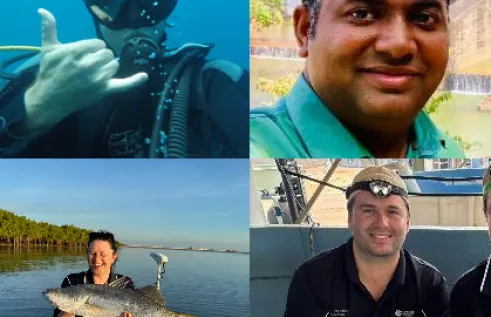
Marine science in the NT: From research and monitoring to stock assessment
In this seminar, the team will provide an overview of fisheries research in the Northern Territory, highlighting monitoring programs, data collection, and how these activities inform stock assessment and fisheries management
Read more about Marine science in the NT: From research and monitoring to stock assessment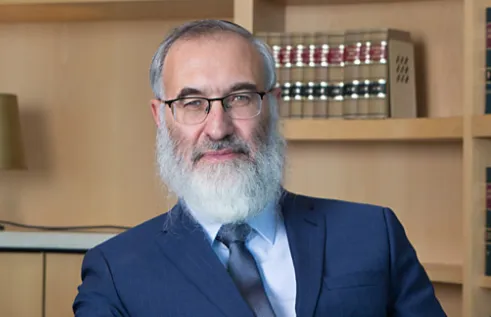
Freedom of Political Communication and Social Cohesion
The 15th Austin Asche Oration features The Hon. Justice Marcus Solomon SC, who will examine how debates surrounding free speech, rising prejudice, and declining social cohesion are reshaping Australia's legal and political landscapes.
Read more about Freedom of Political Communication and Social Cohesion
Time for research
This workshop shows you how to guarantee you spend high quality time on your research outputs. It covers prioritising, goal setting and managing competing demands in a university context. If you want to increase your research output without compromising your work/life balance, then this workshop is for you.
Read more about Time for research


