RIEL seminar series
Gender research at RIEL: the case for considering gender in environmental research
| Presenter | Emily Gibson, Jenny House, Gianna Bonis-Profumo, Natasha Stacey | |
|---|---|---|
| Date/Time |
to
|
|
| Contact person |
Fiona Quintner
|
|
| Location |
Yellow 1.1.39 and Zoom Followed by Friday Fancy |
|
| Open to | Public | |
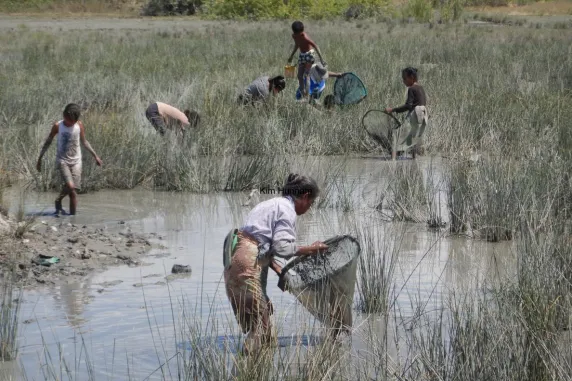
Our panel consists of four papers which consider environmental research and natural resource management from a gender perspective. Ecosystems are highly gendered – women and men derive different values and benefits from ecosystem services and resources, and they hold different roles in accessing, using and managing these resources. Our papers will discuss gendered livelihoods and resource use, the social and environmental benefits of participatory monitoring, measuring women’s empowerment and gender approaches in development projects.
Emily Gibson | Gendered livelihoods and implications for natural resource management
This presentation will describe a cross-section of a coastal ecosystem (forest through to deep ocean, including mangroves, reef flats, reef slope) and discuss who has access to, control over, or benefits from the use of resources in those areas and what the implications of this might be – particularly with respect to livelihoods, management frameworks and food security outcomes.
Jenny House | Participatory monitoring and gender in natural resource management
Participatory monitoring can be an effective data collection tool in data poor systems, as well as a point of entry for community engagement in natural resource management. Participatory monitoring involves community members in collecting, analysing and understanding data, as well as decision- making. A gender-inclusive approach can improve monitoring and management outcomes, and increase women's participation in decision-making, contributing towards more equitable and sustainable management.
Gianna Bonis-Profumo | Measuring women's empowerment in agriculture
Women’s empowerment is a social construct, which has typically been ineffectively addressed in policies and programmes due to measurement issues. The Women’s Empowerment in Agriculture Index (WEAI) is an innovative survey-based tool designed to measure the empowerment, agency, and inclusion of women in the agricultural sector. This multi-dimensional index is particularly relevant inrural areas of low- and middle-income countries, where a significant proportion of the population base their livelihoods in agriculture, such as Timor-Leste.
Natasha Stacey | Evaluation of recent initiatives on gender, women and sustainable livelihoods in Indonesian small-scale fisheries
Gender has been notably absent from the literature on small-scale fisheries and associated livelihood improvement programs, despite increasing evidence of the importance of gender equality and women’s empowerment in achieving such outcomes in other contexts. Our analysis of how gender was considered in coastal development projects in Indonesia reveals the need for more understanding of the role of gender in reducing poverty and increasing well-being outcomes, and greater integration of gender in livelihood improvement projects.
About the speakers
Emily Gibson is a PhD candidate with the Research Institute for the Environment and Livelihoods. Emily’s research explores the intersection of gender and food and nutrition security in the context of small-scale fisheries, and coastal communities in the Indo-Pacific Region. Emily holds Masters in Law (Environmental Law) (ANU) and International Development (RMIT) and recently contributed to an evaluation of gender and coastal livelihood initiatives in Indonesia.
Jenny House is a PhD Candidate researching community-based fisheries management in Timor-Leste from a gender perspective. Her research focuses on participatory monitoring and governance, women’s empowerment and feminist praxis in academia. She is also Monitoring and Evaluation Lead for the marine conservation NGO Blue Ventures Timor-Leste.
Gianna Bonis-Profumo is a social sciences researcher and development practitioner. She is passionate about food security and nutrition issues, specifically those affecting women, Indigenous populations, and smallholder farmers. Her PhD at RIEL explores child and maternal dietary quality and its relationship with women´s empowerment in agriculture in rural Timor-Leste.
Associate Professor Natasha Stacey leads RIEL’s Communities, Livelihoods and Natural Resources Research Group. She is a social scientist with a PhD in anthropology and more than two decades of experience in research and development projects in natural resource management across the Asia- Pacific region. Her research aims to produce knowledge to enhance the livelihoods and wellbeing of Indigenous and local communities, while maintaining resource sustainability in Northern Australia and the Asia Pacific region, in particular, Indonesia and Timor-Leste.
Related Events

The Dr Bilawara Lee OAM (Aunty B), Faculty of Health Public Lecture
Bernard Salt explores how the aging baby boomer generation and a post-pandemic shift toward wellness will drive unprecedented demand and consumer expectations within Australia’s healthcare sector and "care economy" through 2036.
Read more about The Dr Bilawara Lee OAM (Aunty B), Faculty of Health Public Lecture
Freedom of Political Communication and Social Cohesion
The 15th Austin Asche Oration features The Hon. Justice Marcus Solomon SC, who will examine how debates surrounding free speech, rising prejudice, and declining social cohesion are reshaping Australia's legal and political landscapes.
Read more about Freedom of Political Communication and Social Cohesion
Deadly Research
Celebrating NAIDOC Week, the Northern Institute proudly presents ‘Deadly Research’, in collaboration with the Library and Archives NT. Honouring this year's National NAIDOC Week theme, ‘50 Years of Deadly’, this special event shines a spotlight on the incredible contributions of First Nations academics.
Read more about Deadly Research


