RIEL News
Developing scientific capability in freshwater ecology
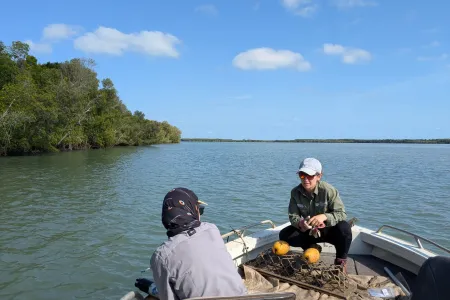
A multi-year cooperative agreement is helping to develop the NT’s scientific capability in freshwater ecology research. The initiative, which is a collaboration between the Commonwealth Scientific and Industrial Research Organisation (CSIRO) and CDU, supports natural resource management in northern Australia through establishing and funding a number of 3-year postdoctoral fellowships.
RIEL hosts several of these postdoctoral positions, with projects covering three broad ecological domains: predicting the resilience of riverine biodiversity, wetland condition and biodiversity, and floodplain and riparian vegetation. All of the projects aim to improve understanding of impacts to freshwater systems due to changes in water availability associated with water resource development and climate change.
The first of the postdoctoral research fellows, Dr Osmar Luiz, began work on riverine biodiversity resilience in January 2022. Dr Luiz developed models to understand the impacts of dams and river flow alteration on aquatic communities and helped identify river catchments of northern Australia that should be a conservation priority for future water resource development.
A second fellow, Dr Kaline de Mello, commenced in April 2023 with a focus on forecasting wetland condition and biodiversity. Since then, Dr de Mello has improved methods for wetland mapping, provided flood maps for the Adelaide River catchment, and supervised students.
The third fellow, Dr Rafael Bohn Reckziegel, arrived at RIEL in June 2023 to work on floodplain and riparian vegetation. Dr Bohn Reckziegel has supported field work, been a guest lecturer, convened the 2024 RIEL Seminar Series, and participated in outreach activities such as CDU Open Day.
Another fellow, Holly Lourie, began her role in November 2022 before joining the RIEL team in 2024. Her work focuses on impacts of feral animals on wetland biodiversity and cultural assets. Ms Lourie has delivered trainings and has completed large feral animal surveys and waterhole assessments during this time.
Between them, the fellows have also submitted and published numerous papers and have presented their work at a wide range of conferences. While most of the research is expected to conclude in 2025, related work will continue into the future.
This initiative highlights not only the importance of freshwater ecology research for northern Australia, but also the enduring research partnership between CSIRO and CDU.
This story was originally published in the RIEL Annual Report 2024
Related Articles
Project examines fisheries and aquaculture work through gender lens
Nilanjana Biswas’s PhD project explores the under-researched role of women in the NT’s commercial seafood sector. Using a gender lens and mixed methods, it examines historical contributions, structural barriers, and policy impacts, making it one of Australia’s first studies in this field.
Read more about Project examines fisheries and aquaculture work through gender lens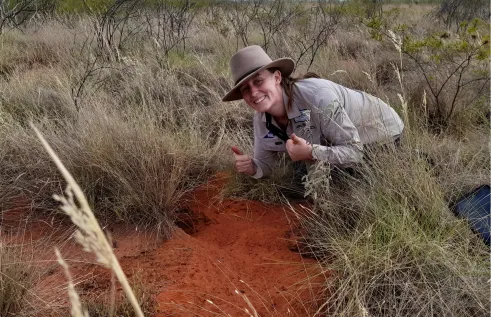
Producing practical recommendations for bilby conservation
Over a multi-year journey, Hayley Geyle completed a valuable PhD project focused on the ecology of the greater bilby. The work centred on improving understanding of the ecology, distribution, and abundance of the bilby in arid and semi-arid Australia, particularly in the NT which is one of the species’ last remaining strongholds.
Read more about Producing practical recommendations for bilby conservation
Preserving genetic diversity of endangered rabbit-rats
Bryn Pickering focused closely on brush-tailed rabbit-rats (Conilurus penicillatus) during his honours year. In particular, he aimed to evaluate the viability of a population of rabbit-rats that were translocated from mainland Cobourg Peninsula onto Greenhill Island, within Garig Gunak Barlu National Park in the NT.
Read more about Preserving genetic diversity of endangered rabbit-rats


